Updates on neutrophil-collagen migration experiments
In my previous blog, I alluded to the issues I was facing in achieving successful migration of neutrophils through the basement membrane into the collagen gels. I am successfully able to achieve transendothelial migration, but migration beyond the endothelial basement membrane is still not achievable. After a lot of thinking, I realized that this, in fact, is an expected phenomenon. Basement membrane is known to provide a much stronger barrier to neutrophil migration than endothelial junctions, and while trans endothelial migration takes only a few minutes, it can take up to 40 minutes for neutrophils to cross BM [1].
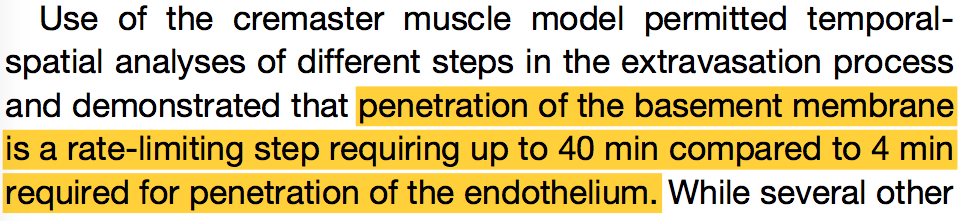
It has been shown many times in the past that neutrophils don’t have to degrade basement membrane in order to cross that barrier [2]. The BM can be reversibly “opened” up for this reason.

Then how does it exactly cross the BM. The BM essentially has gaps in it that are formed due to inadequate secretion from the subjacent pericytes. While BM from ECs is full and intact, the pericyte BM is incomplete and patchy [3]. The overlap of these 2 cellular BM essentially constitutes the whole BM structure, that cells neutrophils have to cross.

In my setup, I don’t have the pericytes present, and no pericyte derived BM either. That might explain some differences, as to why I don’t see enough BM migration.
Enough of theory! What I found seems to make sense in terms of the published data. My current status is as shown in the following figure.

In the absence of endothelial cells or any top gel, I get maximum transmigration (case 1 from left). When I add EC on the membrane, but no top gel, this number is slightly reduced (case 3 from left). When there is both EC and top+bottom gel (case 4, the right most), there is an even further reduction in the number of migrated cells, understandably because the top gel is giving significant barrier for the neutrophils while crossing the membrane. Surprisingly, as shown in case 2 from left, the absence of EC on top gel absolutely eliminates any neutrophil migration in the bottom gel. This observation was seen repeatedly. It implies that the machinery necessary for neutrophils to penetrate the interstitium doesn’t kick in place unless there are ECs present. Seems like some kind of feedback/feed forward loop is in place. PMN activate EC, and they, in turn, prepare PMN? I am not interested in mechanisms at this point, although it’s a very interesting observation.
I am going to proceed with the case 4, i.e. the whole apparatus with ECs and both the gels. I am going to further test the effect of beta-1 integrin blocking antibody to understand whether or not integrin block eliminates any BM migration or not. Stay tuned!
References
[1] J. Song, X. Zhang, K. Buscher, Y. Wang, H. Wang, J. Di Russo, L. Li, S. Lu ̈tke-Enking, A. Zarbock, A. Stadtmann, et al. Endothelial basement membrane laminin 511 contributes to endothelial junctional tightness and thereby inhibits leukocyte transmigration. Cell Reports, 18(5):1256–1269, 2017.
[2] R. Steadman, P. L. St John, R. A. Evans, G. J. Thomas, M. Davies, L. W. Heck, and D. R. Abrahamson. Human neutrophils do not degrade major basement membrane components during chemotactic migration. The international journal of biochemistry & cell biology, 29(7):993–1004, 1997.
[3] S. Nourshargh, P. L. Hordijk, and M. Sixt. Breaching multiple barriers: leukocyte motility through venular walls and the interstitium. Nature reviews Molecular cell biology, 11(5):366–378, 2010.