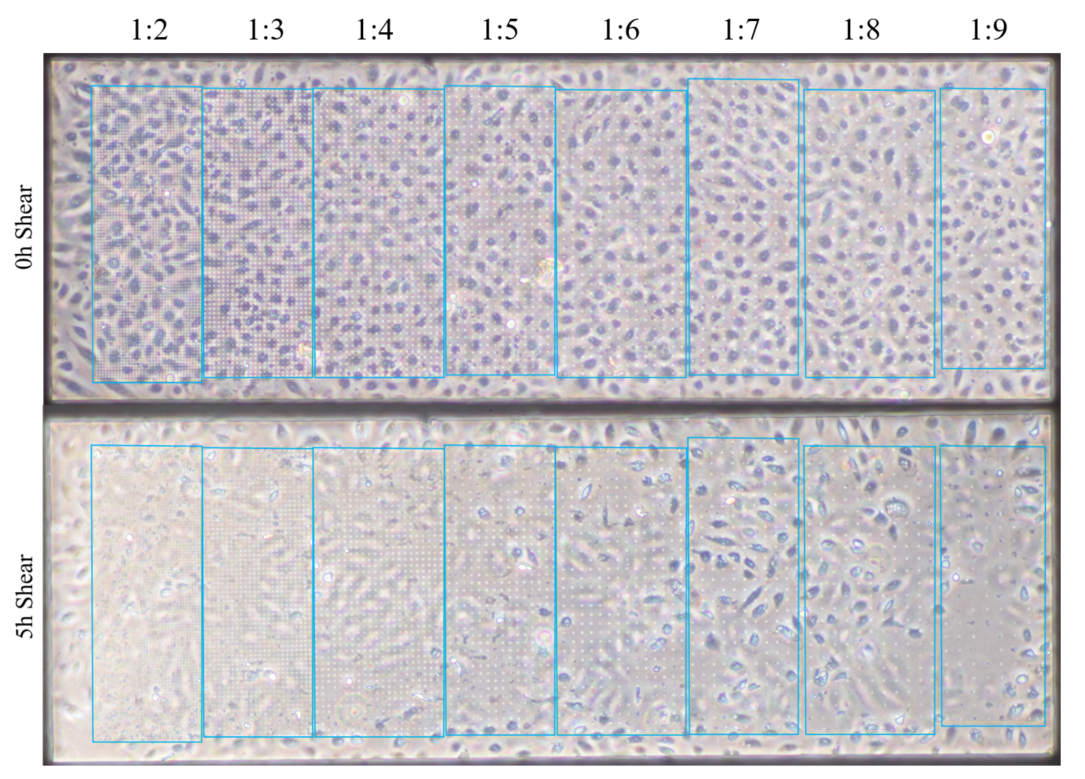
As a continuation to my previous post, I am running a triplicate of cell culture adhesion tests to observe cell lose on our membranes following physiological shear stress.
Methods
HUVECs (P3,4,5) were seed within our mimetic and left to grow to confluent for 24 hours. Shear (4.5 dyn/cm2) was initiated and images were collected following 5 hours.
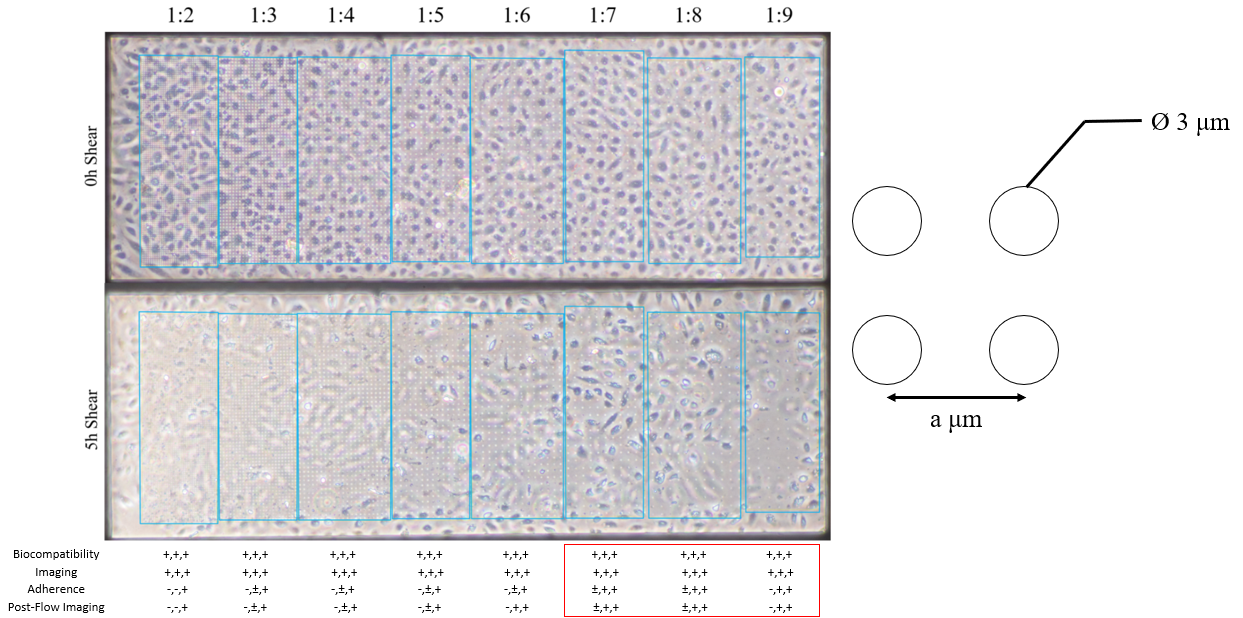
Figure 1. Preliminary data on cell adherence to μ-NPN material. Cell loss in the first 5 hours is most prominent in the first three regions (1:2, 1:3, 1:4).Figure 2. Data collection and characterization. Results were binary and collective result was used to base my final membrane group selection (n=3).
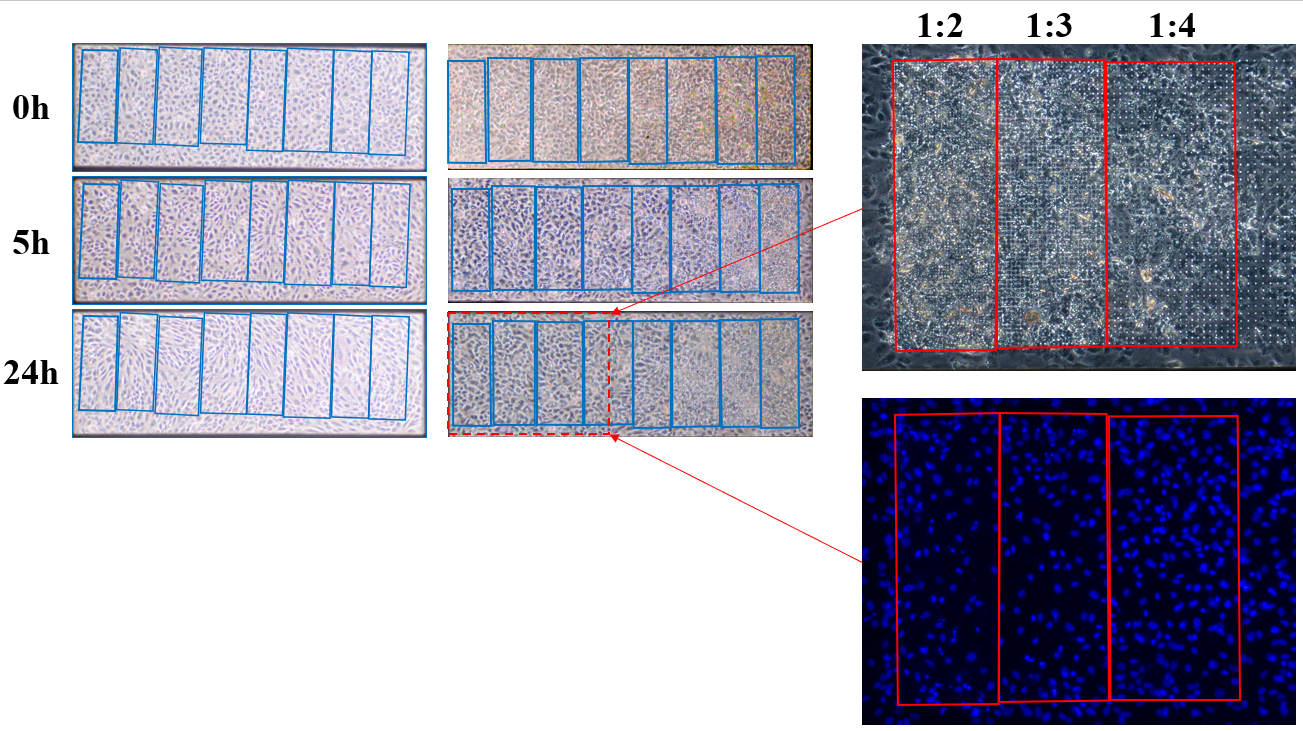
Figure 3. Heterogeneity in shear results a function of pressure?
Figure 4. Cell loss under cell material in side by side pattern experiments.
I’ve performed what might be the last test of the n-Dodecyl β-D-Maltoside (“DDM”) coating. This time I washed for three minutes each sample in HBS just like in the reference, used precisely the same concentration (and type, for that matter) of protein that was used in the reference, and tested a positive control, a negative control,…
Sarah and I did some more gold separations with 10, 20, 40, 50, 60, 80 and 100 nm Au particles. We used the “clean” water purchased from the medical center. Same as last time, we diluted the “as-bought” gold 3 parts to 1 and loaded each cell with 300 uL before pressurizing at 5 psi…
Jess showed me how to use the diffusion chamber to separate proteins on the membranes. I ran a gel to see if any proteins appeared in the filtrate. The gel is posted below: The lanes are (from left): protein standard, control, retentate 1, filtrate 1, retentate 2, filtrate 2. It appears that protein diffused through…
I wanted to update everyone on the recent attempts at the formation of the a closed flow system by bonding PDMS to our membrane chips, using capillary tubing for the inlet and outlets. Last week when we tried to preform the UV Ozone bonding it was unsuccessful. I initially thought the bonding did not occur…
Wafer 398 was deposited on 2/14/2008 but just etched yesterday in the new cell (it’s a beauty esp. when you compare it to the old one). I’ve etched several wafers now in the new cell and none of the membranes show signs of cigarette burns or tears. Good news in regards to the copper contamination…
In pursuit of an extremely sensitive biomarker capture sensor, I have been tasked with chemically functionalizing the surface of our membranes. Our end goal is to attach antibodies to the surface of our membranes which can be used to selectively capture target antigens at a wide range of concentrations. Focusing on low concentration ranges in…