Cell culture shear test with and without debubbler
What happens to cells when they are exposed to a series of bubbles with and without a dubbler?
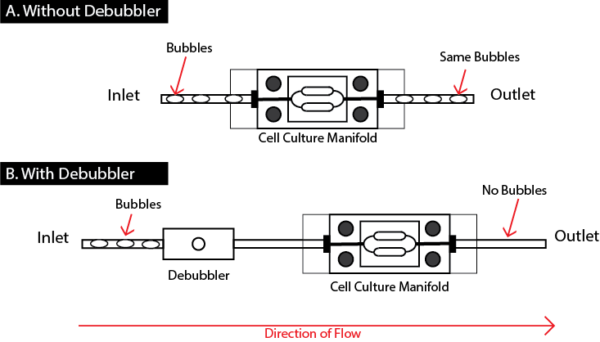
The purpose of this experiment was to prove the hypothesis that bubbles damage cells, and the dubbler prevents cells from experiencing bubble damage. The experiment was performed with a PBS flow rate of about 0.14 mL/min through the cell culture channels, and with and without a debubbler. Brain endothelial cells were cultured in the cell culture manifold before the bubble experiment and stained with live and nuclear stain. In both cases (with and without debubbler), the cells were exposed to just PBS, with a shear stress of 10 dyne/cm2, as well as PBS with a bubble train, which increased the shear stress to about 120 dyne/cm2. It was shown that without a debubbler in place, bubbles not only damaged the cells but also sheared most of them off completely due to the significant increase in shear stress. It was concluded that bubble exposure does in fact harm the cells and the debubbler prevents bubbles from reaching the cell culture manifold, and therefore prevents damage.
Methods:
Cell Culture Manifold & Breakdown of Components:

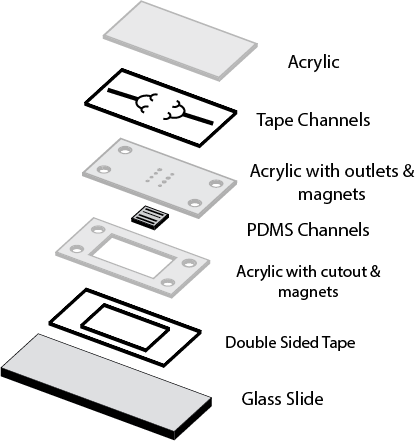
Cell culture Procedure:
Mouse brain endothelial cells were cultured in the cell culture manifold in the well made up of the glass slide, double sided tape, and acrylic. Prior to culturing cells, the glass slide was treated with a thin layer of geltrex (0.1mg/ml) at 37 degrees Celsius for one hour. The cells were seeded at 40,000 cells/cm2 with DMEM with 10% FBS and 1% pen-strep. After attachment, the cells were stained with live stain and Hoechst (1:2000) dilution. For the shear and bubble experiment, the manifold was assembled, and PBS was used to prime the system.
Cell culture shear/bubble test procedure:
The cell culture shear/bubble test was carried out with two cases: with and without the debubbler. In each case, the cells (in the cell culture manifold) were exposed to normal flow (without bubbles) and a series of bubbles in a bubble train (Figure 3). The flow rate was about 0.14mL/min, with a shear stress of about 10 dyne/cm^2 without bubbles. With bubbles, the shear stress increased to about 120 dyne/cm^2. Fluorescence images of the cells were taken before (normal flow) and after bubble exposure for each case.
Results:
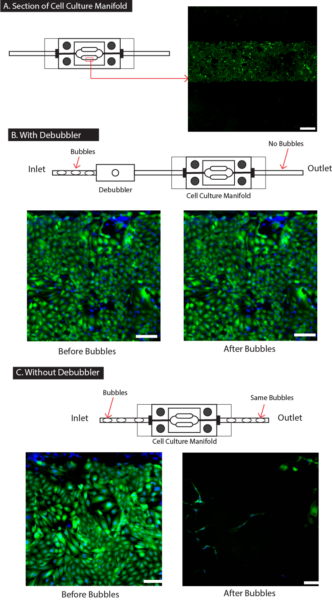
Video demonstrating effect of bubble exposure on cells. Less than 100 bubbles passed through the channel. Flow rate is about 0.14 mL/min. :
https://drive.google.com/open?id=11F1I-iYHwnaFtpqAxW2GUuE7nrDewfOX