Induced non-uniformity in Si over a single wafer
A while back, we discussed leaving the rotation stage off during the a-Si deposition to induce a thickness gradient over a single wafer. The purpose of this experiment was to explore the different morphologies vs. thickness at a given RTP treatment. We estimated that we could cover a 3x thickness range over a 8 cm span on a single wafer based on ellipsometry measurements on an non-uniform oxide film.
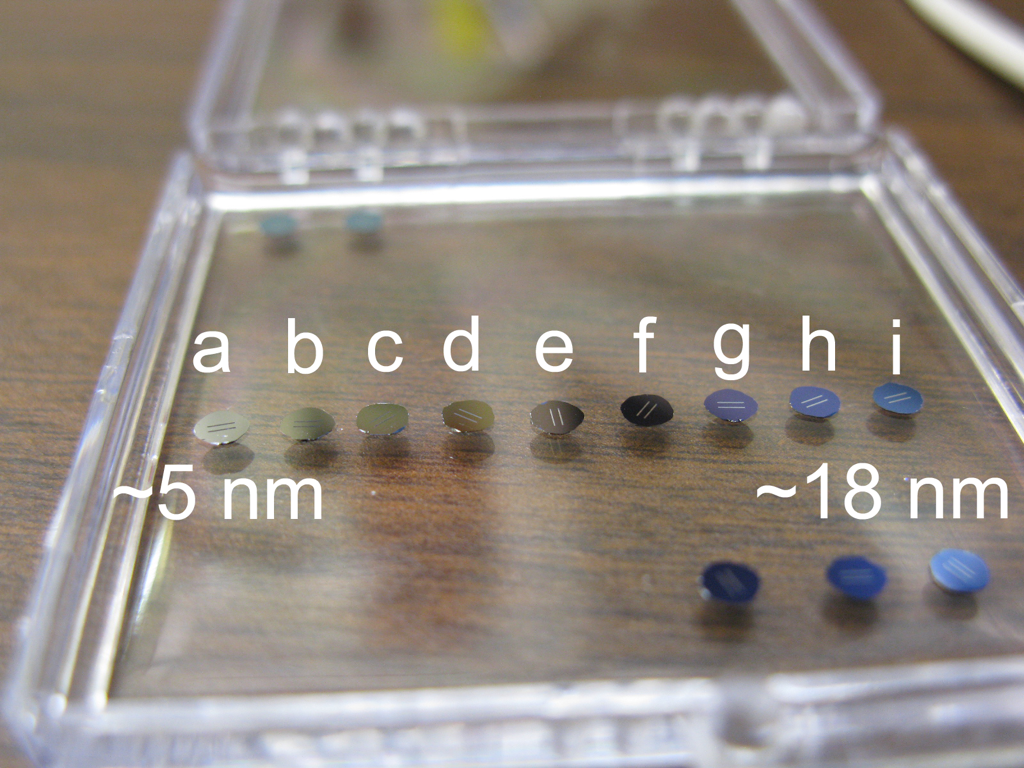
Here is a picture showing samples across the wafer. I used an old TEM grid wafer 286 so that I could pick off samples every 1 cm. The oxide layer is 20 nm (rotation was on during the oxide dep) and the wafer was annealed at 1000 C in the susceptor with a ramp rate of 50 C/s for 1 min.
Here are the TEM micrographs of the membrane at each position.
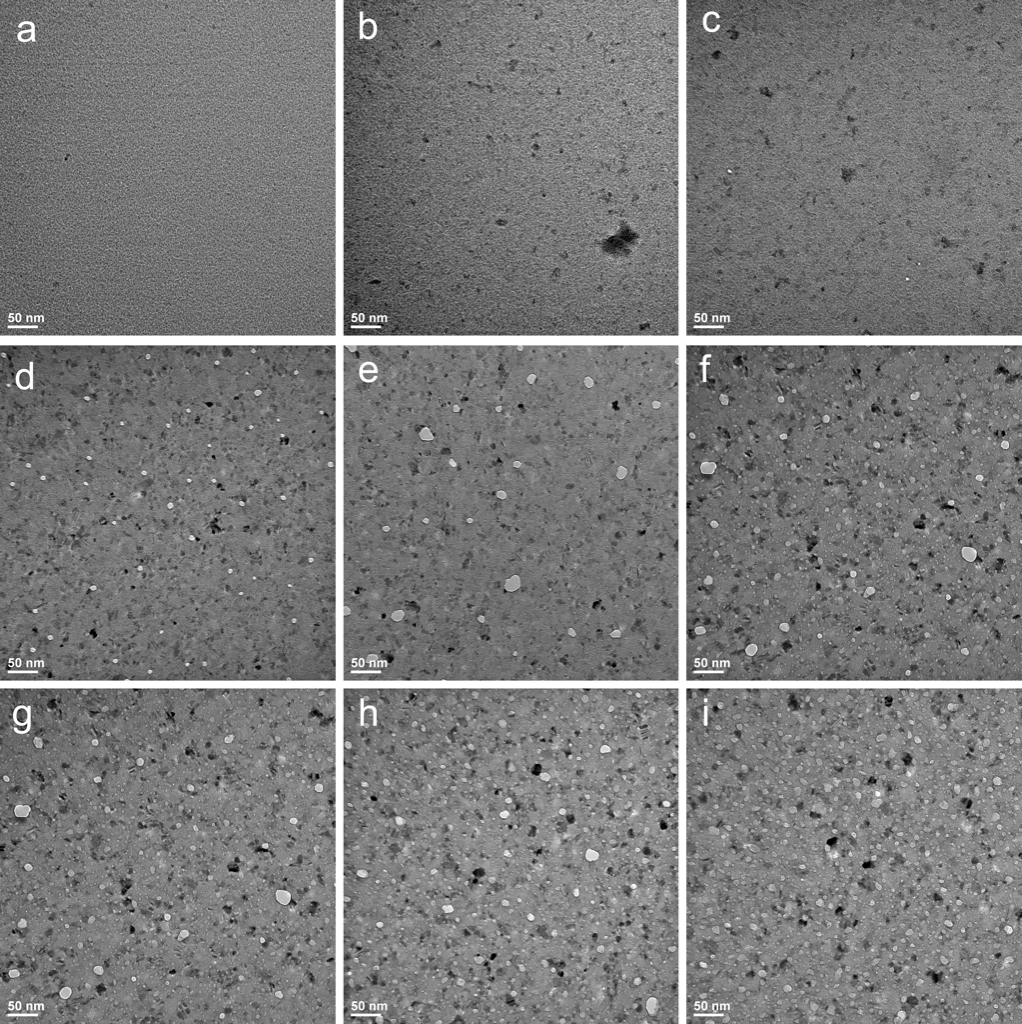
a: ~ 5 nm, no pores, very few small crystallites
b: ~ 6.5 nm, no pores, nucleation of crystallites
c: ~ 8 nm, very few pores, small crystallites
d: ~ 9.5 nm, increase in density of pores (highly mono-disperse), increase in crystalline features (stacking faults, twins)
e: ~ 11 nm, introduction of larger pores (distribution broadens)
f, g, h: ~ 13.5, 15, 16.5 nm, development of “ghost pores” in the background, could they be nano-divots or embedded “bubbles”?
i: ~ 18 nm, drop in porosity, background features increase in density and size
The first question we should ask is why the 15 nm film annealed at 1000 C has such a low porosity. It should look something like this:

My theories on the discrepancy are (from most likely to least):
- Contamination in the film. While sandblasting this week, I noticed a high level of Er in the sandblasting media (Er sparks when bombarding metal surfaces). Since we have been using the same media for sandblasting Er coated shields in the sputterer, there has been an increasing concentration of it being embedded into our shields. This wafer was the first wafer I deposited after sandblasting.
- RTP has shifted. Although we’ve halted carbonization until the quartz chamber can be cleaned, there is a noticeable deposit of carbon directly above and below the susceptor. Also, we switched to a different susceptor top since the original broke last week.
- Stress in the TEM patterned wafer is significantly different from a SepCon patterned wafer thus affecting the pore formation during annealing. JP – did you ever compare the stresses in the film between the different patterns in your senior design project?
I will repeat this experiment once fresh sandblasting media has arrived and all the parts are re-cleaned.
Update 11/07/2009
A pnc-Si wafer deposited after this non-uniform wafer showed normal morphology. It’s possible that after one deposition, the Er has been passivated by a coat of Si/SiO2.