RTP treatment helps!
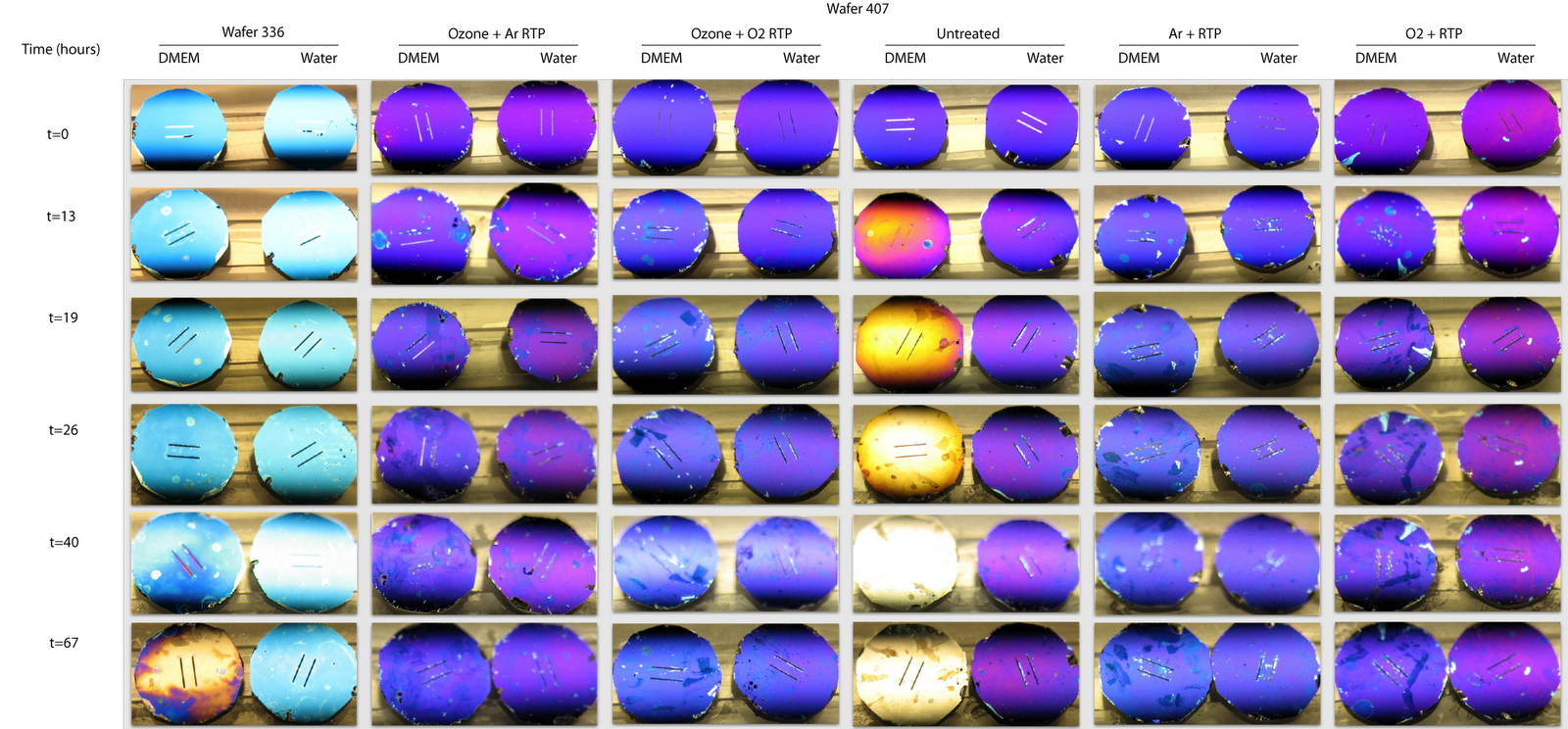
I’ve been trying for a year now to make a nanofluidic transistor – a nanomembrane with a thin layer of metal coated in dielectric that allows for the dynamic modulation of the sieving characteristics of the chip. Beginning with the last 14 chips from wafer #1081, I coated them in ~3 nm of Ti and…
Using the techniques described in my previous post: TEM Tomography of NPN and npMgF2, we have recreated some tomograms that have contour (position) and height (depth) information contained in them. Our goal now is to express that height information in the form of a surface, or volume. Segmentation Having some evidence that…
Continuing the project that Mark had been working on, I have made some progress towards electroosmosis. Specifically, I was able to observe electrolysis through an intact membrane. Hopefully I will be able to observe electroosmosis through the movement of microspheres or nanoparticles through the capillary tubes. I tried a few variations of Mark’s design using…
I’ve become increasing suspicious of the membrane clogging during the hydraulic permeability experiments. I ran an experiment where I took three fresh samples (sc 582) and pushed water through for 5, 10, and 20 minutes. Ideally, the permeability would be the same for all three time points. However, I observed a decrease at each increasing…
In my last post I reported findings that the bottom well of a CytoVu assembly is capable of adsorbing protein at about 0.03 ug/mL, or 0.75ng of protein. This is a fairly small value, but for the purposes of a sensitive separation such as the FLAG tests that I’ve been working on, it can be…
As an introduction, my name is Alec Salminen. I received my BS in Biomedical Engineering at the University of Arkansas and am currently in my first year of the BME PhD program at the University of Rochester. As my rotation in the McGrath lab gets underway, I would like to share with the group my…
Comments are closed.
Terrific looking study. Now we just need a little help interpreting … what could Ar/RTP without UV/ozone have done to change things?
Jim,
Even without UV/ozone treatment before RTP, there is an initial native oxide on silicon. RTP is basically annealing. RTP is normally used to either diffuse dopants, cure lattice distortion or site dislocation due to implantation, and densify the oxide layer. Here denser oxide should play the role improving chemical stability.
The thing I am not 100% sure is, since native oxide is about 1-2nm thick, is that already enough for isolation?
Anyway, something about UV/ozone…
when I set up the UV/ozone, I thought it was only used to do the contamination cleaning… actually I don’t think incubate silicon in ozone chamber can result in a thick oxide layer.
Some of the membranes break over time even though the color is holding steady. I assume that to take these pictures you need to remove the membranes from the liquid and partial drying might be causing this?
Also some membrane were broken from the start. We should discuss (or test) the ability of the membranes to hold up to these treatments.
It seems clear that the RTP treatment is helping with bio-stability of the membranes, so we should now start looking into weather we are creating any other problems with flow and/or strength.
The whole reason for trying the RTP treatment was to see weather we can further stabilize the surface oxide and/or grain boundaries. We apparently are, and it’s curious that everything that was tried with the RTP worked over this experimental duration. Are these studies ongoing? What is our target stability – say 1 week?
In these experiments I’m not too concerned about the membranes breaking after drying. If they were broken before drying, I would be slightly more concerned. This is really problematic material anyway, so we cannot draw any real conclusions about the material strength.
Update after one week duration: We were wondering why should Ar RTP help! Here’s something that’s showing up.. The Ar RTP samples started discoloring in a week’s time, whereas the O2 RTP treated samples still remain intact in DMEM. Thus, RTP is helping for sure but O2 RTP is better than Ar RTP.