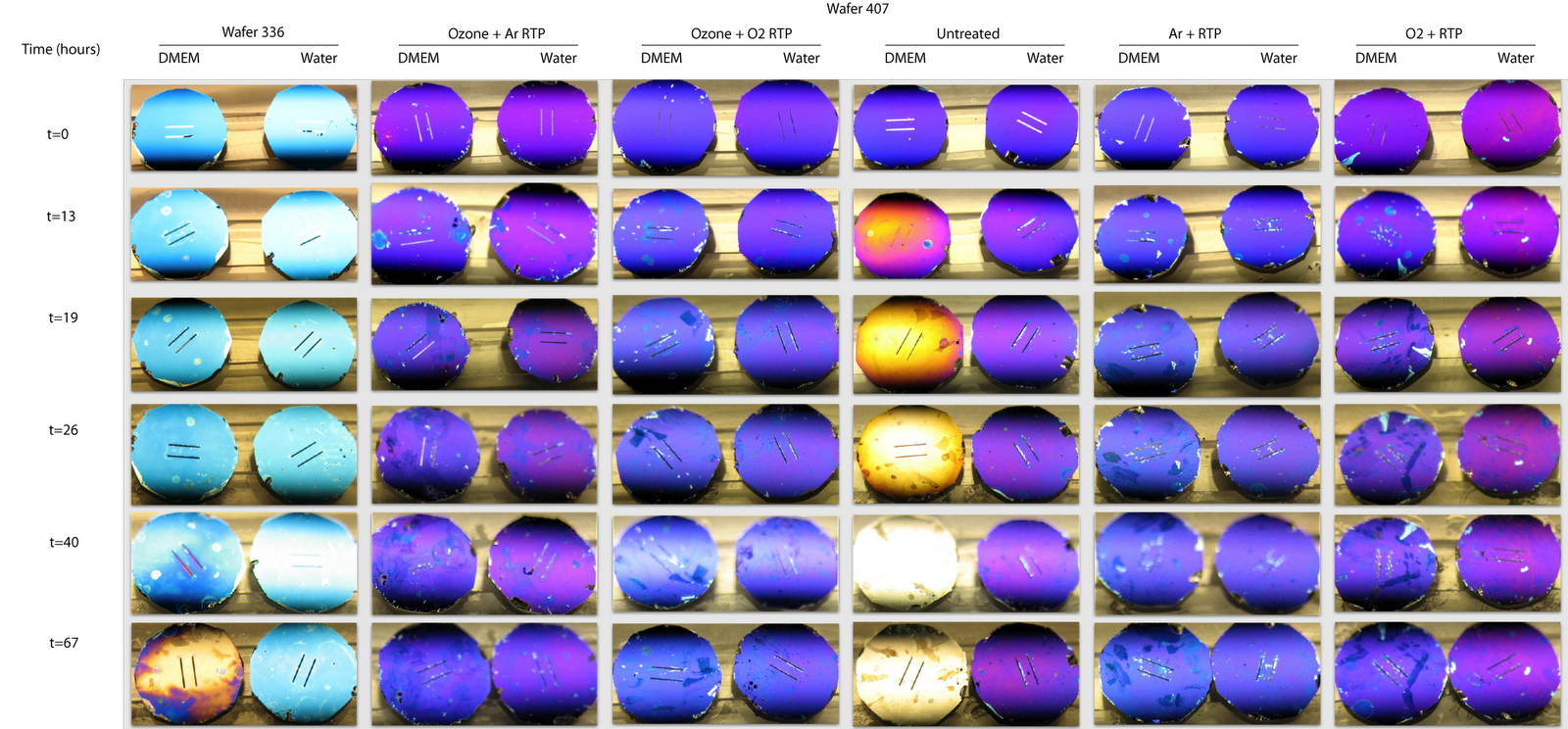
RTP treatment helps!
The human IgG did not seem to diffuse through the membrane the first time we conducted a diffusion experiment. Barrett believed that the lack of diffusion was most likely due to protein aggregates blocking the pores. So, the human IgG was filtered, and this post is the result of a second round of diffusion experiments….
I made a post yesterday showing that in 20mM HEPES, pH7.5, +10mM NaCl solution equivalent amounts of DDM were diffusing through the “treated” and “untreated” SC256 samples. Additionally it appeared that minimal amounts of BSA were diffusing across either sample. I set up another diffusion experiment and let it sit overnight. DDM analysis: As observed…
We were targeting a TEOS layer of 300 nm for the SiO2 membrane. The wafers were patterned with ø3 µm pores using S1813 resist (~1.5 µm thick). The target etch time in the Drytek RIE is 4 min 10 s using SF6 and Ar. We will need a thicker resist coating to prevent the RIE…
The schematic of the slot device is shown below. The main support structure is the pnc-Si membrane with Au or Ag metal on both sides. There is a conformal covering of Alumina shown in blue in the figure which actually makes the slot. This type of structure helps in squeezing the light in the nanoholes….
The premise of this project is built around the ideas that our membranes can: Be used as concentrators for very dilute targets Catch and hold particles for further processing on the membrane Here, we wish to test these ideas for dilute viral genome extraction in large volumes of waste water. We looked to improve upon…
Summary My analysis of npMgF2 has relied heavily on both tomogram and segmentation processes. The tomogram generation has thus far been sufficient, giving enough detail to our eye to identify different structures, but turning the tomograms into 3d models has been a lot more labor intensive. Using a neural network classifier (Weka, out of a…
Comments are closed.
Terrific looking study. Now we just need a little help interpreting … what could Ar/RTP without UV/ozone have done to change things?
Jim,
Even without UV/ozone treatment before RTP, there is an initial native oxide on silicon. RTP is basically annealing. RTP is normally used to either diffuse dopants, cure lattice distortion or site dislocation due to implantation, and densify the oxide layer. Here denser oxide should play the role improving chemical stability.
The thing I am not 100% sure is, since native oxide is about 1-2nm thick, is that already enough for isolation?
Anyway, something about UV/ozone…
when I set up the UV/ozone, I thought it was only used to do the contamination cleaning… actually I don’t think incubate silicon in ozone chamber can result in a thick oxide layer.
Some of the membranes break over time even though the color is holding steady. I assume that to take these pictures you need to remove the membranes from the liquid and partial drying might be causing this?
Also some membrane were broken from the start. We should discuss (or test) the ability of the membranes to hold up to these treatments.
It seems clear that the RTP treatment is helping with bio-stability of the membranes, so we should now start looking into weather we are creating any other problems with flow and/or strength.
The whole reason for trying the RTP treatment was to see weather we can further stabilize the surface oxide and/or grain boundaries. We apparently are, and it’s curious that everything that was tried with the RTP worked over this experimental duration. Are these studies ongoing? What is our target stability – say 1 week?
In these experiments I’m not too concerned about the membranes breaking after drying. If they were broken before drying, I would be slightly more concerned. This is really problematic material anyway, so we cannot draw any real conclusions about the material strength.
Update after one week duration: We were wondering why should Ar RTP help! Here’s something that’s showing up.. The Ar RTP samples started discoloring in a week’s time, whereas the O2 RTP treated samples still remain intact in DMEM. Thus, RTP is helping for sure but O2 RTP is better than Ar RTP.