Silicon substrate bias series
We have always speculated that the substrate bias during the a-Si deposition had a strong effect on pore morphology of pnc-Si. Here, I looked at three 15 nm silicon films deposited with 00W, 25W, and 50W substrate bias. Recall, that the substrate bias applies rf energy to the substrate surface so that impinging Si atoms can “re-arrange” themselves in such a way as to minimize their free energy. Thus by applying different levels of substrate bias we can tune the structure of the amorphous film i.e. change the film stress. Since we hypothesize that the film stress is a player in changing morphology, we should expect to see a change as we vary the substrate bias. Here is a figure with TEMs of three different membranes deposited at 0, 25, and 50 W substrate bias. (panels a, b, and c, respectively) The annealing temperature was 1000 C.
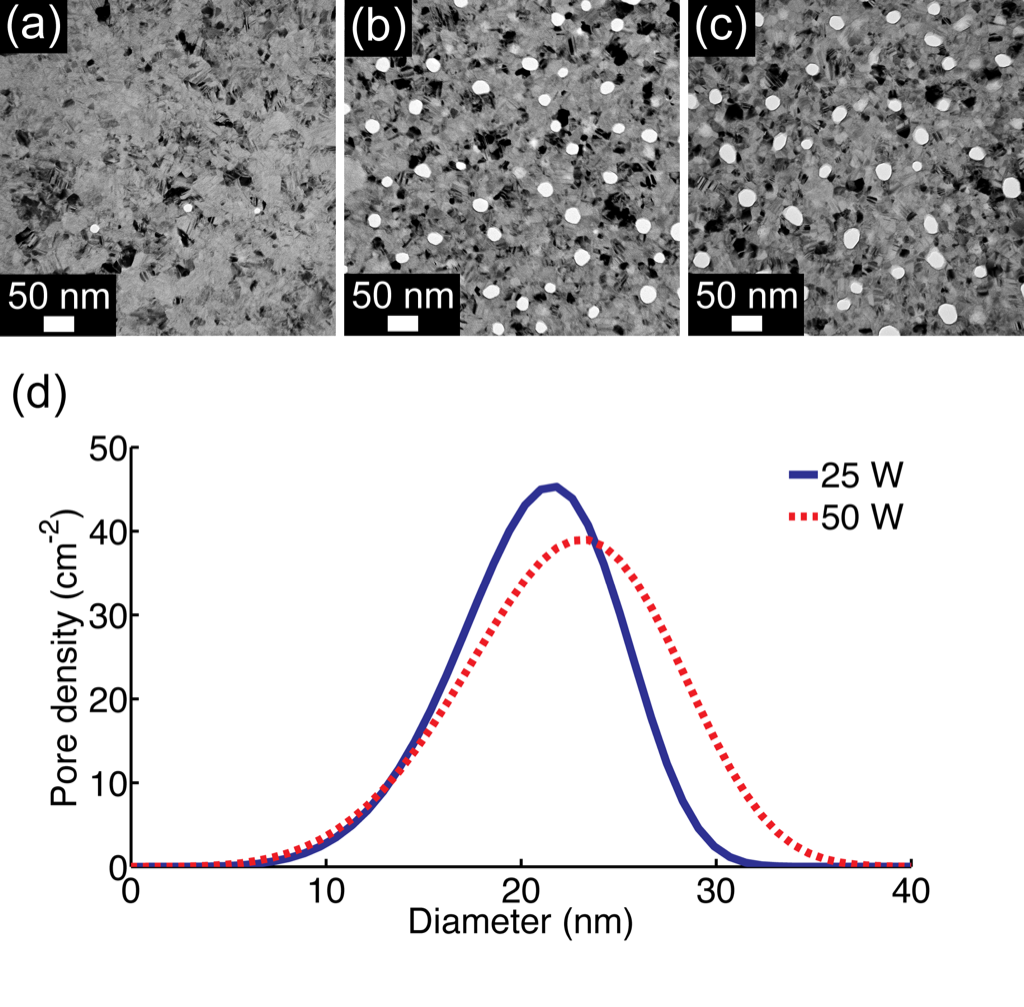
There is a huge jump in porosity between 00 and 25 W. It is known that as deposited amorphous silicon is denser than nanocrystalline silicon (from ellipsometry, see below) thus in a higher compressive state. This stress appears to suppress pore formation. With the application of substrate bias, we allow Si atoms to move on the surface and I believe this lowers the film stress which promotes pore formation. Further increasing the bias to 50 W, we see the average diameter of pores increases ~3 nm.
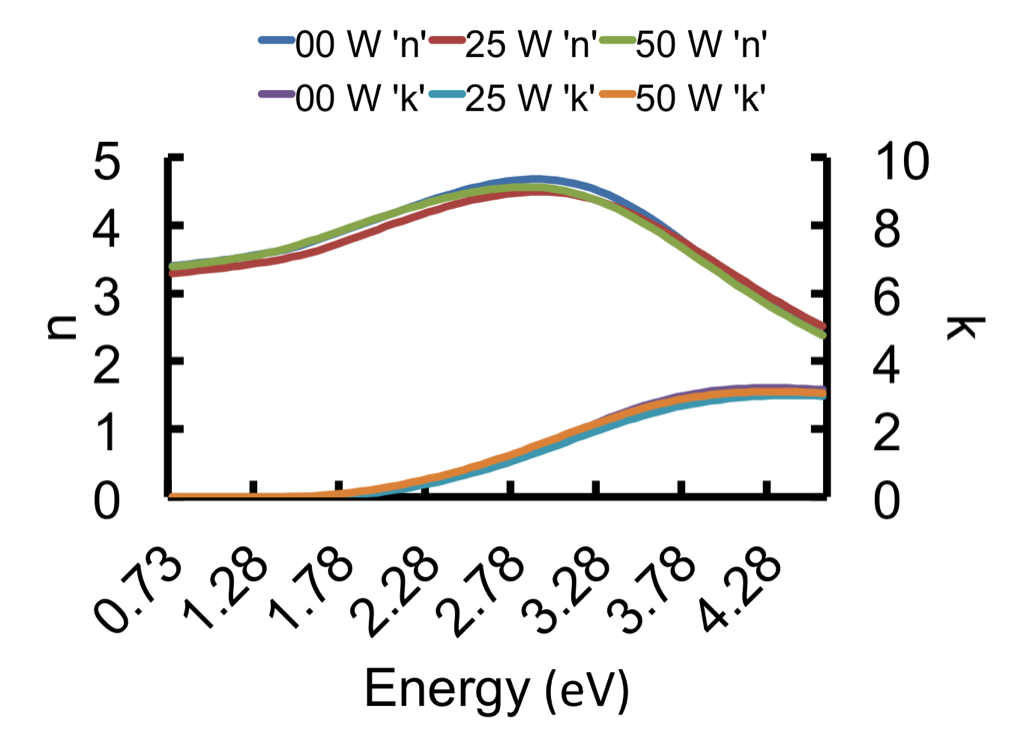
Here is a figure showing the index of refraction ‘n’ and extinction coefficient ‘k’ of the three a-Si films deposited at 00, 25, and 50 W substrate bias.
The next step in this study is to look at the residual film stress of films deposited with different substrate biases.