Multi-annealing of free standing OSO stack (2)
Last time I showed that the sample with multi-annealing yielded higher porosity and larger average pore diameter than the sample with direct annealing. In this post, I further investigate the multi-annealing of free standing OSO stack (20/15/10) by varying the pre-annealing time. The heat treatment process is illustrated in the following figure.

Free standing OSO samples were first heated to 680C with a 50C/s ramp rate and hold there for different times. The holding times ranged from 1s to 60s, 300s and 900s. Samples then cooled down to room temperature. After that they were then heated to 1000C with a 50C/s ramp rate, held for 1s and cooled down to room temperature finally. Samples with single annealing at 1000C for 1s with a 50C/s ramp rate are as control samples.
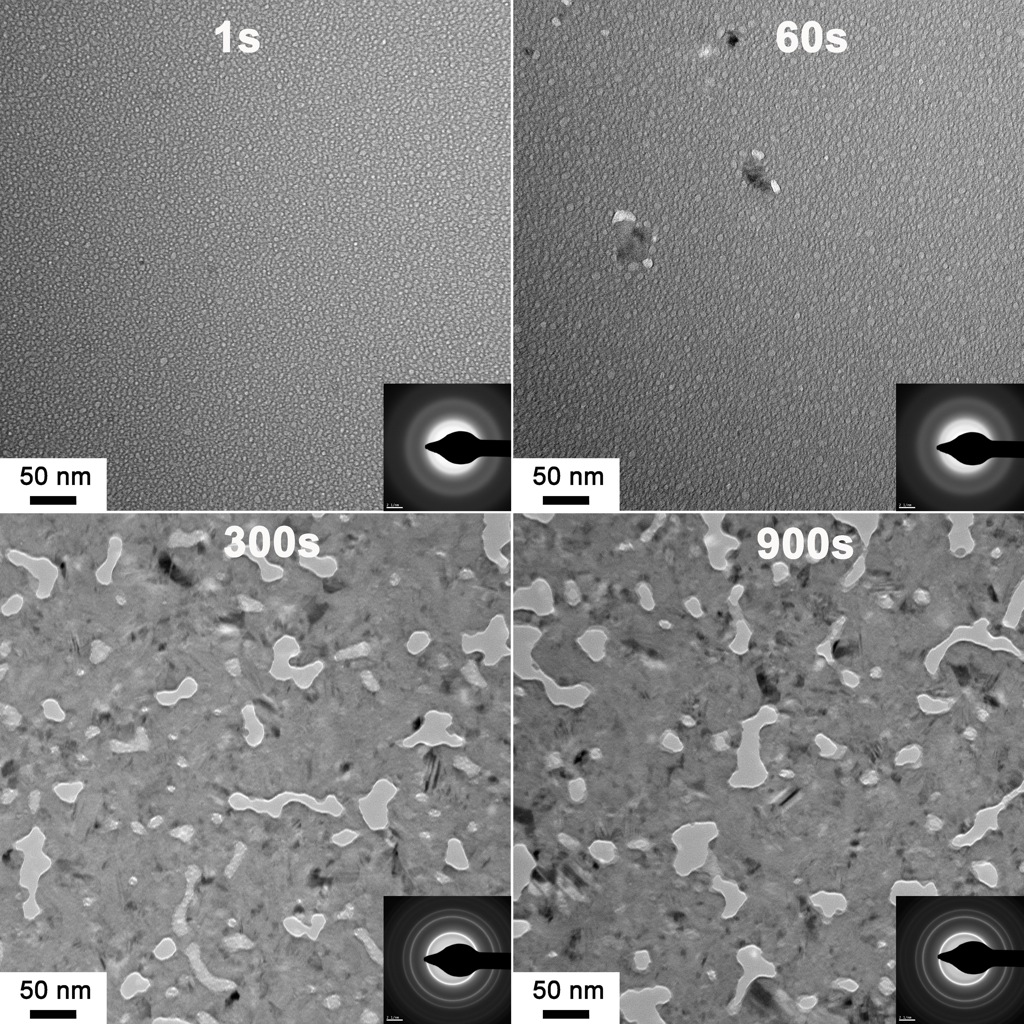
The following are the TEM images of OSO samples after the first low temperature annealing. From the TEM images it can be seen that Si film is still amorphous when the annealing time is 1s or 60s. No obvious silicon crystals are observed after 1s annealing at 680C. The majority feature is the ‘pit-like’ structure in the amorphous silicon film. From the previous in-situ annealing study we know that the reamorphization of silicon film takes place at this temperature. When annealing time increases to 60s, a few silicon crystals surrounded by sparing open pores can be observed in silicon film. However, the majority of silicon film is still amorphous, which can be proved by the diffraction image. Further increasing the holding time to 300s yields crystallized silicon film with lots of irregular elongated open pores. 900 seconds annealing yields very similar morphology as that from 300s annealing.
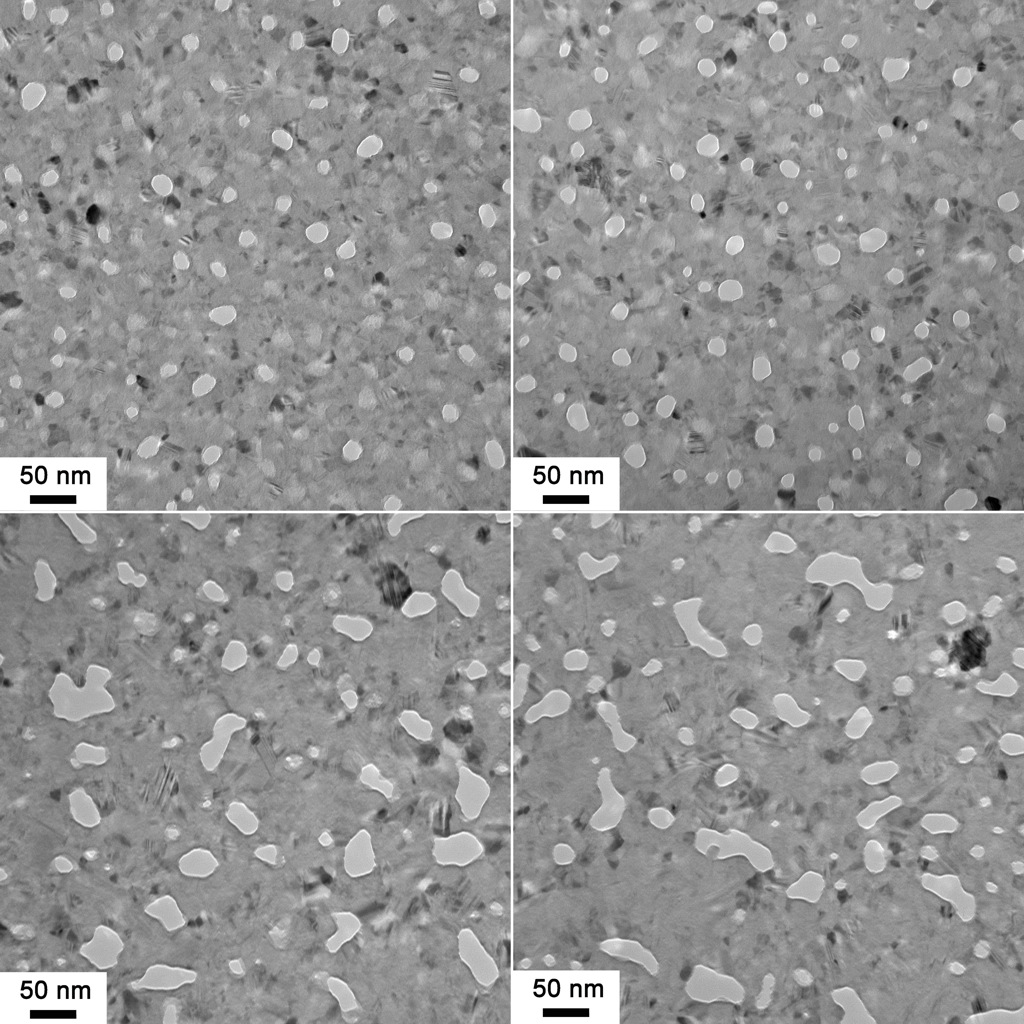
The following are the TEM images of multi-annealed samples. It can be seen that regular round pores are formed in the shorter time preannealed (1s and 60s) samples. The morphologies of pre-crystallized samples, which corresponding to 300s and 900s preannealing, do not change much. Those elongated pores are still the dominating features. However, the ratio between the long axial and short axial decreases. In other words, those elongated pores tend to become less elongated but more round. Moreover, some round pores are also observed from the TEM images.
Since it’s not fair to compare the porosity from the regular round pores with the irregular elongated pores, the porosity, pore size and pore distribution plot in the following are only from the first two multi-annealed samples and the control sample (single annealing). The small change to the last two samples with longer preannealing time may due to the crystallization of residue amorphous silicon in the silicon film. It is possible that the preannealing at 680C for even 900s would not fully crystallize the silicon film, but majority of the silicon. That’s why the second higher temperature annealing does not greatly affect the pore morphology.
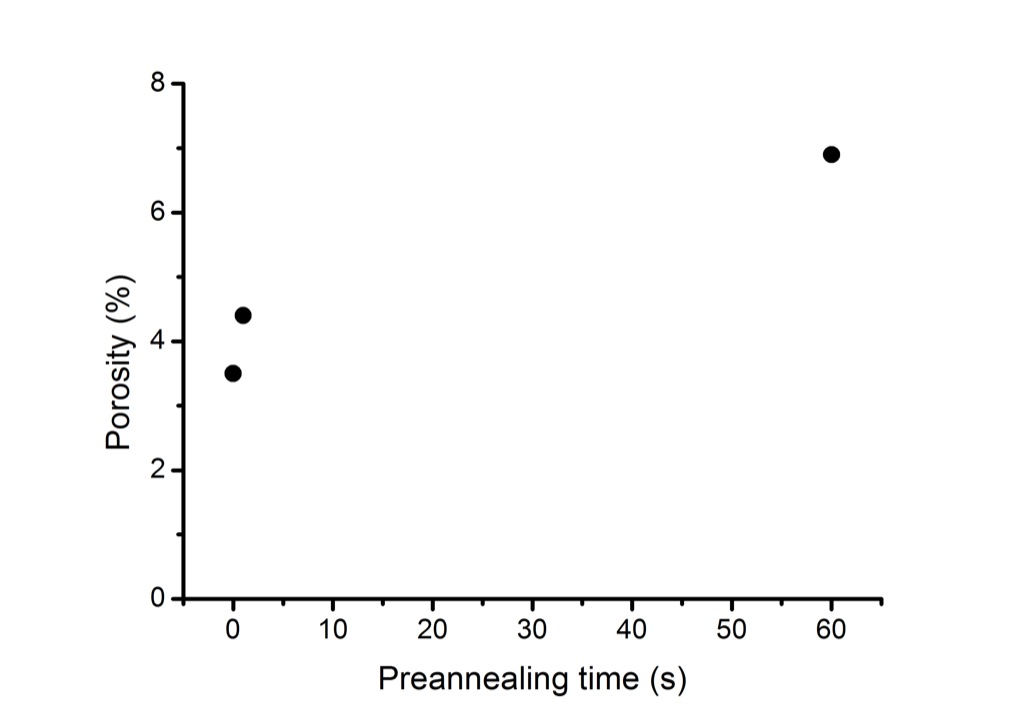
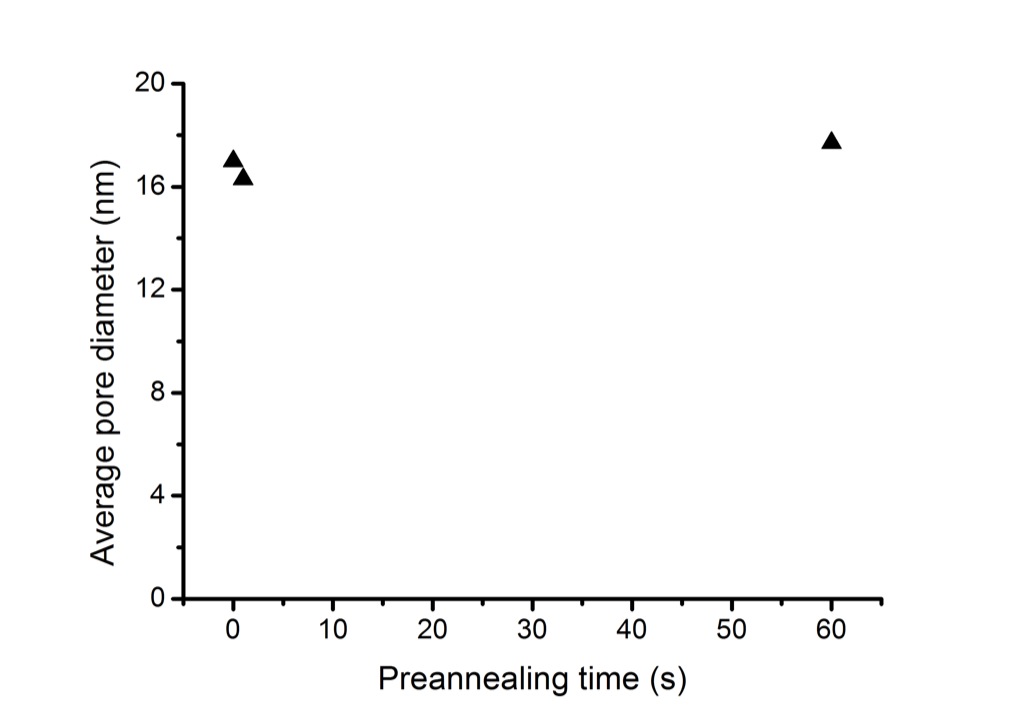
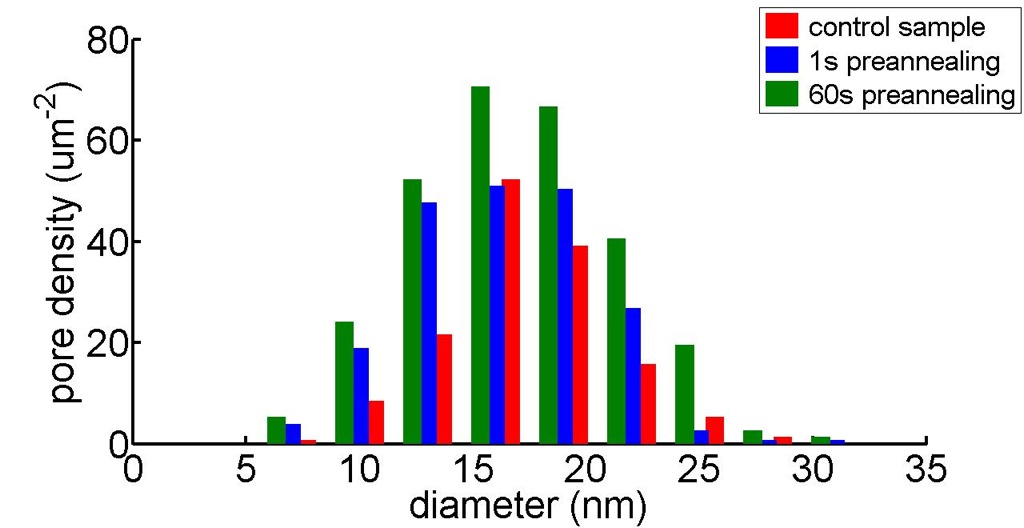 The porosity plot shows the same trend as that of the last experiment that multi-annealing increases the porosity compared with the single annealing. It also shows that the sample with 60s preannealing yields larger pores compared with the one that only preannealed for 1s. The average pore diameter plot shows that the sample with 1s preannealing yields a slight lower average pore diameter while the other one with 60s annealing yields a larger average pore diameter compared with that of the control sample. The pore distribution plot shows us the pore distribution of three sample. From the plot it can be seen that the sample with 60s preannealing forms lots of pores with diameter from 15nm to 20nm compared with the control and I believe this attributes to the higher porosity and larger average pore diameter. The sample with 1s preannealing yields lots of pores with diameter around 12nm compared with the control sample and that is why the average pore diameter is slightly lower for this sample.
Now let’s further dig into this multi-annealing experiment. The preannealing bassically contributes to the ‘structure relaxation’, process in which the whole network rearranges upon annealing in order to decrease its free energy, and the tetrahedral bond-angle distortion decreases, and short
range ordering occurs [C. Spinellaa, J. Appl. Phy., 86 (1984)]. Here shows a energy diagram of different phases of silicon from the same reference above.
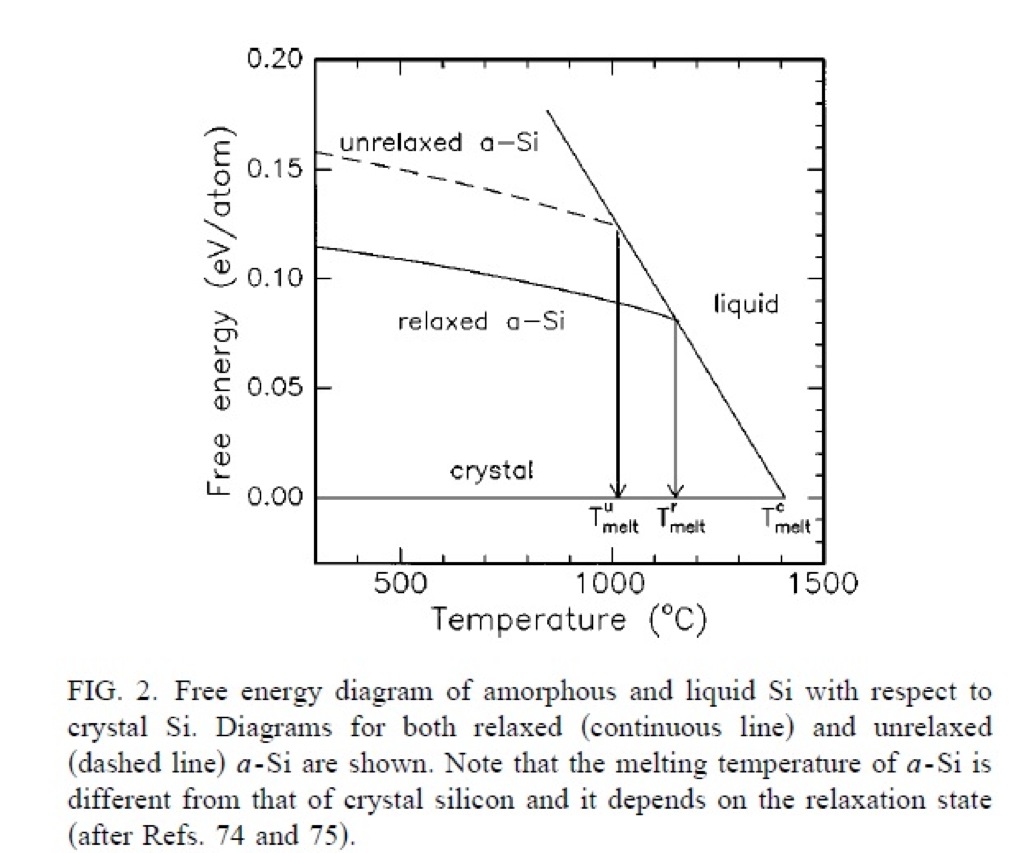
This plot reveals that preannealed amorphous silicon, or relaxed a-Si, is a lower free energy state compared with deposited a-Si, or unrelaxed a-Si, even though both of them are still higher energy states compared with crystalline silicon. This explains that why the same higher temperature annealing (1000C) yields different grain sizes, as well as porosity, since the relaxed a-Si has a lower activation energy than the unrelaxed one. The porosity differences between two preannealed samples may come from the different relaxed stages of those two samples as a result of different preannealing time (1s vs. 60s).
Next post I’ll try to introduce some crystallization kinetics to understand this multiannealing experiment.