Goniometer Introduction
With the goniometer nearly finished, I’d like to share a look at what has been created:
Introduction
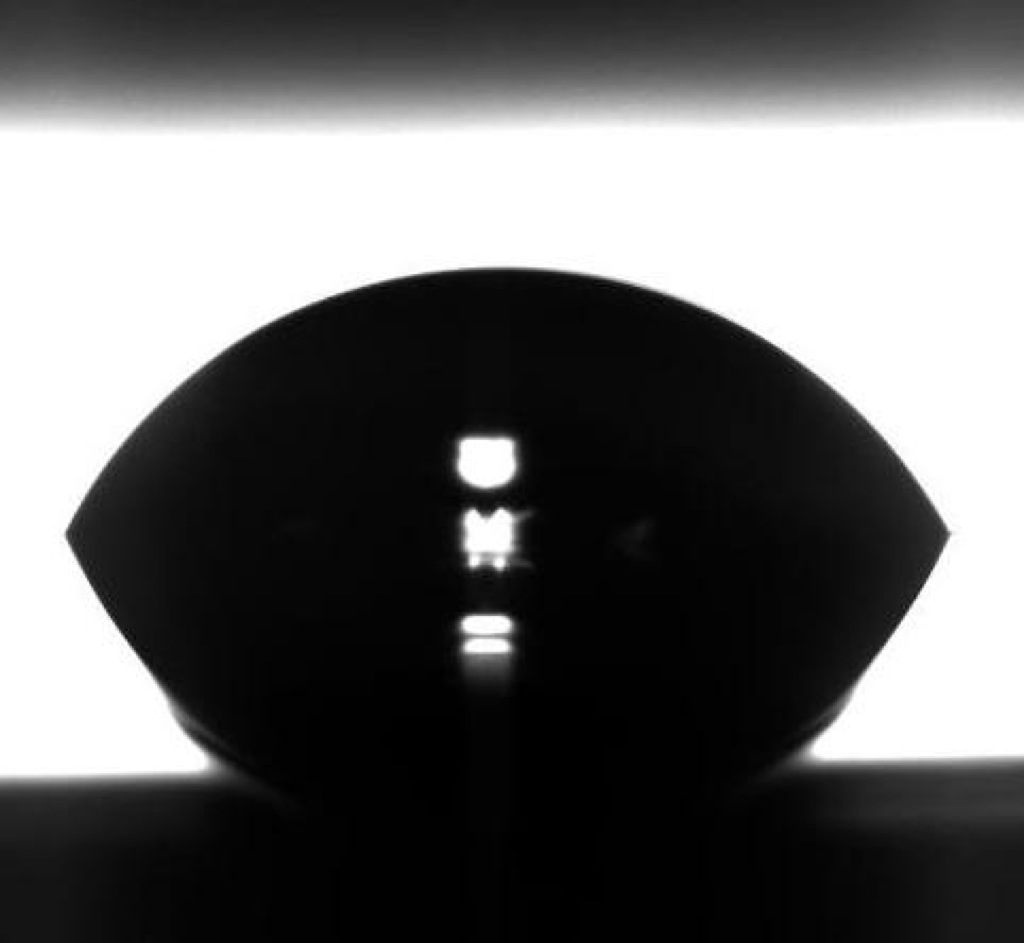
A surface contact angle goniometer (SCAG) measures the angle(s) of contact that a droplet of liquid makes with a surface. This particular SCAG does this by creating a shadow that is isometric with the droplet and recording its image with an image sensor. A beam of nearly-collimated light (±6º divergence) is shone at and around the droplet-surface interface, as illustrated below. Small droplets (.05-.10 mL) act as high-curvature convex lenses and incident light is diffracted away from the collimated path at a high angle, creating a “shadow” in the beam. This shadow is captured by a sensor with a small field of view, at which point the surface contact angles can be measured.

Image Processing
The angle can either be measured directly or, more easily, with the half-angle method. The contact angle of a droplet on a level, untilted surface is twice that of the angle from the edge of the interface to the maximum height, or 2*arctan(height/base_radius), by the nature of a droplet’s volume distribution.
Angle using ImageJ’s angle tool:

180 – 105.255 = 74.745
Angle With the Half-Angle Method:

.10mL droplet on Vinyl
Details of Use
The current setup involves a high-intensity LED equipped with an aspheric collimating lens, a stage, a microsyringe pipette and support, and a 1/3″ CMOS USB camera (image sensor) equipped with a short-range, low magnification telecentric lens. The stage is soon to be replaced with better-suited alternative.


The crucial element of the tool is creating a straight line from the LED through the lenses and to the sensor. Image accuracy depends on it, and adjusting the position of each component causes some misalignment. Adequate straightness can be achieved by aligning the rims of the two lens-holders with the parallel edges of the stage (see the second picture above) and securing the alignment of the LED/coll. lens (the third picture). The camera/tele. lens should also be aligned with the translation stage it sits on so that fine-focusing does not translate the image.
When everything has been aligned, the specimen stage (not pictured) and pipette are prepared and set and the system is powered on. The camera’s position is set to focus on the needle (the eventual center of the droplet) by moving it to about 65mm away and then fine-tuning with the stage it sits on. A hanging drop is made with the pipette and is deposited (i.e. not dropped) on the surface when it is fully-formed.
One issue that arose was that nearly-collimated light produces significant glare from the reflection of its slightly divergent rays off the stage. Fortunately, the concentration of downward-diverging rays falls-off towards the top of the lens and a sweet-spot exists just before upward-diverging rays are dominant where reflection is not apparent. The video shows the transition through the ideal height.
An accurate representation of the droplet-surface interface (baseline) is critical and improper setup can result in a useless image of it. An easy way to test accuracy is touching a vertex to the stage beside the center of the droplet — if the vertex-surface interface does not sink or float above the apparent baseline, you know it is accurate. This video shows how it is done:
Uses
A more detailed and empirically-informed summary of potential uses for the tool at hand will be presented when the new stage is installed. Especially with membrane surfaces, accuracy and range of uses depend on isolating the sources of contact angle hysteresis. For now, here is a summary of SCAG uses that I have found so far:
The most typical use of SCAG’s is measuring the phobicity/philicity of a liquid, typically water, with the surface of a solid (“wettability”). The equation for ideal conditions is Young’s equation, γLVcos(θ) = γSV – γSL, where
γLV = liquid-vapor surface energy (.072 N/m for pure water),
γSV solid-vapor surface energy,
γSL = solid-liquid interfacial energy,
and θ = contact angle at the triple-points.
While determining the value of γSV or γSL requires additional relationships, this relationship is still useful in determining the Spreading Parameter (S) that defines wettibility: S = γSV – (γSL + γLV) = γLV(cos(θ) – 1) (Young-Duprè equation). It often suffices to use the contact angles of a sessile drop alone, but a more accurate angle measure is described below. Young’s equation can also be used to measure precision by observing the smoothness of the trend of cos(θ) with droplet volume and γLV.
Even droplets on perfectly clean, smooth, and homogeneous surfaces will experience a some spreading over the surface with time (hysteresis, H). For rough surfaces such as porous membranes, hysteresis of the contact angle is significant and can be used to describe the surface as long as the causes of hysteresis are restricted to the unevenness of the surface itself. When talking about contact angles, H = θA – θR, (Robert J Good, 1992) where
θA = Advancing angle, contact angle at points where the drop is spreading
θR = Retreating angle, contact angle at points where the drop is pulled away.
These measurements can be obtained with a tilting stage and possibly a captive-needle method.
Evaluating hysteresis in terms of the Cassie-Baxter and Wenzel models describes the surface’s homo/heterogeneity, and there have been various techniques developed to offer in-depth observations of a how liquid interacts with porous surfaces.
Hysteresis can also be taken into account to improve the accuracy of contact angle measures, where θ can be redefined as θ = arccos((rA*cos(θA) + rR*cos(θR))/(rA + rR)) where
r = (sin3θ/(2 – 3cosθ + cos3θ))1/3, using the corresponding angle measure for θ
(Rafael Tadmor, 2004).
This is just an idea of what can be done with a SCAG. I will post a more thorough explanation of the uses and equations that pertain to our system when it is finalized.
To finish, here is a picture of a droplet on a CD-ROM