Permeabilities vs. pore sizes for ideal membranes
Because our membranes are not mono-disperse, we often debate the relative contribution of large pores vs small pores in both diffusive and convective separations. Indeed it is possible that the way pores contribute to transport in these two modes is different and would give rise to different fractionations of the same sample with the same membrane. Small pores are important because they are typically more numerous than large pores. But large pores are more active precisely because they are larger. How this battle plays out depends on the actual density histograms for our membranes and the physics of transport for the mode we are working with.
An important conceptual tool is the hypothetical monodisperse membrane. If we further imagine a manufacturing process in which membranes with the same porosity can be made at whatever pore size we wished, we could make some membranes with many small pores and others with fewer large pores. Pore formation in this manufacturing process would be constrained by …

Where Psi is the porosity, N is the density of pores and r is the pore radius.
In convection, the volumetric (liquid) flow rate through an individual pore is predicted by Dagan’s equation as …

For convenience let us further take the limiting case of an infinitely thin membrane (t -> 0). The volumetric flow density is calculated by multiplying the pore density times the flow per pore. Using Eq. 1 for the pore density …

Thus the ratio of the flow rates between two membranes used under identical flow conditions would be given by …

So the larger pore membrane experiences a larger flow in proportion to the ratio of the pore sizes.
This type of discussion may be helpful in thinking about our non-monodisperse membranes if we imagine that the density of pores at a given size are related to the pore size by something like Eq 1 (so that our membranes are like a superposition of ideal membranes). Then one would predict from Eq. 4 that the contribution from large pores to the overall flow grows roughly in proportion to the pore size. This is despite the fact that the flow through any individual large pore will increase with the r^3 dependence suggested by Dagan – but there are just so few of them because of the constraint of Eq. 1.
Interestingly, we get the inverse of Eq 4 for diffusion. According to Shigeru, the correct description of the diffusive permeability for monodisperse, infinitely thin membranes is …

Substituting the constraint of Eq. 1 now results in …
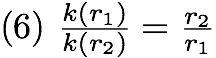
So now the smaller pore membrane experiences more transport. It turns out the higher density of small pores matters more for diffusion. This suggests that diffusion should allow for better separation (i.e. lower cut-offs) than convection.
How valuable this discussion is depends on the validity with which Eq. 1 relates the density of pores at a given size to the pore size for our membranes. If it holds we would expect a -2 slope on a log-log plot of density vs. pore size. Here is a check of that for w341.
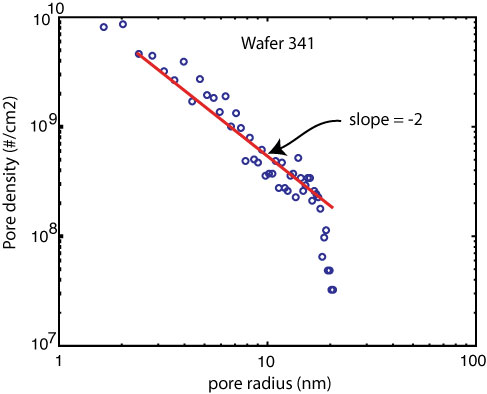
Pretty suggestive. Note that -2 is just drawn as a check. It is not a best fit. There is quite a bit of power in these types of plots. It suggests for example, that the same physical process is behind all pores below 10 nm but that something else starts happening above 10 nm.