Long Term Urea: Evaporation measurement and Pressure Calculations.
The initial measurements with multiple tests tubes containing either Serum or PBS failed to demonstrate evaporation and in fact the weights of the collection tubes increased after sitting in the refrigerator overnight. Perhaps the tape collected water? At any rate (<– trite expression), I redid the experiment with a single tube of serum. The tube with serum was weighed before being placed in the refrigerator for 24 hours and again after being removed from the refrigerator.
Initial weight of Serum, W = 412.3 mg, Initial volume of Serum, V = 402.3 µL.
Final weight of Serum, W = 409.5 mg, Final volume of Serum, V = 399.5 µL.
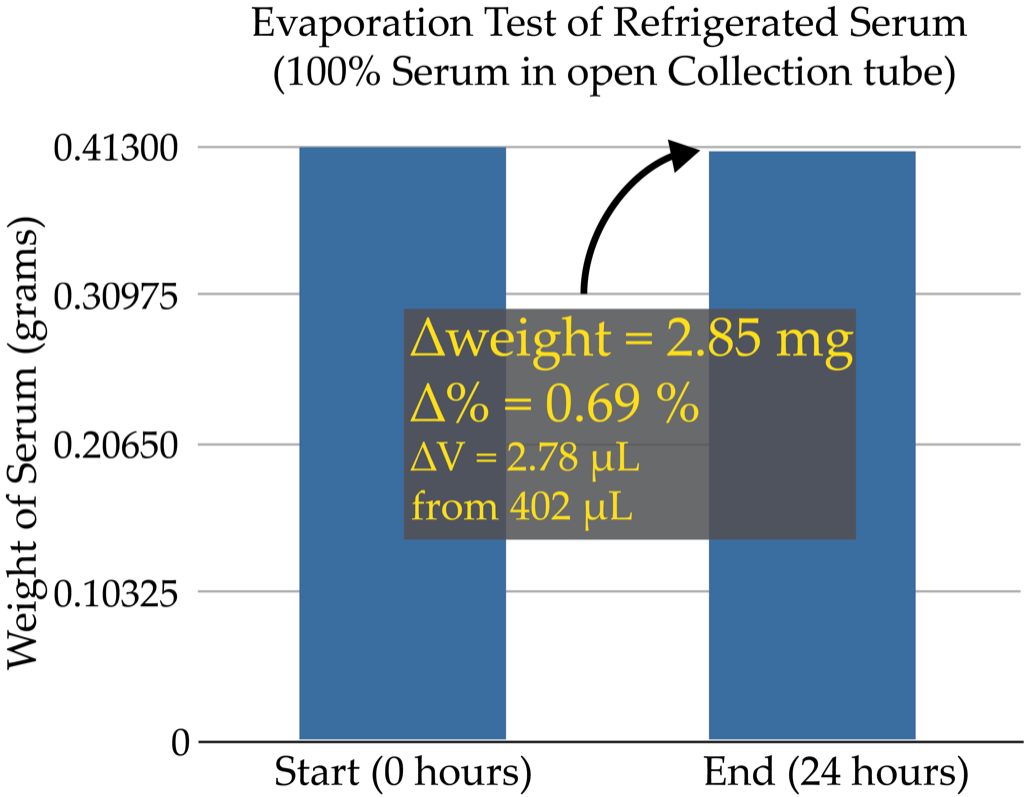
This means that evaporation cannot explain the time-dependent decrease in urea concentration over the duration of the long-term urea clearance tests.
Now we turn our attention to the possibility of pressure driven trans-membrane flow from the beaker to the dialyzer channel. For this type of flow to occur, the pressure due to the water in the beaker, above the membrane, must be higher than the presser in the channel. The channel pressure is lowest at the outlet to the tubing, so we calculate this value, Po, and compare it to the pressure supplied by the column of water in the beaker, Pc.
The pressure at the outlet of the outlet tubing is 1 atmosphere, 101325 Pa. The pressure at the outlet of the dialyzer, Po, is then 1 atm plus the pressure drop along the tubing as determined by the equation…

Q is the volumetric flow rate = 5.6 µL/min (0.093 mm3/s)
L is the length of tubing = 34.25 cm (342.5 mm)
 is the dynamic viscosity = 1.04 x10⁻³ Pa s
r is the tubing radius = 0.5 mm
 is the mathematical constant Pi = 3.1415927
 P is the pressure drop along the tubing = 1.35 Pa
The tubing exits the device and rises to the separation collector, 65 mm.
Pst = pressure from the serum in the output tube (Pa)
h = height of tube (65×10-3 m)
ρ = density of Serum ( 1024 kg/m3)
g = the gravitational constant (9.81 m/s2)
Pst = h ρ g = 653 Pa
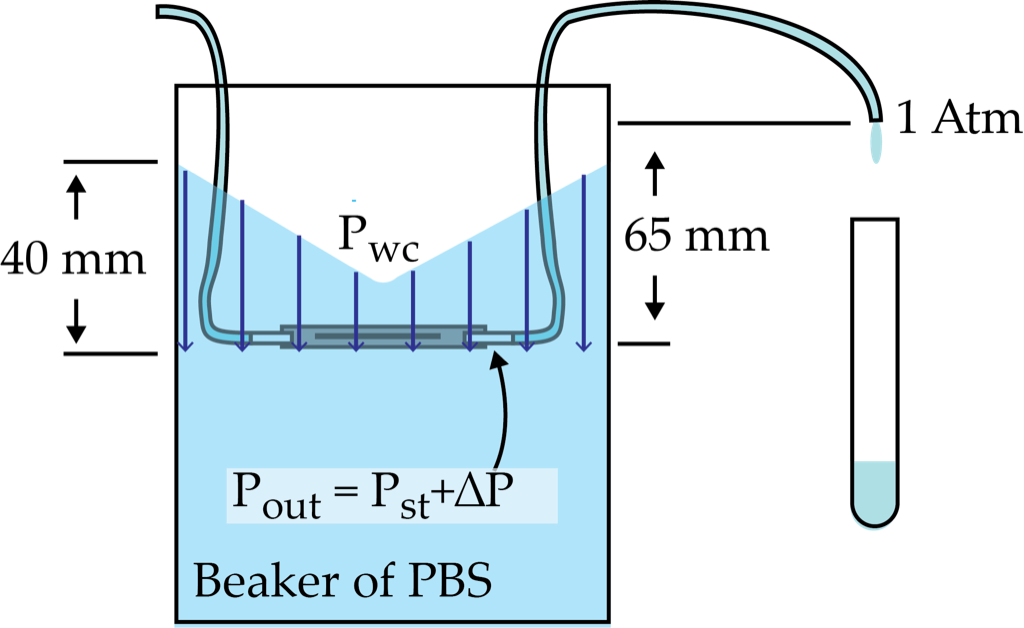
Pressure due to the water column:
Pwc = h ρ g
where
Pwc = pressure from the water column (Pa)
h = depth at which the pressure is measured (0.04 m)
ρ = density of PBS ( 1000 kg/m3)
g = the gravitational constant (9.81 m/s2)
Pwc = 392.4 Pa
So the pressure against the outside of the membrane is 392 Pa (plus 1 atm) while the pressure in the channel (at the end) is 654 Pa (plus 1 atm)
So the pressure from the beaker water, Pwc, is less than the pressure in the dialyzer channel, Pout. Pwc < Pout.
 there is no flow into the dialyzer channel from the beaker.
This is still a simplification. For example the stir bar in the beaker causes the PBS in the beaker to take on a non-planar form. What effeect this has on the hydrostatic pressure is not considered. The PBS moving past the membrane may cause a pressure differential due to Bernoulli’s effect. The dynamic viscosity for refrigerated serum is not used, probably not a huge effect, but still not taken into account.
I thought you are trying to account for LESS volume than expected in the fractions? Hence the discussion of evaporation?
How would water flowing from the beaker into the dialyzer account for fluid LOSS?
I don’t understand….please help!!!
We are trying to account for lower concentrations in later samples. Two of the hypotheses are as follows. The first was that water was evaporating leaving higher concentrations in the older samples, thus the evaporation test. The second was that hydrostatic pressure from the liquid in the beaker was driving fluid across the membrane into the collection tubes (more in later samples than in earlier samples).
I have not collected data on the volumes of the fractions only the concentrations. Another hypothesis was that urea concentration is declining in the source fluid for some reason. I have an experiment designed to measure the urea concentration over time at the input of the dialysis chip.
Didn’t you say at the last NRG meeting that you are ending up with 15% less total serum volume after the experiment? I thought that was the basis of the evaporation discussion that I heard. Obviously, if you are loosing serum volume, there is no water flowing in from the beaker, it is flowing out from the serum. This makes the most sense, since hydrostatic pressure is so small (and exists in the tubes as well, right?)
When will you be able to repeat the experiment and measure the volume in the fractions? Once we understand the flow rate over time, we’ll be in a better position to understand the dynamics of the urea concentration.
Why would water flowing from the beaker lead to more volume in the later samples??
The theory that you left off was that fluid is flowing out of the serum and into the beaker, gradually creating a cake layer on the membrane. The more convective flow out of the membrane, the less effective diffusion will be. Over time, as convective flow slows, diffusion lowers the urea concentration, since urea diffusion is less effected by the cake layer.
In the future, it would be easier to interpret the results if the pressure is balanced, so that volume is conserved in the serum.
Can you estimate the RPM of the stir bar? I want to try the Bernoulli calculation.
The stir bar is going at about 240 RPM.
People have studied everything