Back in November we were visited by Tom Berkelman of BioRad to see if he could use our NPN membranes to successfully separate some proprietary nanoparticles from IgG in a solvent with secret ingredients. These particles have an interesting absorbance spectrum as well as strong fluorescence.
During that visit and in subsequent separations in the McGrath lab and at BioRad, we clog the membrane after passing only 20-30 µL. This occurs at concentrations of 0.1 mg/mL and higher, when using the constant pressure setup. Lower concentrations seem to allow greater total volume to pass through the filter, but clogging still occurs. We want to find a way to use our membranes to filter solutions with particles/protein at higher concentrations.
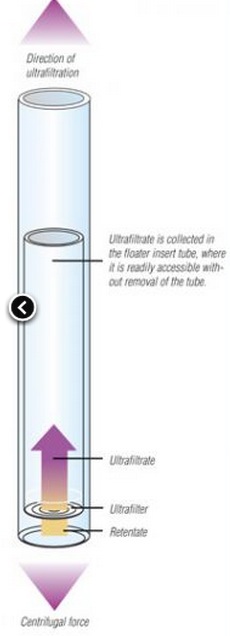
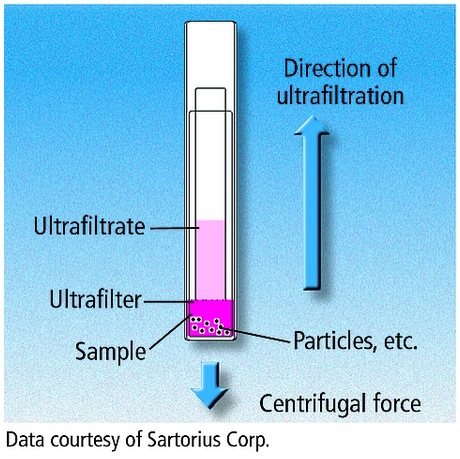
One hope we have of addressing this clogging is a “reverse” centrifuge technique. When Tom originally visited us on 11-20-13, he made mention of the Sartorius Centrisart
The centrifugal force acts to equilibrate the solution levels inside and outside the inner tube. This drives solution through the filter while also driving larger particulates away from the filter towards the bottom of the centrifuge tube. In this configuration, blocked particles should be less likely to stay at the filter and clog flow.
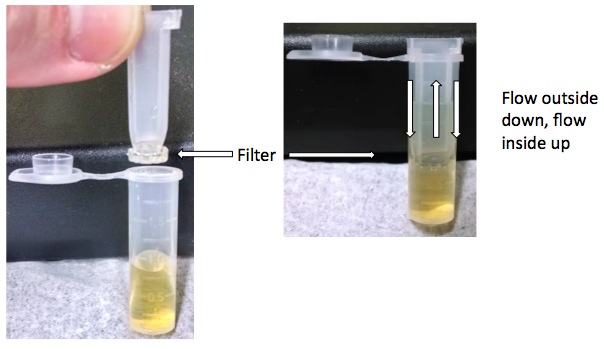
Jim suggested we try a similar approach using our Gen2 SepCon assemblies. The attached figure below
Gen2 Sepcon placed into 2 mL tube
shows the Gen2 being used with a 2 mL centrifuge tube. We tried Gen2 because it has a narrower profile and allows for more volume (~150 µL) around the side than the Gen3 tubes.
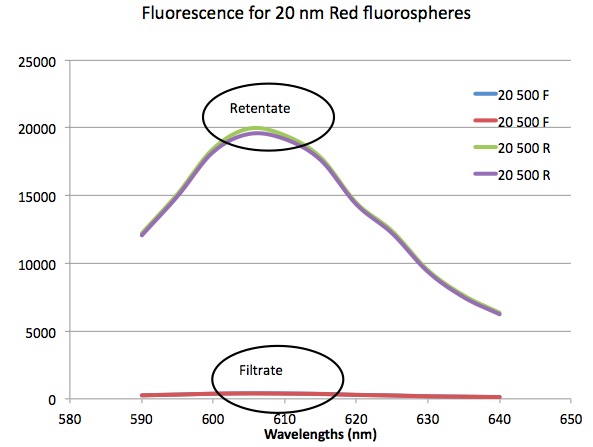
I started by testing a mixture of 500 nm yellow fluorospheres and ~20 nm red fluorospheres in 1X PBS. I diluted each stock 100 to 1 by volume. I believe this corresponds to 3 E9 particles/mL of 500 nm and 5 E13 particles/mL of 20 nm. This mixture has typically blocked flow through a membrane after ~30 µL of flow. I started the centrifuge at 2krpm for a series of 1 and then 5 min runs. There was very little if any flow visible. Maybe 20 µl. I upped the rpms to 3 k for 5 mins, saw a little flow. Then added 5 min at 4 krpm. At this point approximately ~100 µl of filtrate had been collected. Next I increased the rpms to 5k with continued success for 10 minutes. The membrane broke at 6 krpm. Little to no red or yellow particles seemed to have made it through the filter, as seen in the attached fluorescence plots.
I replicated the above test using two mixtures of materials Tom B. left after his visit. BR1 is combination of 1500 µl PBS/fairy dust + 15 µl 10mg/ml IgG + 150 µl “T24”.
BR2 is 1500 µl PBS/fairy dust + 15 µl “25b”.
“T24” is a particle prep that creates particles with ~32nm diameter at 122 ppm.
25b is “unfractionated IgG conjugation reaction” antibody to particle ratio 2:1. 524 ppm particles, 1.05 mg/ml IgG.
Both had 100 ul or more pass through the membrane to the 20+ 500 nm solution discussed above. I’ve attached the measured absorbance and flourescence data showing little to no particles passing through the membrane while at least some IgG has passed through. No IgG seems to have passed through in the BR2 test. (Or the concentration may simply be too low to measure using the nanoquant plate.)
BR 1 absorbance showing T24 absorbance peaks at ~325 and ~460 nm.
BR 1 fluorescence
BR 2 absorbance
BR 2 fluorescence
I think these positive results merit further study. Immediate actions might be to modify the current 2 ml centrifuge tubes so that less total volume is required. Currently we need at least 1.5 ml. If we fill the bottom of the tube with PDMS for example, we might only need 0.5 ml.
We should also repeat these experiments with higher concentrations of IgG and particles.
(In a parallel effort, we recently purchased some Labview microfluidics equipments to drive filtration with a syringe pump while monitoring the pressure building up behind the membrane.)
I have a couple questions: Does anyone know of a stock of open bottom pieces for the Gen2 assemblies? I have many of the closed versions, which are not ideal for this test.
I believe I need to use 100 um gasket material for the Gen2 SepCons. Correct? These are 300 um chips.
In my last post, I presented the results of my BBB TEER experiments. For the BBB co-culture, there was a spike in TEER. I hypothesized that this was caused by media acidification by rapidly proliferating glial cells, which in turn negatively affected barrier function of endothelial cells. When I presented this data to Angela Glading,…
Hi All, Presented in this post is the following paper, titled: “Detection and isolation of circulating exosomes and microvesicles for cancer monitoring and diagnostics using micro-/nano-based devices” [REVIEW] exosome handling in micro and nano devices Keynote presentation: [PRSENTATION] NRG (2015-11-16) exosomes
This post is a continuation of the affinity based capture of streptavidin conjugated EVs. The difference is that instead of using the tangential flow system we used the ALine devices. Sam’s previous work discussed the use of ALine devices for size based capture of EVs, but in this case we wanted to try the streptavidin-biotin…
This week, I tried to make a large number of MgF2 nanomembranes for my collaboration with Kevin Webb. I wanted to keep the evaporated surface as pristine as possible, so instead of using the Kapton tape to attach the chips to the platen on its face, I used double sided kapton tape. Our reserves of…
Although most previous studies suggest a weakened cell-substrate interaction over porous membranes, there are variations in the observed cell responses, likely due to the use of different cell types, substrate materials, and experimental methods. We are seeking to develop a computational model using the Active Brownian Particle (ABP) approach to study the role of pore…
The idea of this project started when we were writing a mini-review about cell-substrate interaction. Although most of studies of cellular responses to porous membranes have pointed towards a multiphasic response with the same trend of changes with respect to the pore sizes, we also found some variation in the results. We suggested that some…
This could be a breakthrough for SepCon applied to biologicals and concentrated nanoparticles.
The role of the g-force in keeping the membrane clear of particles is interesting. We need to spin high enough pull the cake away. A little counter-intuitive, but spinning harder might be the key to prevent clogging.
Chris recently asked about the relative number of particles in solution and pores in the membrane.
I calculate a typical 5 slot sepcon has ~ 1 E8 million pores.
The solution with 20 nm NPs used above has 5 E13 NPs/mL.
At these concentrations, there are many more particles than pores.




This could be a breakthrough for SepCon applied to biologicals and concentrated nanoparticles.
The role of the g-force in keeping the membrane clear of particles is interesting. We need to spin high enough pull the cake away. A little counter-intuitive, but spinning harder might be the key to prevent clogging.
Chris recently asked about the relative number of particles in solution and pores in the membrane.
I calculate a typical 5 slot sepcon has ~ 1 E8 million pores.
The solution with 20 nm NPs used above has 5 E13 NPs/mL.
At these concentrations, there are many more particles than pores.