Back in November we were visited by Tom Berkelman of BioRad to see if he could use our NPN membranes to successfully separate some proprietary nanoparticles from IgG in a solvent with secret ingredients. These particles have an interesting absorbance spectrum as well as strong fluorescence.
During that visit and in subsequent separations in the McGrath lab and at BioRad, we clog the membrane after passing only 20-30 µL. This occurs at concentrations of 0.1 mg/mL and higher, when using the constant pressure setup. Lower concentrations seem to allow greater total volume to pass through the filter, but clogging still occurs. We want to find a way to use our membranes to filter solutions with particles/protein at higher concentrations.
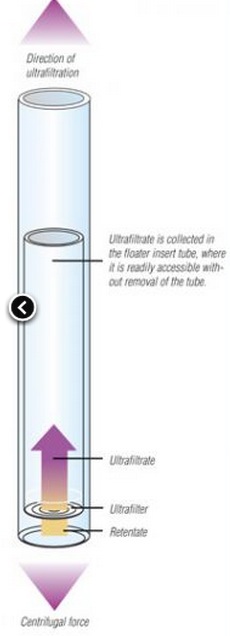
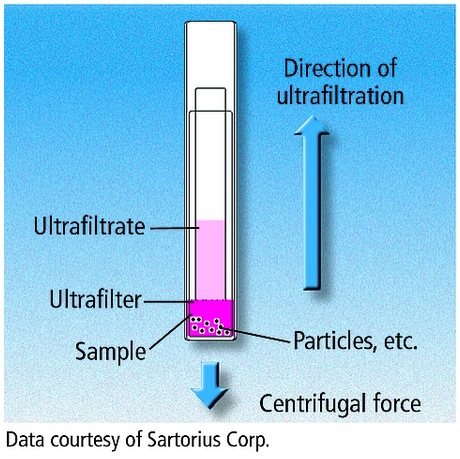
One hope we have of addressing this clogging is a “reverse” centrifuge technique. When Tom originally visited us on 11-20-13, he made mention of the Sartorius Centrisart
The centrifugal force acts to equilibrate the solution levels inside and outside the inner tube. This drives solution through the filter while also driving larger particulates away from the filter towards the bottom of the centrifuge tube. In this configuration, blocked particles should be less likely to stay at the filter and clog flow.
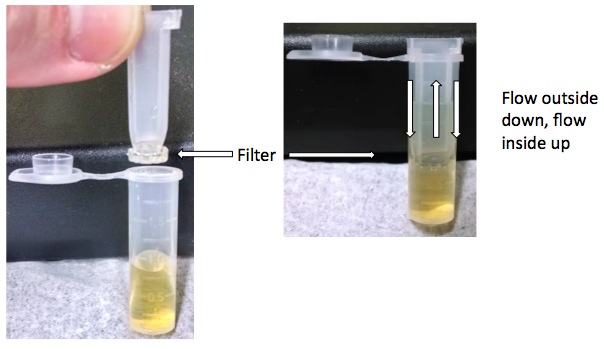
Jim suggested we try a similar approach using our Gen2 SepCon assemblies. The attached figure below
Gen2 Sepcon placed into 2 mL tube
shows the Gen2 being used with a 2 mL centrifuge tube. We tried Gen2 because it has a narrower profile and allows for more volume (~150 µL) around the side than the Gen3 tubes.
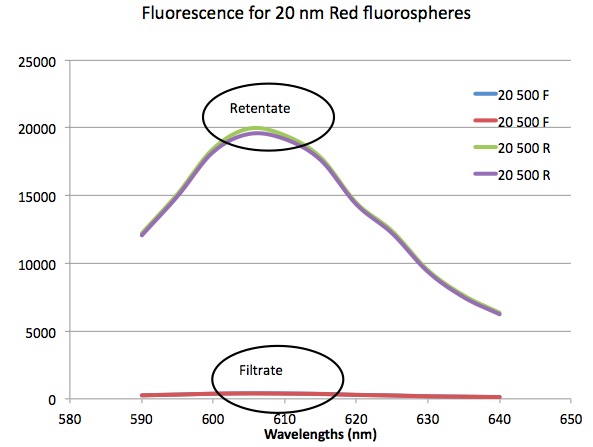
I started by testing a mixture of 500 nm yellow fluorospheres and ~20 nm red fluorospheres in 1X PBS. I diluted each stock 100 to 1 by volume. I believe this corresponds to 3 E9 particles/mL of 500 nm and 5 E13 particles/mL of 20 nm. This mixture has typically blocked flow through a membrane after ~30 µL of flow. I started the centrifuge at 2krpm for a series of 1 and then 5 min runs. There was very little if any flow visible. Maybe 20 µl. I upped the rpms to 3 k for 5 mins, saw a little flow. Then added 5 min at 4 krpm. At this point approximately ~100 µl of filtrate had been collected. Next I increased the rpms to 5k with continued success for 10 minutes. The membrane broke at 6 krpm. Little to no red or yellow particles seemed to have made it through the filter, as seen in the attached fluorescence plots.
I replicated the above test using two mixtures of materials Tom B. left after his visit. BR1 is combination of 1500 µl PBS/fairy dust + 15 µl 10mg/ml IgG + 150 µl “T24”.
BR2 is 1500 µl PBS/fairy dust + 15 µl “25b”.
“T24” is a particle prep that creates particles with ~32nm diameter at 122 ppm.
25b is “unfractionated IgG conjugation reaction” antibody to particle ratio 2:1. 524 ppm particles, 1.05 mg/ml IgG.
Both had 100 ul or more pass through the membrane to the 20+ 500 nm solution discussed above. I’ve attached the measured absorbance and flourescence data showing little to no particles passing through the membrane while at least some IgG has passed through. No IgG seems to have passed through in the BR2 test. (Or the concentration may simply be too low to measure using the nanoquant plate.)
BR 1 absorbance showing T24 absorbance peaks at ~325 and ~460 nm.
BR 1 fluorescence
BR 2 absorbance
BR 2 fluorescence
I think these positive results merit further study. Immediate actions might be to modify the current 2 ml centrifuge tubes so that less total volume is required. Currently we need at least 1.5 ml. If we fill the bottom of the tube with PDMS for example, we might only need 0.5 ml.
We should also repeat these experiments with higher concentrations of IgG and particles.
(In a parallel effort, we recently purchased some Labview microfluidics equipments to drive filtration with a syringe pump while monitoring the pressure building up behind the membrane.)
I have a couple questions: Does anyone know of a stock of open bottom pieces for the Gen2 assemblies? I have many of the closed versions, which are not ideal for this test.
I believe I need to use 100 um gasket material for the Gen2 SepCons. Correct? These are 300 um chips.
I took a look back through the Melvern data I collected, particularly focusing on changes in the intensity data in the BSA-DDM solution (the previously posted plots were of number data). When I compared the peak intensities for BSA, DDM, and DDM-BSA complex I noticed that the intensity peaks fall over the same size distribution…
Links and Papers: Article with video Lung on a Chip Device Paper Lung on a Chip Application (Pulmonary Edema) Chris came across the publicity video last week and Jim asked me to look into the specifics. It’s a pretty nifty device. As the video shows, the device is a co-culture structure fabricated entirely from PDMS….
I am not sure what prompted me to carry out this experiment. I took few samples from W703 (No RTP) and put them in petri dishes with DMEM (-FBS) at room temperature. I had two samples in a dish, with one flipped over (well side up). The sample with well side up discolored much earlier…
Sugiura 2010 (Anal. Chem) This paper details a PDMS microfluidic system to perform dose response assays (what I’m hoping to achieve over this summer). They use serial dilutions to get separate trials spanning six orders of magnitude, showing an optimal dosage to kill HeLa cells. Their system is very efficient, using very shallow channels and balancing the…
Dave Fang posted a poster in 2010 about particles found in DI water. I encountered the same issue during the nano-pocket permeability experiment. He said, “I’ve become increasingly suspicious of membrane clogging during the … permeability experiments.” I conducted an experiment with ultrapure water (UPW), typically filling a 1L glass container from a UPW machine….
After last week’s post detailing the problems I’ve been having with my streaming potential setup, Jirachai was kind enough to come by the U of R last friday to look at my device. We banged our heads into the wall for a good two hours, but the drifting potentials and apparent insensitivity of the streaming…
This could be a breakthrough for SepCon applied to biologicals and concentrated nanoparticles.
The role of the g-force in keeping the membrane clear of particles is interesting. We need to spin high enough pull the cake away. A little counter-intuitive, but spinning harder might be the key to prevent clogging.
Chris recently asked about the relative number of particles in solution and pores in the membrane.
I calculate a typical 5 slot sepcon has ~ 1 E8 million pores.
The solution with 20 nm NPs used above has 5 E13 NPs/mL.
At these concentrations, there are many more particles than pores.




This could be a breakthrough for SepCon applied to biologicals and concentrated nanoparticles.
The role of the g-force in keeping the membrane clear of particles is interesting. We need to spin high enough pull the cake away. A little counter-intuitive, but spinning harder might be the key to prevent clogging.
Chris recently asked about the relative number of particles in solution and pores in the membrane.
I calculate a typical 5 slot sepcon has ~ 1 E8 million pores.
The solution with 20 nm NPs used above has 5 E13 NPs/mL.
At these concentrations, there are many more particles than pores.