Discoloration in a flipped sample
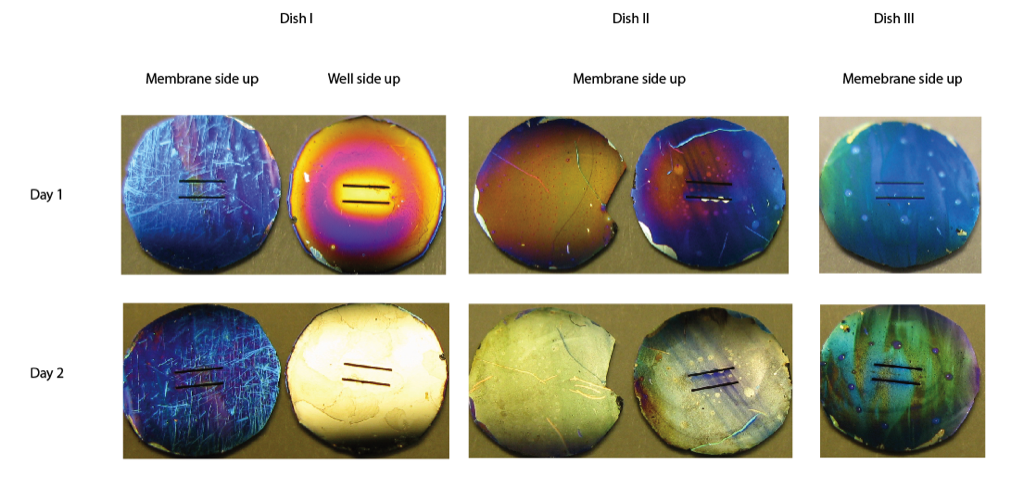
I am not sure what prompted me to carry out this experiment. I took few samples from W703 (No RTP) and put them in petri dishes with DMEM (-FBS) at room temperature. I had two samples in a dish, with one flipped over (well side up). The sample with well side up discolored much earlier than the one with membrane side up. We haven’t seen something like this before and associating discoloration with the orientation of the membrane chip is something that could to be looked into. Any guess as why would this happen?
Experiments have always been done with the ‘membrane side up’ until now?
If the well side up discolored slower, then it could have been reasonable to guess that the solution just couldn’t get access to the pnc-Si. In your case, I’m not sure what’s going on. Maybe you have a “captive solution” that isn’t mixing with the bulk?
Yes experiments were done with membrane side up (and using cloning rings).
I think keeping the chip suspended (not touching the floor) with well side up (may be by using spacers) should answer the question whether there’s any ‘captive solution’ responsible for this kind of behavior.
I’ve always done discoloration experiments with membrane side up, but never with cloning rings.
This is probably worth repeating since it only happened once and the dish 2 chips had similar discoloration rates.
I have used cloning rings only in cell culture experiments, not for discoloration ones.
In dish 2, the chip w/o slit has a broken edge which might be responsible for faster discoloration (we have seen this before in one of Barrett’s post) of the samples in that dish. I will repeat this experiment.