Labsmith microfluidic pressure sensor (updated)
I’ve been trying to do separations with the NPN 5-slot filters by driving the solution with a syringe pump. This type of separation is required by INT for use in their cartridge. Unfortunately, at most concentrations, solutions with fluorospheres tend to stop flowing after 20-30 µL of filtrate is collected. We believe their is a cake-layer forming, rather than pores being clogged with individual particles, because forward flow can be restored after a reverse flow or quick rinse. INT is limited to the use of a syringe pump in a dead-end type filtration, so we need to find a way to make this work. I did some preliminary tests with driving forward a various fixed rates, and also stepping the flow in forward and reverse directions in the hopes of dislodging any cake layer that formed during the forward flow. I quickly became frustrated because I had no feedback from the system, meaning for example, I had no idea what pressure was building up behind the membrane. So I asked around and Bob got me in touch with Aytug in Prof. Lapizco-Encinas’ lab. Aytug showed me their impressive assortment of Labsmith microfluidics equipment and shortly after we purchased the base components required to monitor pressure in our system with minimal volume requirements. Our setup is pictured below:
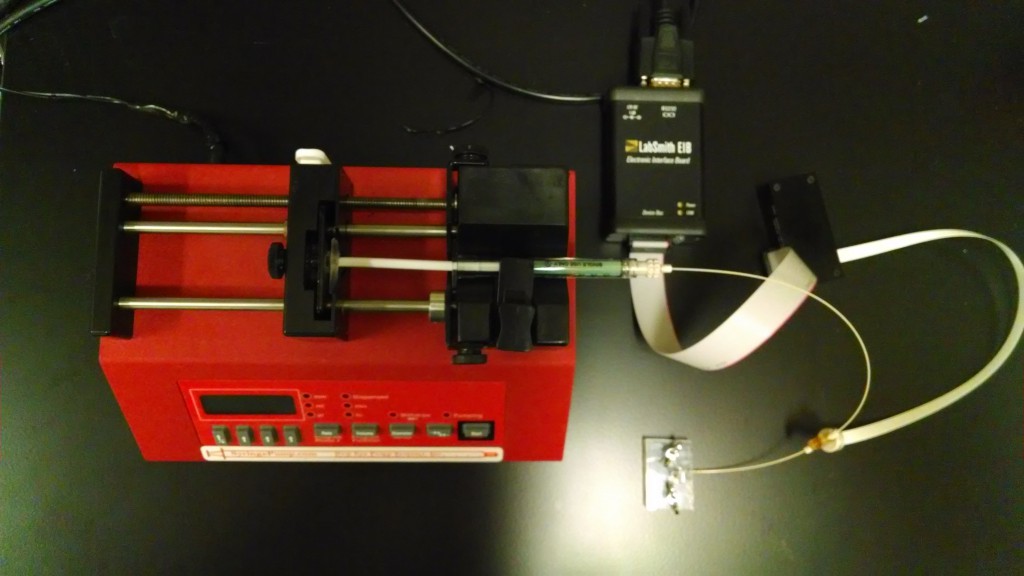
The red syringe pump was a pump we already owned and we use a disposable plastic syringe. The black box in the middle top part of the photo is the main interface between the equipment and the computer. The EIC is connected with a simple USB-RS232 adapter. The software is free, but only works on Windows from what I could find. The EIC connects to various instruments such as pressure sensor manifolds, valve manifolds, or syringe pumps via the gray ribbon cable seen in the photo or via a breadboard. The small black box that is hard to differentiate from the counter-top is the pressure sensor manifold. It is capable of receiving signals from up to 4 pressure sensors. We have one pressure sensor connected in this setup. It is the tan colored cylinder connected to a “T” fitting. (closeup below)
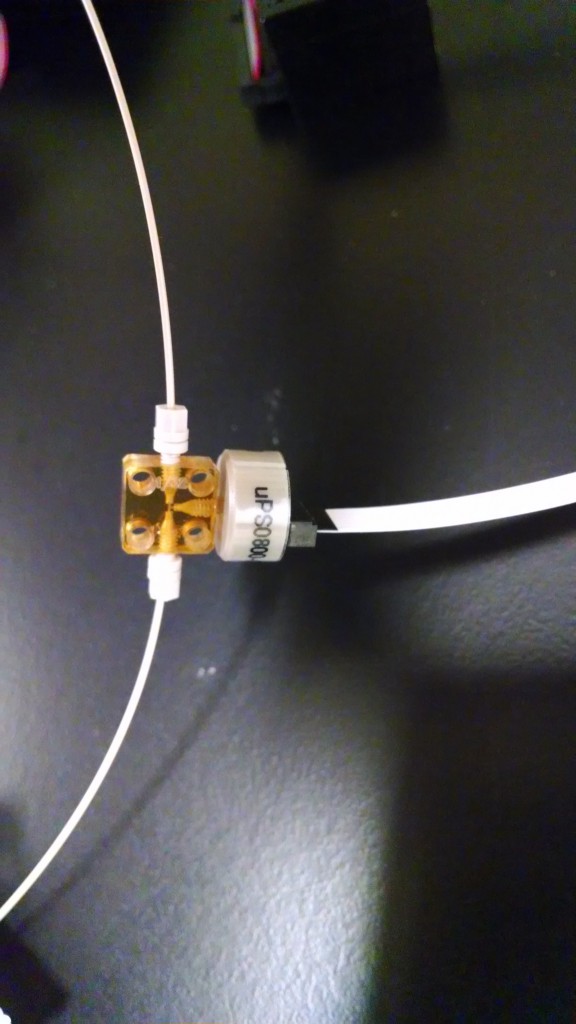
The pressure sensor is inserted into a “T” fitting that is placed inline between the syringe pump and the filter. I’m not sure how clear this is in the picture, but there is practically no volume of material “lost” to the pressure sensor.
So far I’ve just been doing some quick tests to get a feel for things. Below are a few plots of pressure vs time as the syringe pump is activated at different rates and directions.
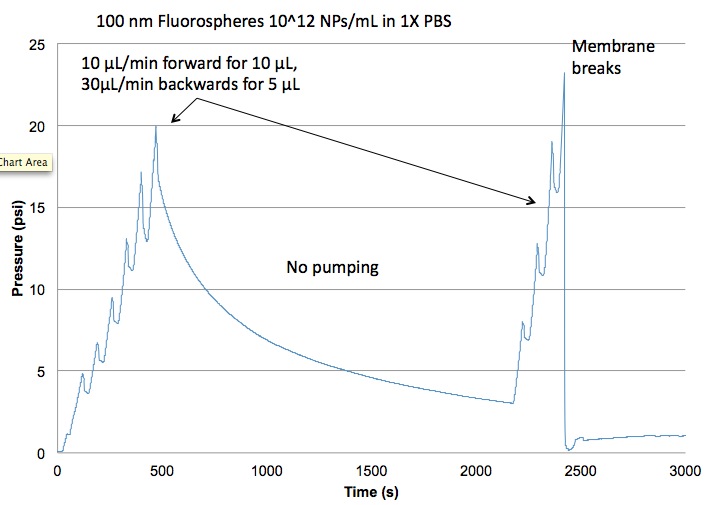
Next I tried to reduce the forward flow rate from 10 to 1 µL/min, while keeping everything else constant:
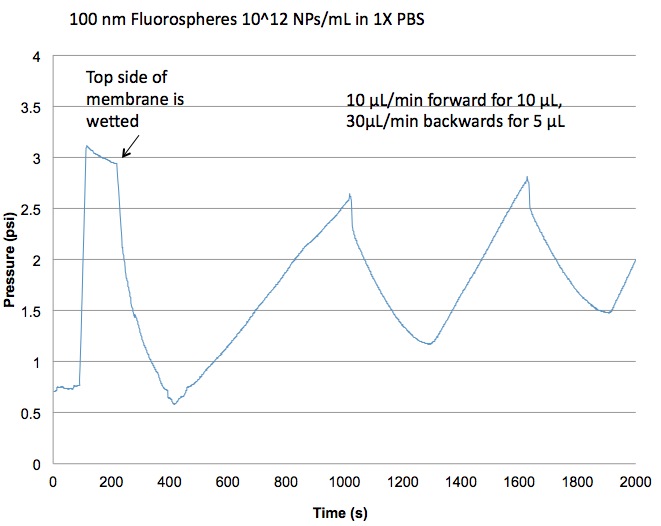
Unfortunately, the pressure seems to be building up rapidly in these scenarios. The back flush does not seem to be helping. The following image is the first 2000 s from the above plot. For this run, I flow solution until the membrane had been completed wetted on the backside and let the pressure build up to 3 psi. I then stopped the syringe pump and worked on wetting the top side. You can see the pressure drop quickly once I successfully wetted the top side. (There also seems to be some decay in pressure even before wetting the membrane, but at a slower rate. I suppose this could be a leak in the tubes or fittings, but no leaks were visible)
I can think of a lot of different tests to run from here. For example, fixing the syringe pump rate, but varying the concentration of particles. Keeping the solution fixed but varying the syringe rate. Fixing concentration and flow rate, but varying particle size. Adding IgG and/or BSA. You name it.
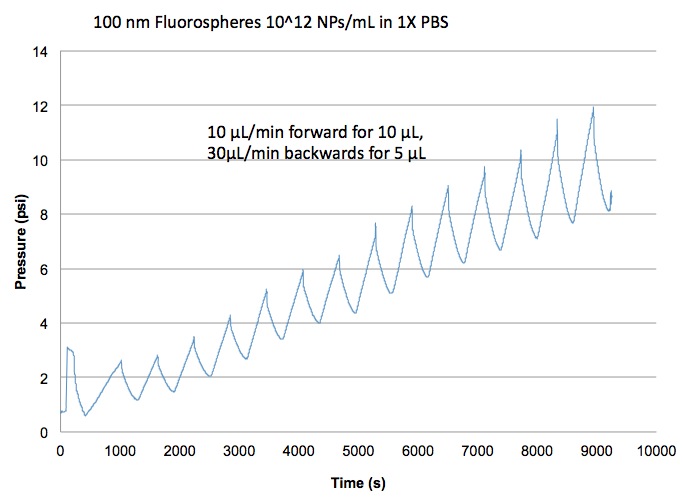
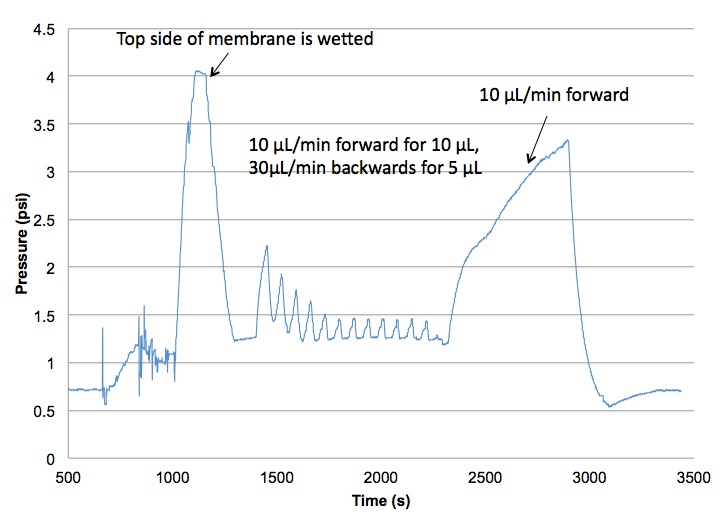
**Updated** Below are some tests with water only. We see pressure does not build up with the forward/backward cycling but was building up with only forward flow. The syringe was stopped at the end to watch the pressure drop.
Nice.
IS the opposite side of the membrane open to atmosphere? Is the pressure sensor referenced to atmosphere? If so, you are never actually reversing the flow, just lowering the pressure, which should keep the cake in place.
It is strange for pressure to build with a flow rate of 1 uL/min. This implies that your flow rate through the membrane is < 1uL/min, is this true?
You will probably find several counter-intuitive behaviors now that you can measure them. Hopefully it won't drive you totally insane….