Silica NP sizes
Hybrid silica studies the size of their particles by fluorescence correlation spectroscopy. I used our dynamic light scattering instrument to see what sizes it would get from these particles.
Their 45nm particles:

Avg center of peak = 46.2 nm
Avg width = 15.6
Their 22nm particles:
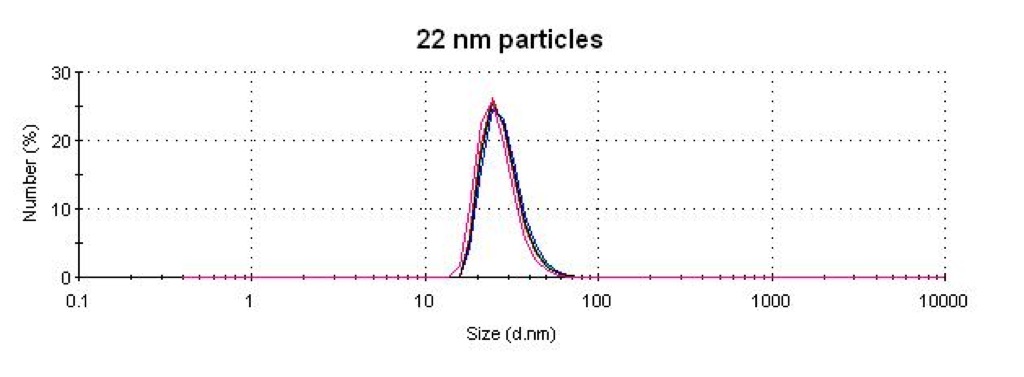
Avg peak center = 27.8nm
Avg width = 7.5nm
There was an issue measuring the 10nm particles. The machine would error with a message saying the data was unsuitable for measurement without an explaination why. I tried different concentrations but it still wouldn’t work. The count rates were good (even high in some cases), but there was little or no correlation over time. Tom mentioned the solution may be contaminated, and I observed just a couple bacteria in the sample with the scope. We thought that maybe his filtrate sample from his previously mentioned experiments would be a good sample since bacteria couldn’t possibly fit through the membrane. Unfortunately the machine errored again.
Here is a printout of the count rate and correlation of 1:10 dilution 10nm particles from membrane filtrate. Count rate is good, correlation very bad.
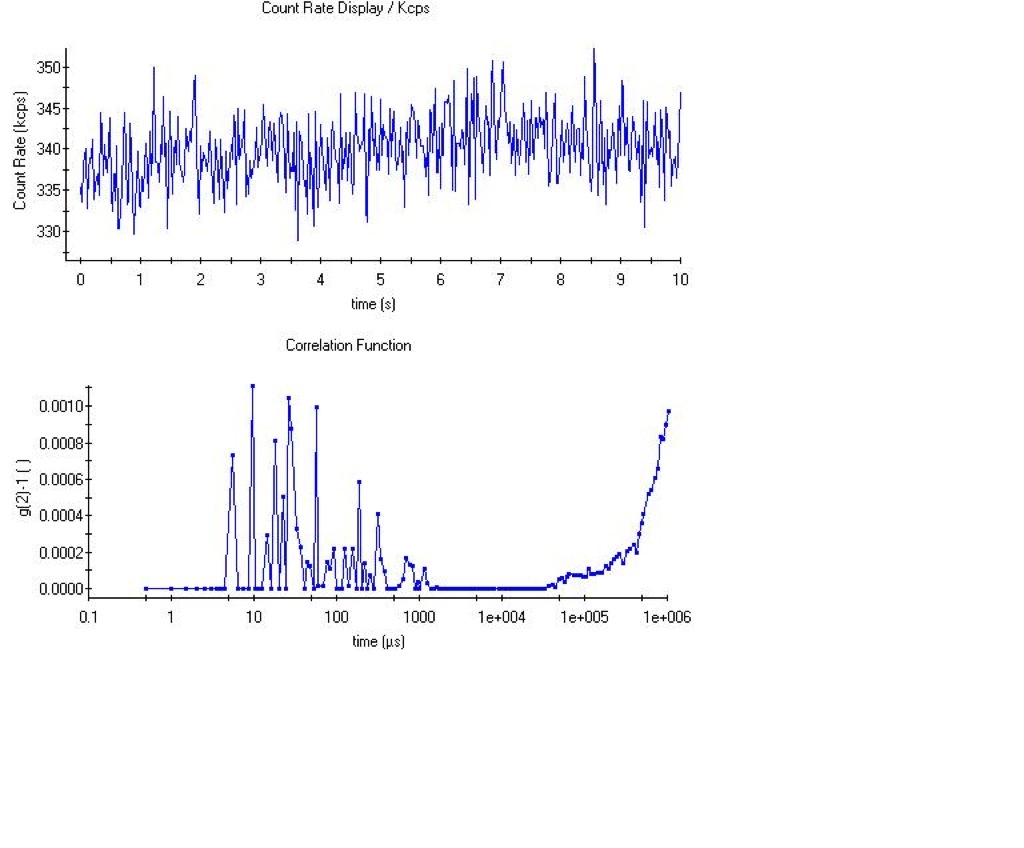
I then thought, well what if there aren’t enough particles or maybe they’re too small (<2 nm) for the Zetasizer to count. In previous cases of low concentration the count rate is very low (around 50 cps). I thought this held true for small particles too. The solution is a blue color, so maybe we just have free dye? I decided to run 1mM rhodamine to check what free dye would look like:

Again, ok count rate, bad correlation. Maybe the 10nm sample is just free dye? Anyone have any other ideas?
Mini update: 2nm gold has an extremely low count rate even at full concentration. It does though have a semblance of a correlation, which could potentially be attributed to a few larger contaminants (sizing is coming out around 100nm). That makes me surprised that rhodamine and potentially free dye in the 10nm sample has high count rates but no correlation. Call me confused.
I would run this past Mort as he has done a systematic study of count rate and accuracy vs size. We know the instrument becomes unreliable for < 10 nm but exactly how small we can measure probably varies from one material to the next. High counts and no correlation is consistent with something scattering but moving too fast for the system to follow. And yes, perhaps your measuring a low density contaminant in the 2 nm gold solution and getting effectively no contribution from the gold.
You could dilute (maybe 1000:1) the 10nm particles and throw them on a membrane and have Karen or Dave take a look under TEM. It will be easy to see silica particles if they are there.
Be careful comparing scattering from gold and silica, the silica should scatter much much less, although I have no idea how the instrument works. Silica has a refractive index of 1.46, while water is around 1.33. I’m not sure what the dye is doing, though. Gold is a metal, so the refractive index is very high, even for very small particles.