Flow Sensing and Energy Harvesting Capabilities of NPN Membrane
Principle of Operation
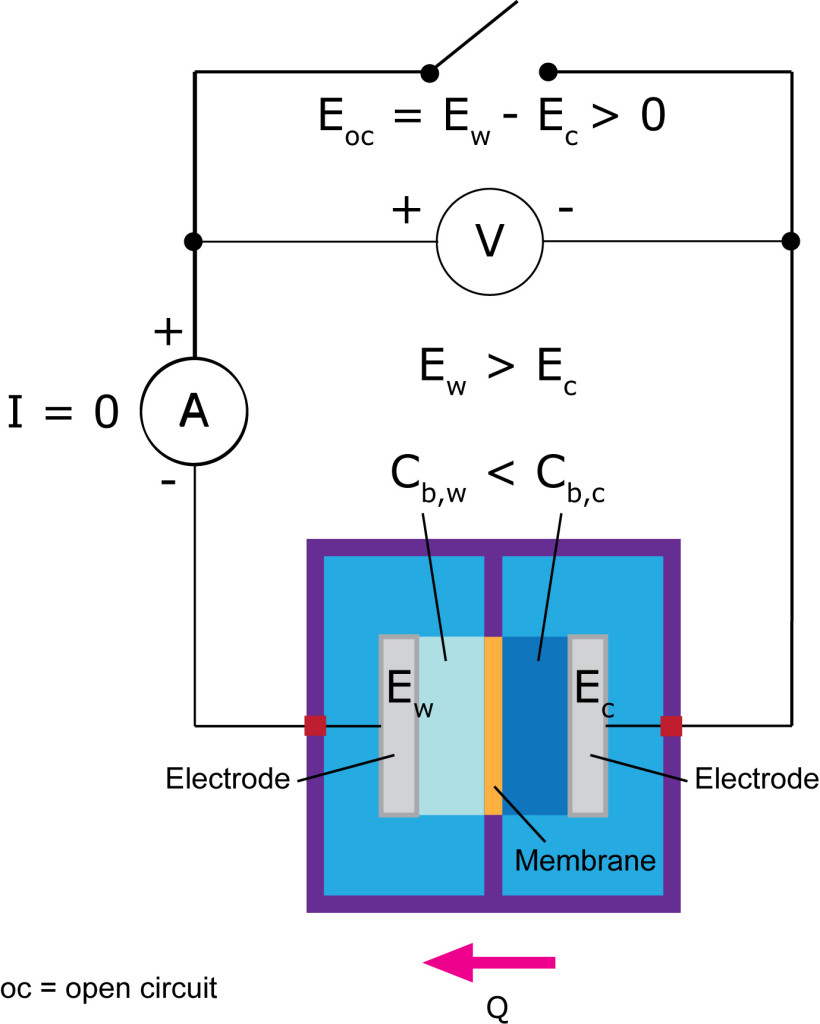
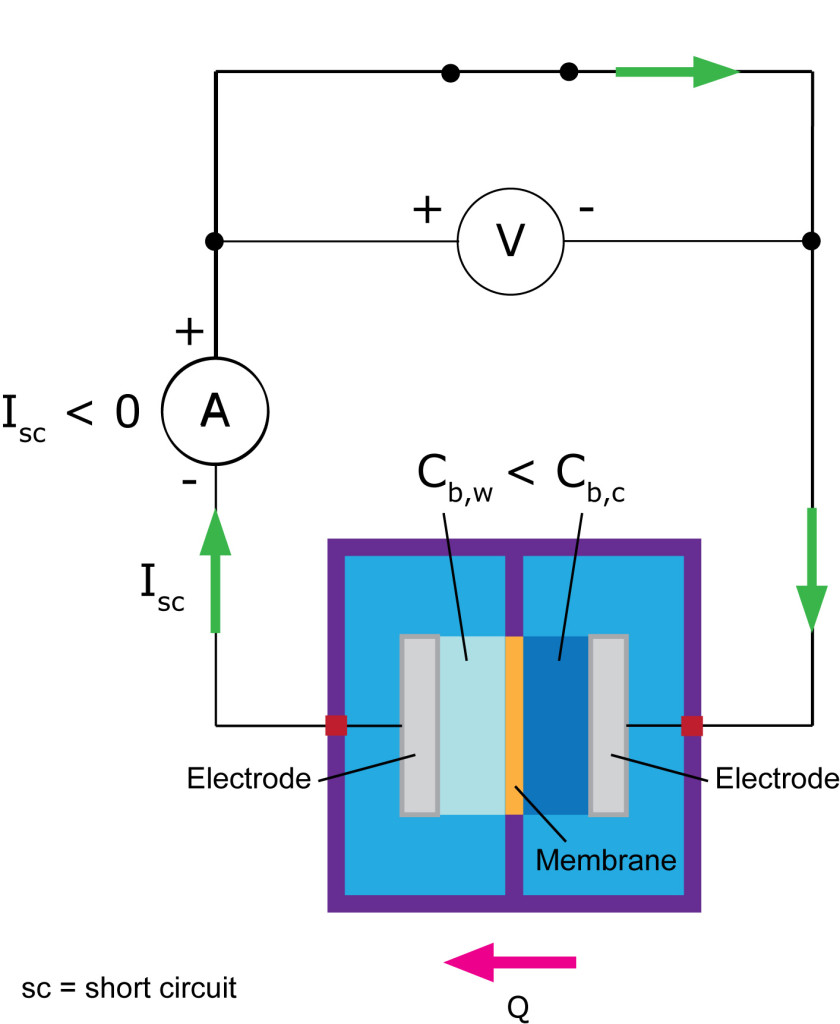
The electrokinetic properties of charged membrane make it possible for conversion between the electrical and mechanical regimes. The electroosmosis is an example of converting from the electrical to mechanical powers. In reverse, exchanging the mechanical energy for electrical energy relies on two electrokinetic phenomena – the streaming potential and current. Consider an electrolytic cell with electrode-membrane-electrode configuration where the electrodes are connected to a voltmeter and ammeter as shown in Figure 1.
 |
 |
| (a) | (b) |
| Figure 1 Principle of operation for converting from mechanical to electrical energies relies on the electrokinetic phenomena that the flow of solution across a charged membrane results in a change in an open-circuit potential and short-circuit current. (a) An open-circuit configuration where the switch is open preventing the flow of current across the cell. The potential read out by a voltmeter gives the open-circuit potential, which is a function of flow rate. (b) A short-circuit configuration where the switch is close allowing the current to flow across the cell. The current read out by an ammeter gives the short-circuit current, which is also a function of flow rate. | |
Due to the electrokinetic properties of the charged membrane, a change in flow rate across the membrane causes a change in the potential drop across the electrodes and a change in the current flow between electrodes. This change in potential and current can be examined by using the configurations shown in Figure 1(a) and Figure 1(b), respectively. It is worth noting that subtracting the open-circuit potential and short-circuit current with their baseline values, measured at stagnation or under no pressure-driven flow condition, yields the streaming potential and current.
Transient Responses of Eoc and Isc to Pressure-Driven Flows
The proof of principle is evident from the transient responses of the open-circuit potential Eoc and short-circuit current Isc to a variation in the pressure-driven flows. Figure 2 shows the staircase patterns of the applied pressure steps used for this demonstration.
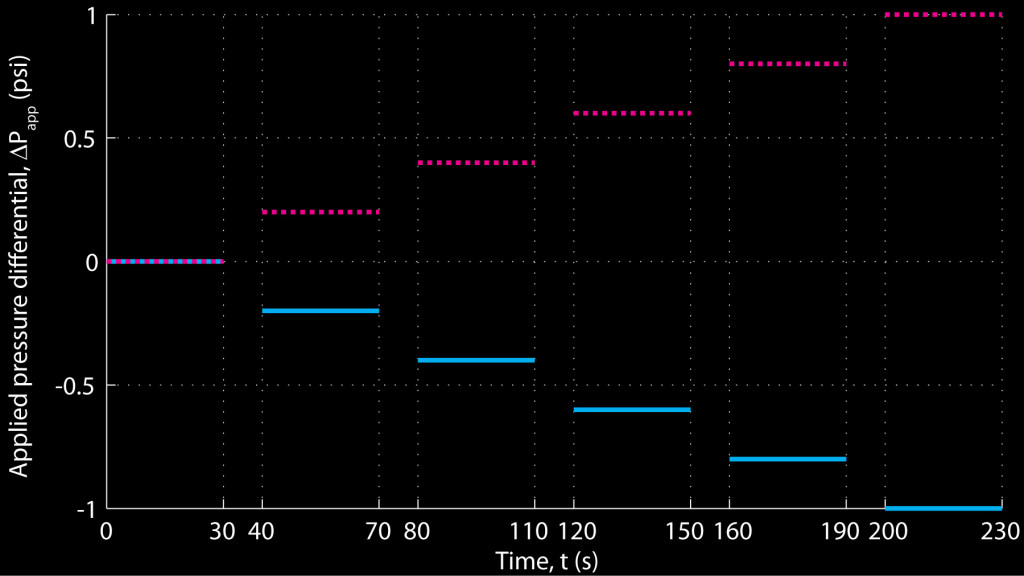
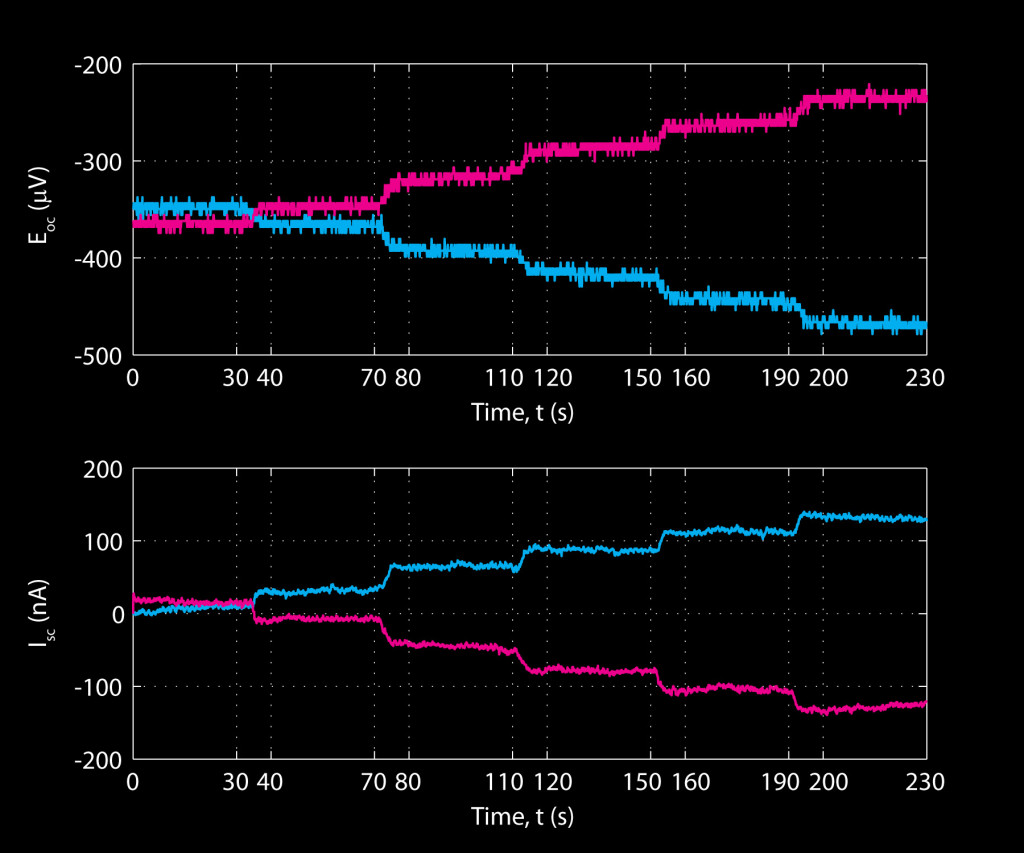
Figure 3 shows the transient responses of the open-circuit potential and short-circuit current across an NPN membrane in 100 mM NaCl (aq), unbuffered solution. Both open-circuit potential and short-circuit current exhibit the dynamic behaviors similar to that of the applied pressure steps. Notice the direction of the short-circuit current; it corresponds to the polarity of ammeter shown in Figure 1.
It is worth noting that the surface of Si3N4 might be oxidized during oxygen plasma treatment used for bonding the silicone gasket onto NPN chip.
Flow Sensing Capability
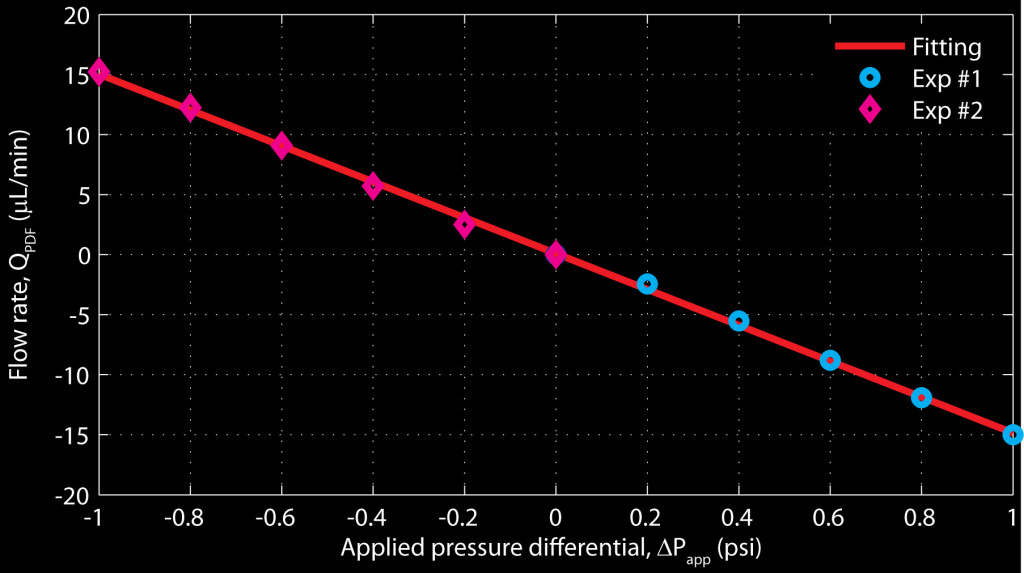
Correlating either the streaming potential or current with flow rate reveals an intriguing capability of the membrane. Based on the measured flow rate of the pressure-driven flow shown in Figure 4, the steaming potential and current vary linearly with the flow rates as characterized by Figure 5.
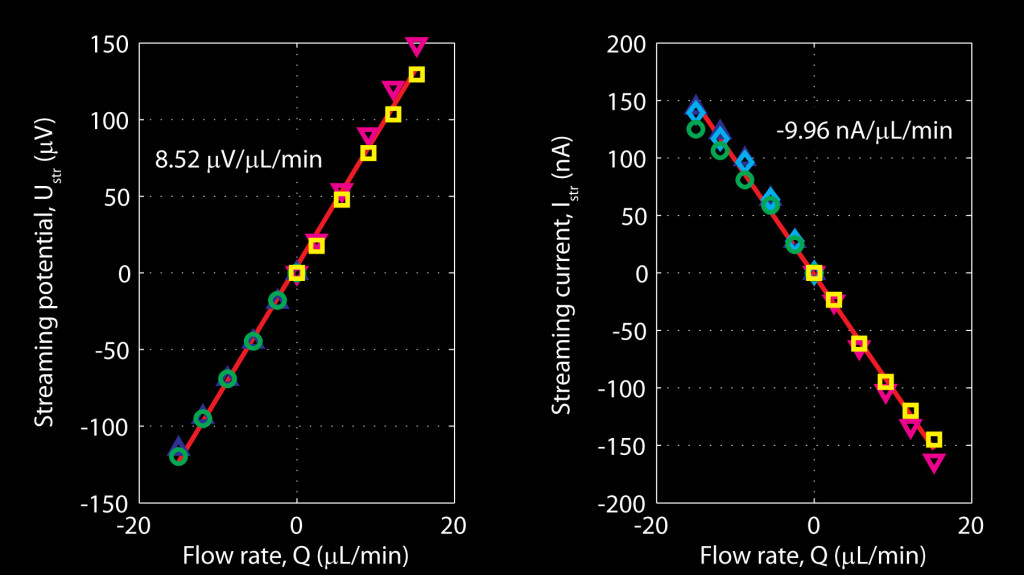
The fluctuation in either the streaming potential or current with the change in flow rate in a predictable fashion, as in Figure 5, indicates the flow sensing capability of the membrane. Therefore, by measuring the streaming potential or current, the rate of flow of solution across the membrane can be estimated instantaneously.
Energy Harvesting Capability
The presence of short-circuit current hints on a constant change in charge over time while the flow exists. Substantiated by Figure 6, the charge is accumulated over time at the rate corresponding with the rate of flow of solution across the membrane. The higher the flow rate, the faster the charge accumulation as indicated by the steeper slope of the characteristic curve.
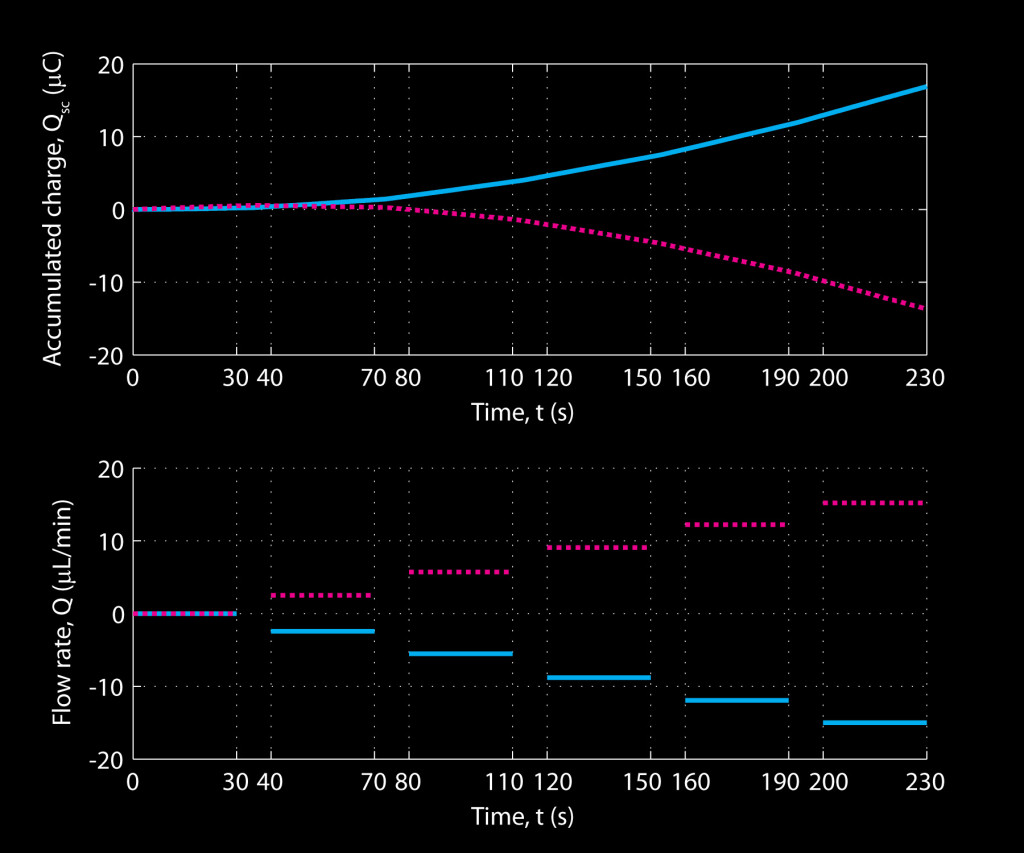
The charge accumulation over time while the flow exists indicates the energy harvesting capability of the membrane. With the use of a capacitor, the accumulated charge can be stored and used upon demand.
Efficiency
The efficiency of energy conversion becomes a metric for evaluating and comparing among various systems. For the system utilizing a charged membrane, the efficiency of converting from mechanical to electrical powers can be computed from the measured streaming potential, streaming current, flow rate, and pressure differential being applied. The mechanical input power is governed by the applied pressure differential and corresponding flow rate, while the electrical output power is dictated by the streaming potential and current. Figure 7 shows the characteristic curve of the system utilizing an NPN membrane in 100 mM NaCl (aq), unbuffered solution; the efficiency can be determined from its slope.
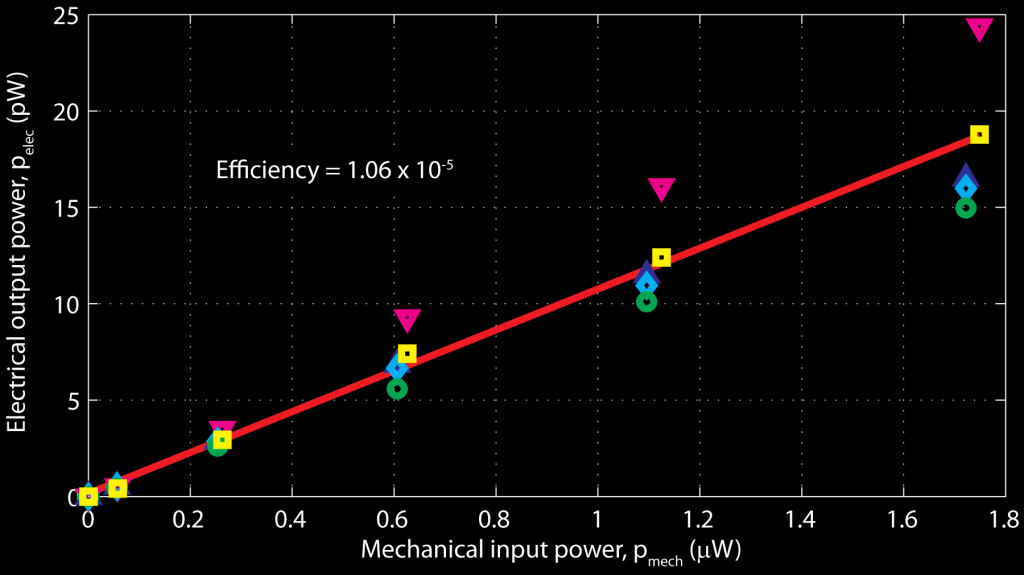
It is found that the efficiency is very low, reflecting a challenge to overcome for its viable flow sensing and energy harvesting applications. Functionalization of the membrane might be one of the possible solutions. Increasing the surface charge will help amplify both streaming potential and current. In addition, making the membrane pores hydrophobic so that slip length is no longer negligible, will enhances the zeta potential ζ and accordingly the streaming potential, current, and ultimately its efficiency.
Method
The test set up is shown in Figure 8. In place of the voltmeter and ammeter depicted in Figure 1, the VersaSTAT 4 potentiostat/galvanostat was used for measuring the open-circuit potentials and short-circuit currents. The two-electrode test cell composed of a pair of Ag/AgCl electrodes flanking an NPN membrane in 100 mM NaCl (aq), unbuffered solution. The pressure was supplied to the test cell by an air-pressure regulator to drive the flow of solution across the membrane.
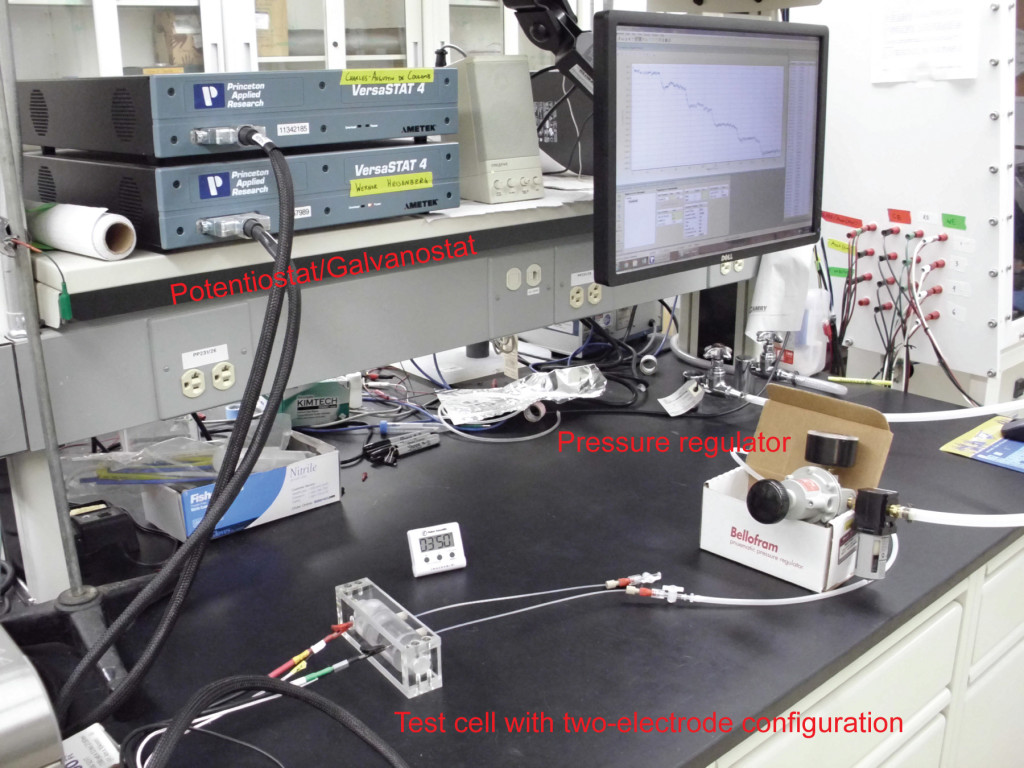
It is worth noting that to measure the short-circuit current, the VersaSTAT 4 was set to operate in Potentiostatic mode with the applied voltage set to zero with respect to the open-circuit potential. This configuration had proven to provide better measurements with higher signal-to-noise ratio than the conventional zero-resistance ammeter (ZRA) mode of operation when using a two-electrode cell. In addition, the flow rate was measured by tracing the traveling menisci.