New Track Etched Separation Data and Model
I’ve been working hard on my model paper for a few months now. My first attempt at doing separations with Track Etched (TE) membranes, which are all 6um thick and come in pore sizes of either 30 nm or 50 nm, resulted in data that was all over the place:
Note that the gold concentrations are significantly lower than we expect for the smallest gold, and also that sometimes larger gold goes through the membranes better than smaller gold. These experiments were done in a modified version of my zetapotential measurement device:
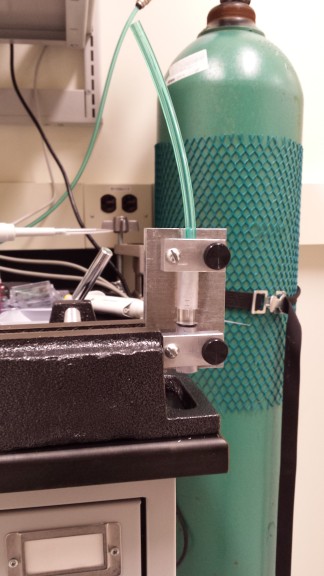
At first I thought maybe the gold was sticking to the sides of the tube, since gold is loaded from the green tube at the top and must travel down to the membrane before the separation could happen. But I ran a quick control where I measured the concentration of the gold before loading and then once it got through to the membrane and found no difference in concentration, suggesting that the gold wasn’t sticking to the tube, and if it was sticking anywhere it was probably to the membrane during the separation.
Next, I changed two things. I went back to the TE-sepcon hybrid setup I used in Josh’s clogging paper:
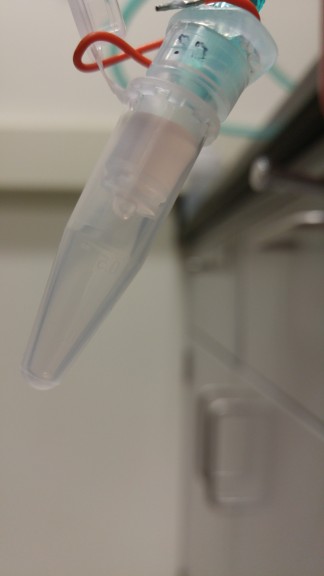
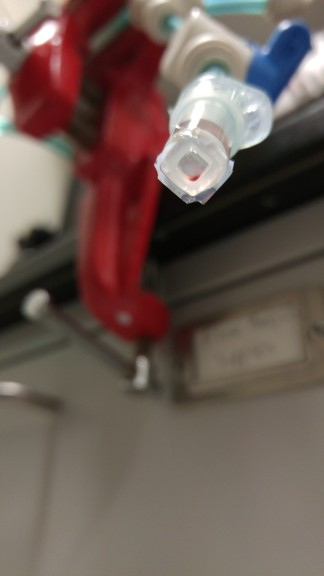
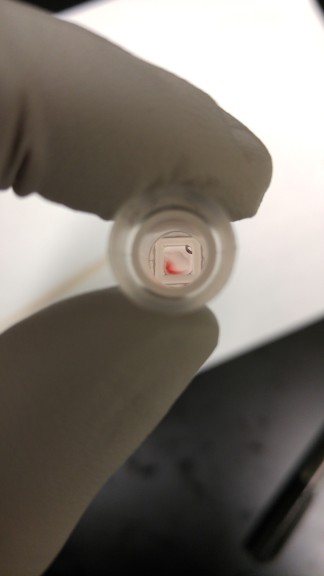
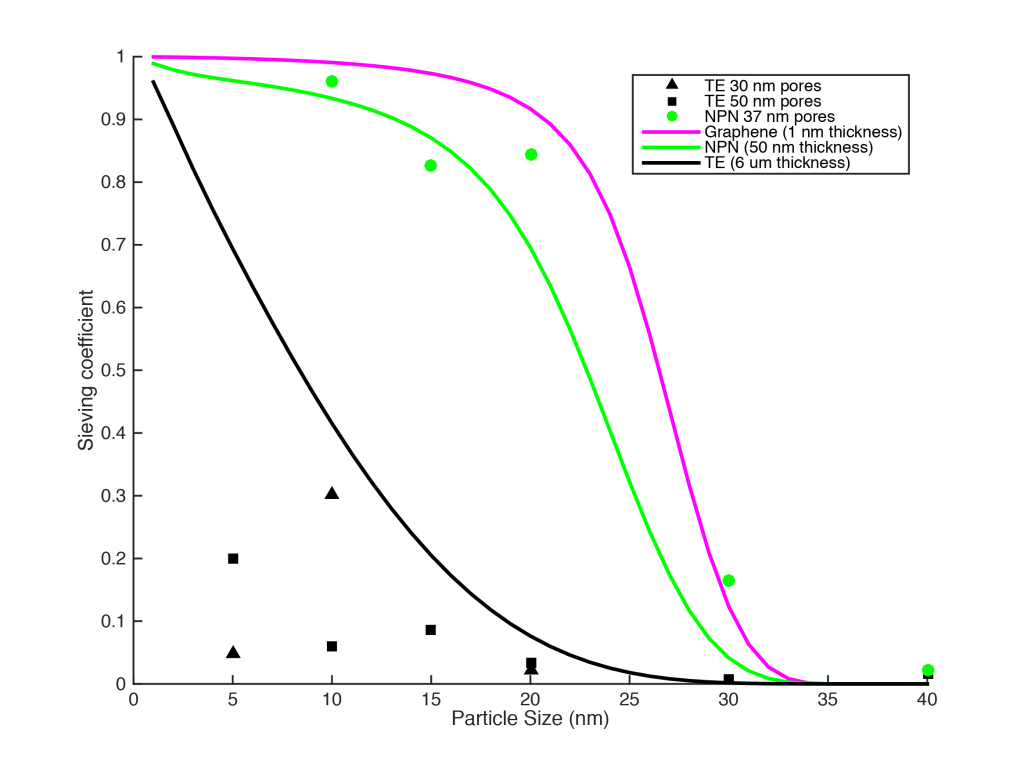
and I increased the starting concentration of gold from a 4:1 dilution of the stock (which is purchased from BBI) to just using straight stock. When I did that, I got the following results:
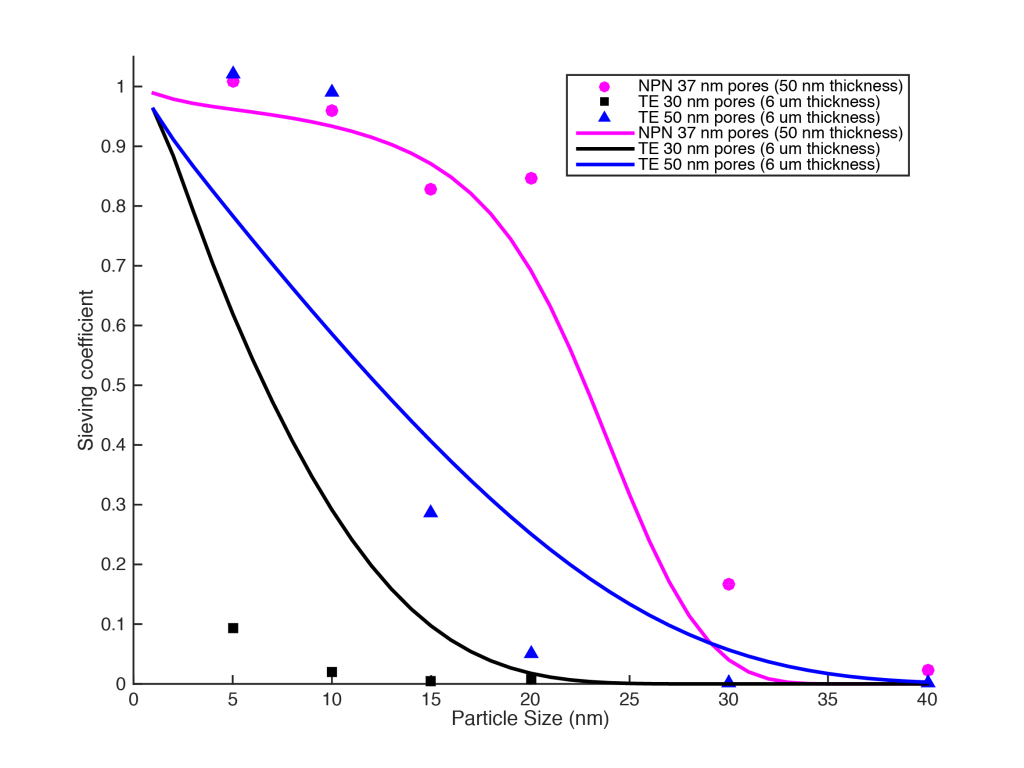
A couple of notes. The model may need to be tweaked – I didn’t change the number of pores from one simulation to the next, for instance, and that may have affected things. 10 nm gold may not be strictly 10 nm – I haven’t DLSed it for a while, but I seem to recall reading that Jess or Tom did and found that it was actually a distribution centered around 7 nm, which would make the data fit the model quite a bit better. Also, note that it takes about 50 minutes to pass 100 uL of fluid through a 50 TE membrane at 1.3 PSI, and 4.5 hours to pass 100 uL through a 30 TE membrane. There’s still a lot of work to be done, but now at least we have an experimental setup that is working for the TE separations.