Monolith X-sections
As the title states, these are images from the monolithically fabricated devices used by Kyle and Vincent in Ottawa. These devices were fractured with tweezers, then tilted and metallized with 5 nm of Pt, mounted on carbon tape.
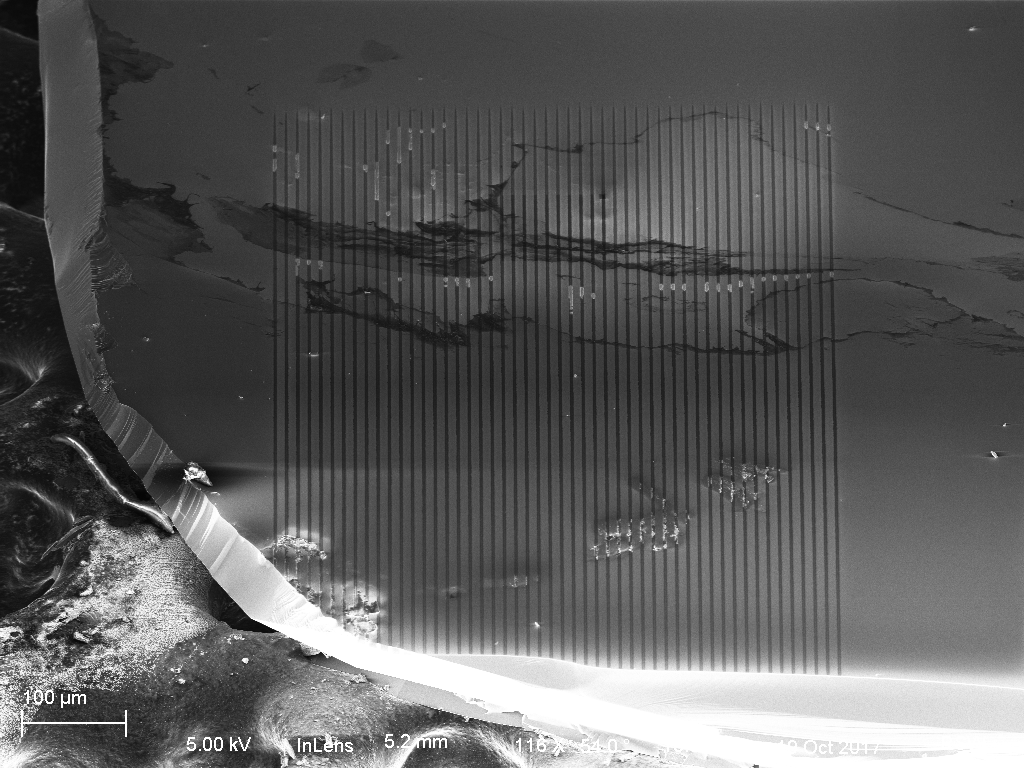
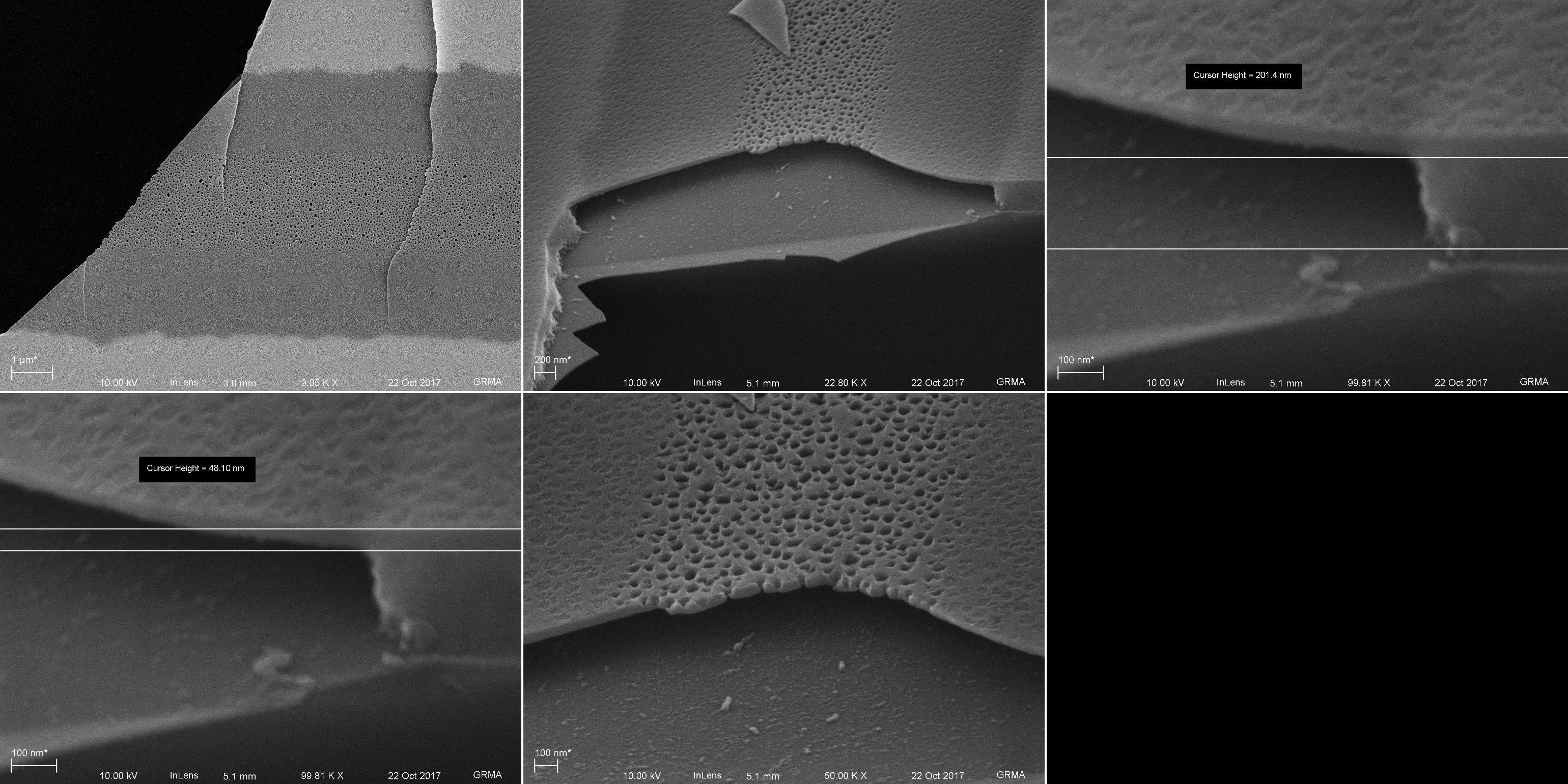

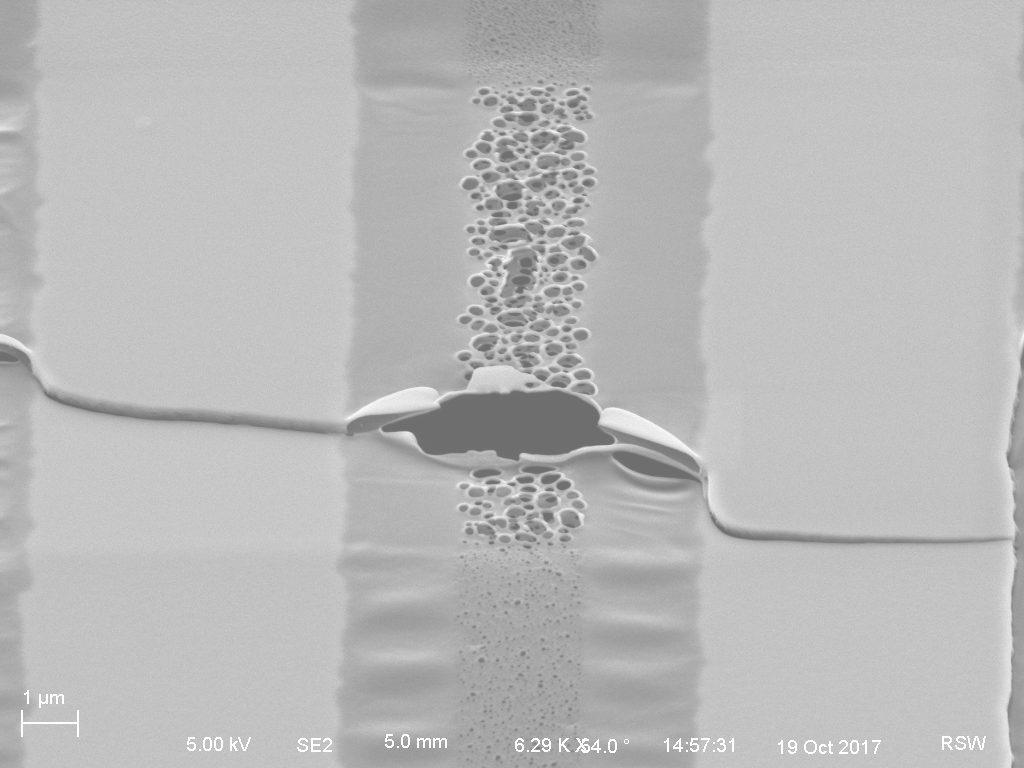
As the title states, these are images from the monolithically fabricated devices used by Kyle and Vincent in Ottawa. These devices were fractured with tweezers, then tilted and metallized with 5 nm of Pt, mounted on carbon tape.
Two of the newer wafers, SC 073 and SC 074, came back with ~30 intact samples. This would be more than enough for the separation work that I’m trying to finish, so I decided to see if they were any good. SC 073 had an area in quadrant I that was caught in the middle…
What is it? A device to remove bubbles from microfluidic lines. Air and liquid enter on one side and only the liquid leaves. Our debubbler is disposable, cheap (<$0.50) and easy to make in the lab. Why use a debubbler? Bubbles can have a severe negative effect on cells cultured in a microfluidic chamber. The…
Josh Miller came up with the idea of filling individual damaged membrane channels with PDMS so the rest of the chip could be salvaged. We worked on it this week, mostly Josh, and we developed a process using strips of silicone laid on the top (flat) side of the damaged channel and PDMS injected onto…
There is some non-uniformity in air permeability based on the position but it is not very clear for wafers 318 and 319. The full wafer measurement in future will make this dependence more obvious.Permeability of w319 is much higher then of w318 (RTP 1000C and 900C) as expected from TEM images where w319 has higher…
We were targeting a TEOS layer of 300 nm for the SiO2 membrane. The wafers were patterned with ø3 µm pores using S1813 resist (~1.5 µm thick). The target etch time in the Drytek RIE is 4 min 10 s using SF6 and Ar. We will need a thicker resist coating to prevent the RIE…
We performed four hours of sham dialysis, using two non-porous nitride membranes. The set-up is described in an earlier post. Blood samples were taken when the animal was received, after one week of the adenine containing diet, then at 1 hour intervals during the dialysis. The data shows that the urea level, which was increased over…
Comments are closed.
Thanks for getting these Greg. A few comments: The first montage, you point out the large under etch…this was a known condition that was expected. Its due to the XeF2 gas, which is very isotropic. As for the debris, this is also a known condition, also due to the XeF2, I believe this is due to contaminates in the poly-Si as deposited (at RIT) and because the selectivity of XeF2 is absurdly high, it does not etch at all. I do not think these ‘crumbs’ would interfere with pore formation since they are not continuous, and since the pores are actually enlarging, they probably are being dissolved in the KCl solution (and therefore not plugging the pore).