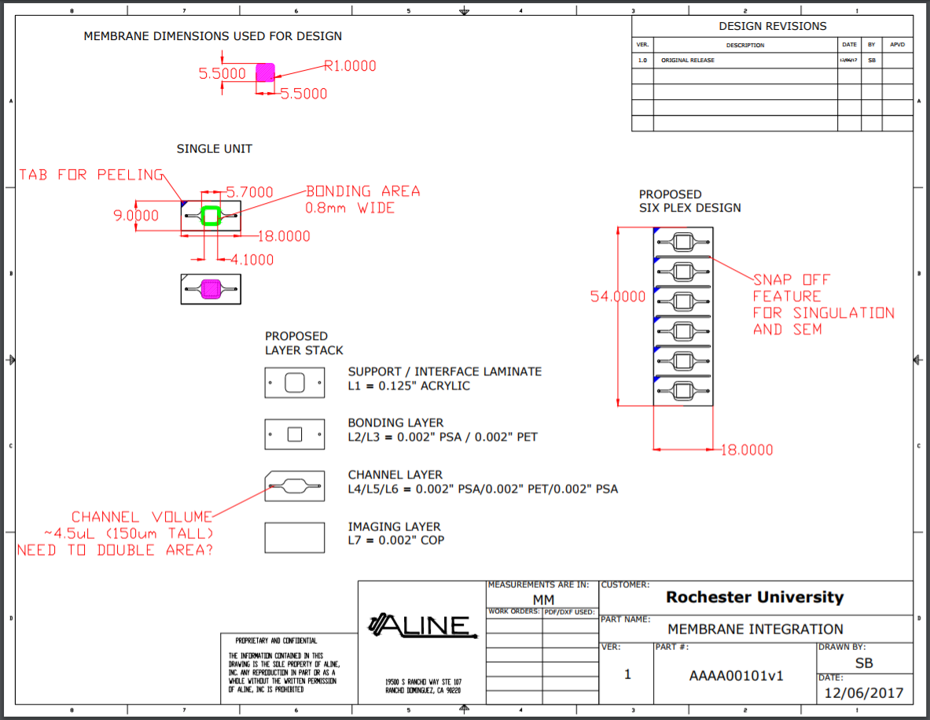
Over the past year, our lab has been working in close collaboration with the Schwarz lab to design, develop, and manufacture microfluidic transwells for their P50 project. The project was initiated after the discovery of S. aureus migration through sub-micron canaliculi in vivo. To further explore the genes involved in this newly proposed mechanism of immune system evasion, the Schwarz group collaborated with our lab to hand build transwell devices that would allow them to mimic the confined geometries of the canaliculi. After the initial experiments involving strictly wt staph, candidate mutants were developed and are now in the process of being tested. In order to facilitate faster biological experiments, we contracted out Aline Inc, a microfluidic company based out of southern California, to build these transwell devices in large batches.
Design Stages
Figure 1. First formal Aline design. Bonding area was suited for three slot 0.5 um SiO2 format chips. The six-plex design was implemented to facilitate multiplexed experiments in an easy to handle format.Figure 2. Membrane failure during production highlighted a potential problem with the high number multiplexed design: if one membrane fails, the whole ‘device’ is not suitable for delivery. It was also harder to handle the six-plex devices then expected at this stage. For these reasons the design was changed to fit a three-plex need.Figure 3. High fluid resistance through the bottom channel, coupled with tiny access ports, made it near impossible to load the bottom channel of these devices. The bottom channel and access ports were both increased in size to adjust for these issues.
Figure 4. The discovery of potential leaks in the system lead to the shrinking of the sealing layer. This final design was easier to load through the bottom channel and was leak tested to confirm nice bonding.Figure 5. Leak testing confirmed firm bonding of the sealing layer to the Si chip.
Membrane Design
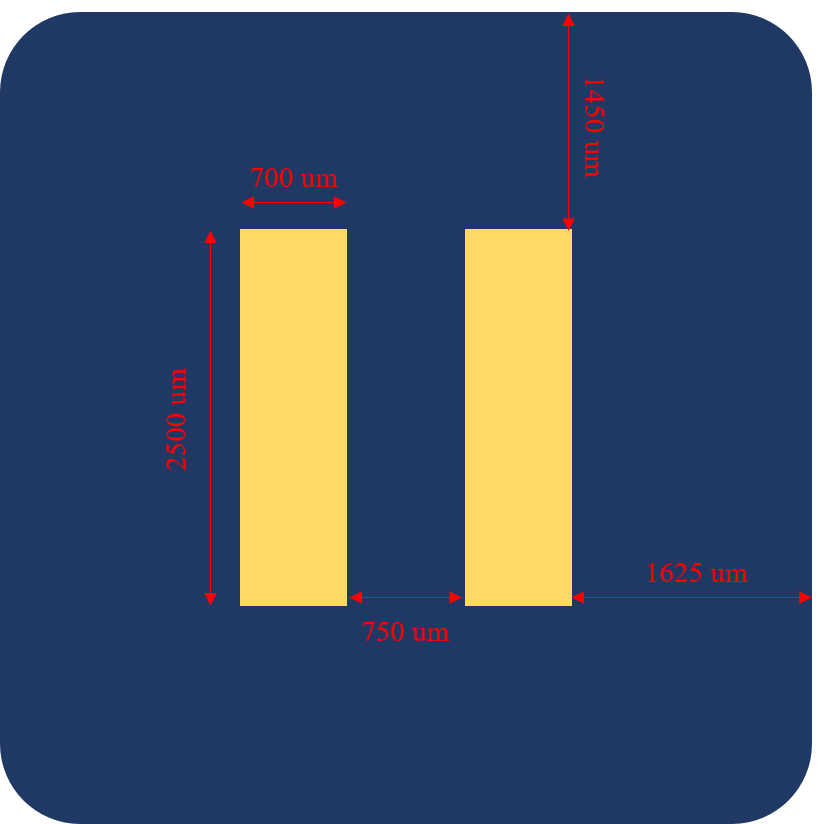
Due to concerns over the available three slot bonding area, two slot chips were designed. This design maintains high membrane area, while increasing bonding area.
Figure 6. 2-slot membrane format.Figure 7. Since completion of the design, we have been able to integrate a variety of membrane formats. The yields from these builds will help guide our future production runs.
Previous posts: Theory Deposition Etching Imaging I have tinkered with the etch recipe some more, adding Argon to help prevent polymer formation (adding 5% O2 was not enough). The current recipe is 200 mTorr (100 mTorr Ar, 5 mTorr O2, 95 mTorr CHF3) at 120-125 W (6-12 W reflected). The plasma color is initially rosy (Argon), settling into a…
I measured the I-V characteristics of our coated membranes on Wed. at RIT. JP observed the measurement. The semicon parameter analyzer in the test lab is “old” but isexactly what we need! Roughly speaking, our coated membraneshave resistance about 2k Ohm, depending on the thicknesses ofmetal films (this is based on pure Ti coated samples,…
Sugiura 2010 (Anal. Chem) This paper details a PDMS microfluidic system to perform dose response assays (what I’m hoping to achieve over this summer). They use serial dilutions to get separate trials spanning six orders of magnitude, showing an optimal dosage to kill HeLa cells. Their system is very efficient, using very shallow channels and balancing the…
The following plot is an attempt to summarize recent work measuring rate of flow through a membrane as a function of concentration. We investigated 100 nm NPs, (totally blocked), 20 nm NPs (partially blocked) and IgG (mostly passed). In all cases, the buffer used was 1xPBS and 0.1% Tween 20. This plot mostly shows the total…
Quick review of “Achieving more frequent and longer dialysis for the majority: wearable dialysis and implantable artificial kidney devices” by Fissell, Roy, and Davenport see Fissell(Roy)_2013_International_Kidney.pdf in the hemodialysis section of the library. First a little background: Two type of wearable devices: Peritoneal Dialysis (PD) and Hemodialysis (HD) In PD, dialysate is pumped into and…
The purpose of this device is to make uniform and straight scratch wounds in a 96 and 24 well plate for migration experiments. Previously, scratch wounds were made by hand using a p-10 pipette tip by scraping the tip in a straight line along the bottom of the well. Not only is manually scratching the…