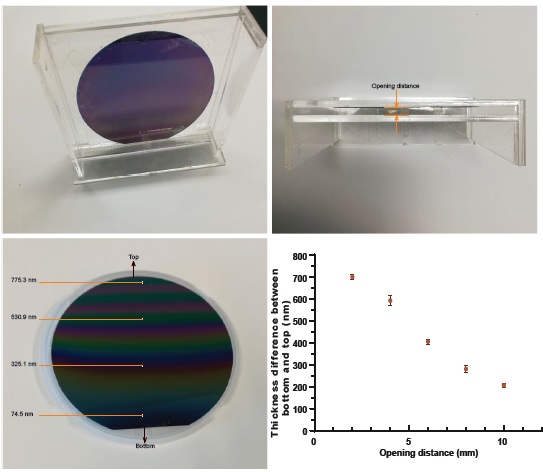
Highly porous Parylene membranes with precise control over pore size using a single mask
Parylene-C is a biocompatible, inert, FDA-approved and nondegradable material, which can be used to fabricate mechanically robust thin membranes. Parylene is used in the medical device industry for coating implantable devices and in the microelectronics industry as insulator. Furthermore, it has been used in biomedical research for a wide variety of applications. In addition, parylene-C is relatively stiff (Young’s Modulus:3.2 GPa) and can be easily removed from or attached to a surface without tearing.
Here is a schematic of the process chart, which I am trying to optimize continuously (now at 27 steps):
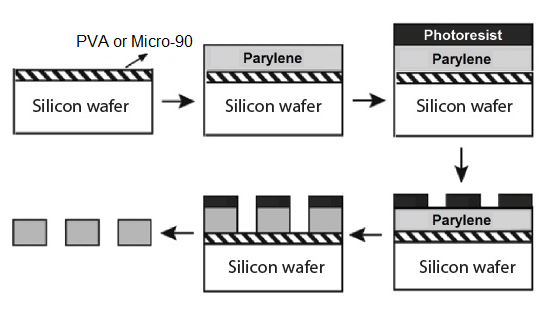
So far, I have been able to lift-off microporous membranes down to 300 nm and up to 1500 nm with minimum difficulty.
As for pore sizes, using a single mask for membrane fabrication for 1 um pore size, I have been able to precisely control pore sizes by 0.1 um steps, obtaining pore sizes down to 0.8 um and up to 1.7 um with successful lift-off, something that is pretty much impossible with other materials.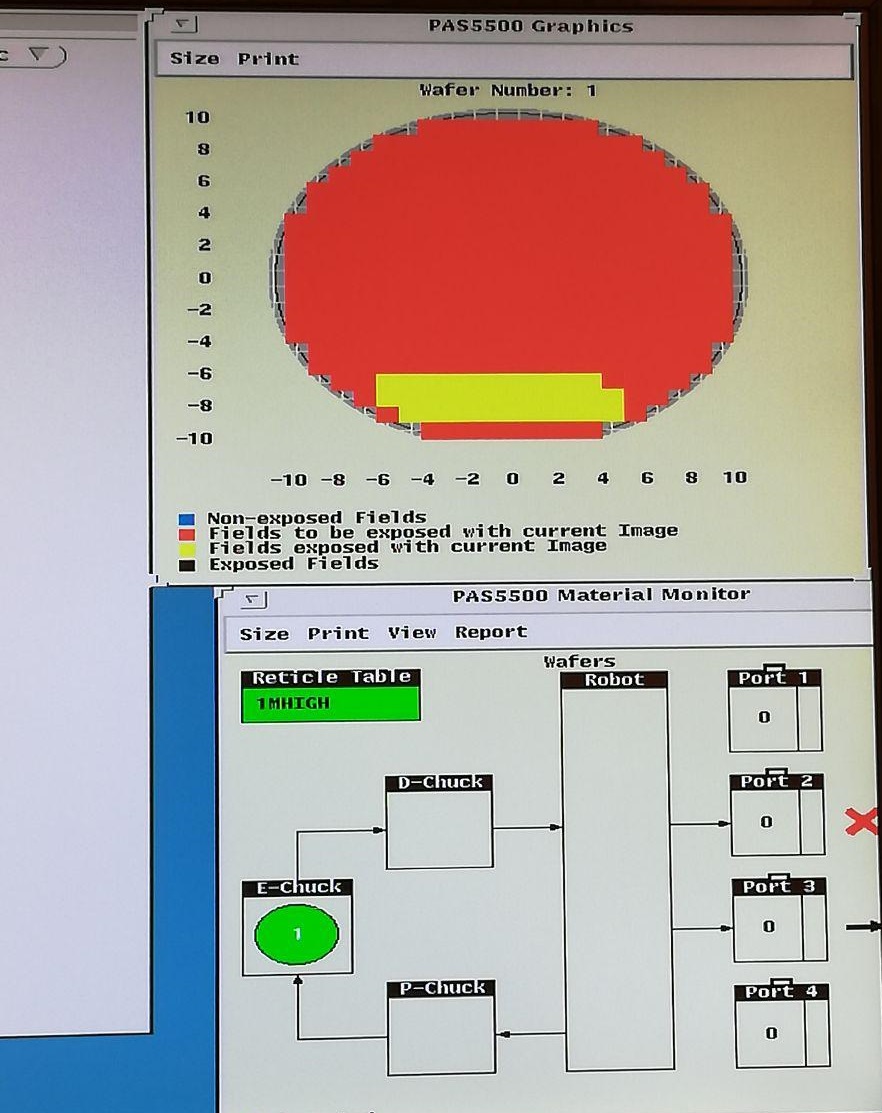
You can play with exposure energy and using different energies (combined with selecting an appropriate PR thickness), you can tune the pore size effectively. The associated software with the ASML stepper allows you to design how much energy you want to have in each die. For instance, you can have one row or column with the same exposure energy, while changing the energy from column to column or row to row, allowing a variety of pore sizes in a single 6-inch wafer. Additionally, it can be combined with a simple parylene thickness gradient setup to have a variety of pore sizes on different stiffnesses, on the same wafer, using a single process pass.