Carbonization is temperature dependent
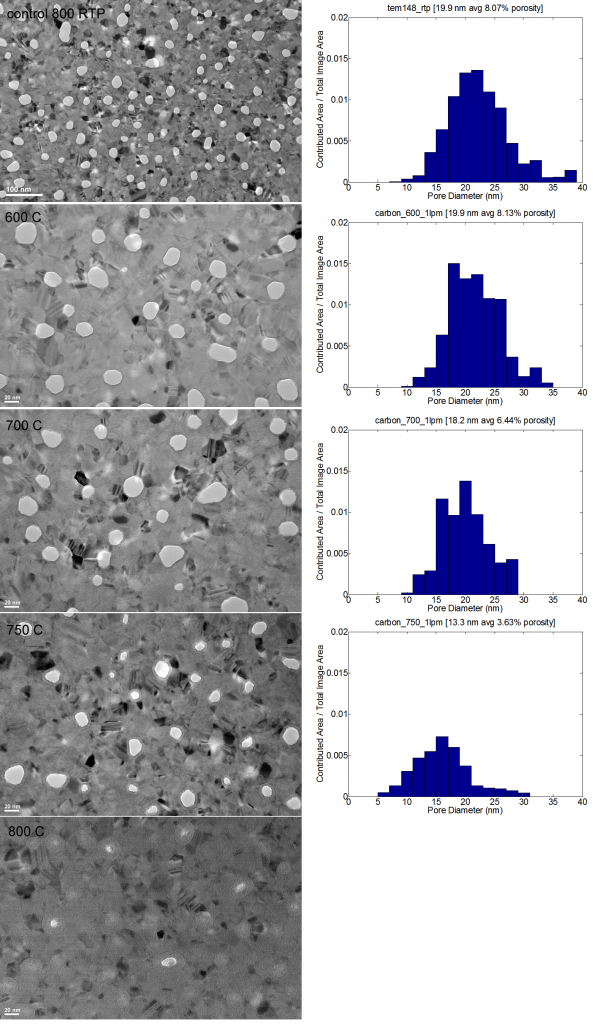
Last week I ran a series of membranes through the carbonization process at four different temperatures (600, 700, 750 and 800 C) at a fixed acetylene concentration (1 LPM). As expected, the growth of the carbon ring around our pores is temperature dependent. Note: image processing was done on 100 kx micrographs with the exception of the 700 C sample which was processed using a 200 kx micrograph. This may have affected the accuracy of the histogram (abrupt end to the high-end tail) due to the reduced field size.
A plot showing porosity and average diameter dependence on temperature:
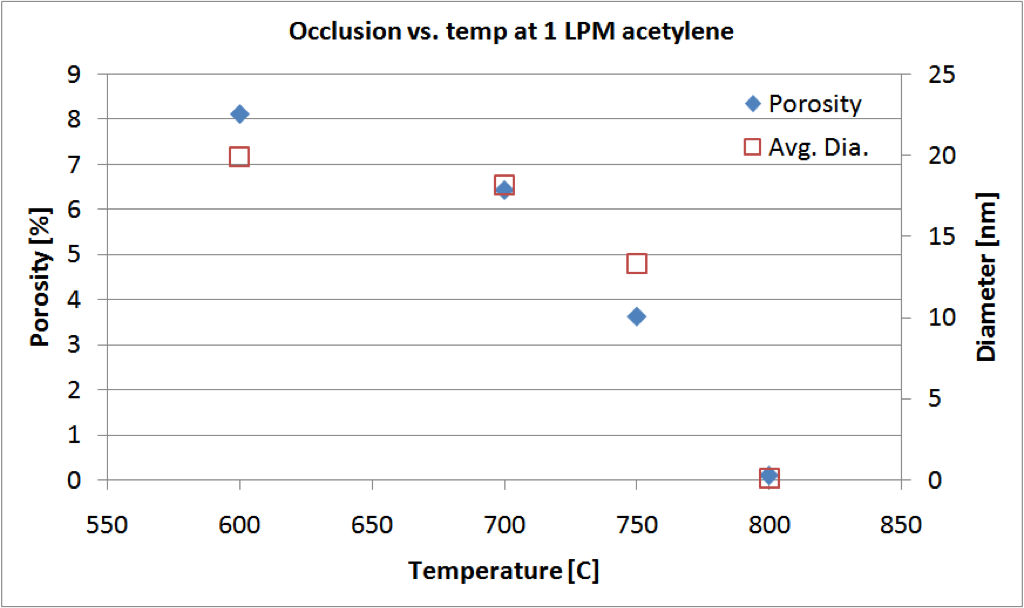
There seems to be an exponential drop-off between 750 C and 800 C which begs the question of whether or not we can further reduce pore sizes in this temperature regime. There is also the possibility of adjusting C2H2 concentration in this “sweet spot”. My guess is that pore occlusion is less dependent on concentration since there was little difference between 1 LPM and 2 LPM at 800 C (see below), but it’s worth a try at the lower temp.
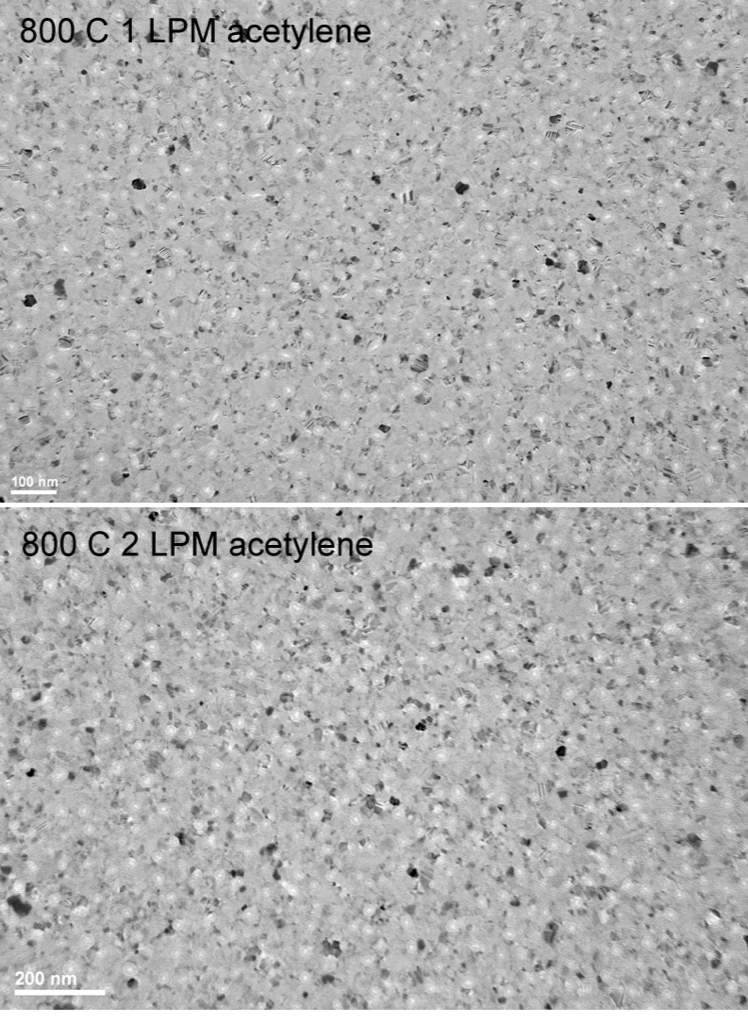
I think the logical approach is to use soak time as the variable that controls thickness, and use the temperature and concentration to change the film properties (density, roughness, hydrophilicity, etc.).
This data is very interesting and I think the 700C and 750C treatments look most promising. I’m not in love with this particular wafer, as I think some of the non-circular pores are messing with the histograms. The long tail at large pore size for the 750C sample is not obvious from the image – do you think it is real?
Ideally, I would suggest that remaining optimizations be conducted on a freshly stripped wafer with round pores. We can run a TEM wafer through with whatever film you want, and there would be 100’s of samples available. I think you could break out sets of 10 if they would be more manageable in the RTP.
I like the idea of trying to vary soak times as this will tell us if the growth process is self-limiting. My instinct tells me that temperature is still the most sensitive control but we’ll see.
The histograms are a bit deceiving because I show a 200 kx image and the histograms are processed from a 100 kx image so there might be some missing information about the distribution.
I don’t think there is any evidence that the growth is limited by anything other then availability of acetylene and time. If growth stopped at a monolayer (0.3 nm, maybe), the situation would be different, but you’ve successfully put 10’s of monolayers down, so deposition appears to be continuous. Since it also seems to work without HF treatment, it means that the chemists who developed this process really have no clue how it works. Apparently, there is no hydrosilyation, but just atmospheric pressure chemical vapor deposition.