Attempted SepCon Separations
Last week I performed spins with SepCons from w310. I tracked permeability and tried to perform some separations with proteins. w310 had high air permeability (link), but from my diffusion data it looked looked like the cutoff was possibly between beta-galactosidase and phosphorylase b (link). Myosin definitely did not make it through these membranes, but my new standards only contain beta-gal, phos b, IgG, and albumin (link).
This gel shows one such experiment. The membrane was an outer sample from w310. There is no visible cutoff in this experiment. Since very little fluid went through the membrane, I concentrated the backside reservoir with a nanosep device. This allowed us to compare the filtrate to the retentate, but the retentate is actually on the order of twenty times more concentrated.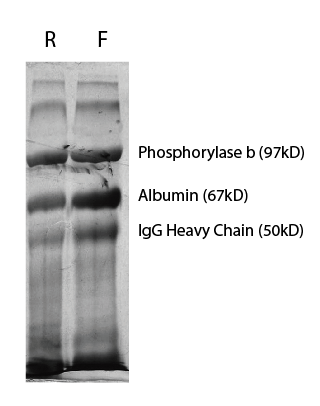 The difficulty with these membranes is that the cutoff is much higher than the proteins I’m currently using. Inner membranes with only small pores have too low of a permeability to run in SepCons (I had previously given inner w187 a try to no avail). Diffusion experiments are tractable with the membranes we currenly posses, but forced flow separations are currently not effective. I will try membranes other than w310 to see if I get different results.
We now have a robust test for assaying SepCon separations because the concentration step overcomes the dilution created in the wet/wet format. This is an important step forward.
The lack of separation is predictable based on your diffusion work with 310. Here are some options that come to mind:
1) Since 310 held back the myosin fragment in diffusion, we could try to make the mysosin fragment ourselves. We should have full length myosin in the freezer. I say we do this as part of Xiao’s rotation project because they would make great proteins and protein fragments for imaging too.
2) We can try with brain extract. This didn’t work before because of our trouble with the dilution issue. Should work now.
3) We can move to smaller pore membranes. 320 has about the same porosity as 310 with smaller pores. May or may not work.
I think option 2 is our best shot at fractionating something in the short term.
We’ve also learned that we need membranes with > 1% porosity to get results by SepCon although < 1% works fine by diffusion.
Has there been any diffusion work with outer 310 membranes? The posted diffusion results are from near the wafer center where the pore size cutoff is around 25nm. The SepCon sample is from the outer portion of the wafer where the pore size cutoff is more like 45nm.
I think it would be very useful to determine whether the diffusion cutoff and flow cutoff are the same. If they are not, it would help with the development of our model…
There is no diffusion data on the outer 310 membranes yet, but I hope to do that when I get back.