Similar Posts
Inside/outside morphology changes due to RTP non-uniformity
Last week, I used a 6-inch thermocouple wafer to profile the temperature uniformity (outside the susceptor) in the RTP. I measured four points: center, front, back, and center-right (positions relative to the RTP door e.g. front means closer to the door). The center-right position was chosen to verify side-to-side uniformity of the lamps. Below is…
Exosome labelling Problems: PKH Nanoparticles
ByAslanHello Everyone, I’ve been working on exosome labelling and trying to characterize it by NTA. So we read a paper published a month ago, explaining the presence of PKH nanoparticles as false positive results in internalization studies. They studied four different staining protocols and showed the presence of these nanoparticles regardless of the staining protocol….
Membranes on STEM
Chris and I got to play on the new Zeiss scanning transmission electron microscope (STEM) today (learn about STEM here). We didn’t get to spend a lot of time on it, but here are some quick images we snapped. wafer 416 @ 25kx (left) and 65kx (right) Even though we’re imaging in transmission mode, the…
Sodium bicarbonate "dose-response"
We’ve been focusing on bicarbonate ions as one of the causes of discoloration. So, I made several sodium bicarbonate solutions and tracked discoloration of non-RTP’ed samples. I made 3.7 mg/mL NaHCO3 (=44mM, this is the concentration in DMEM), 1.85 mg/mL NaHCO3, 0.925 mg/mL NaHCO3, 0.4625 mg/mL NaHCO3 and 0.23125 mg/mL NaHCO3. I also ordered a…
Beta-2 Microglobulin protein, and its surrogate Cytochrome c
Introduction: Kidney failure, also called ESRD, is the last stage of chronic kidney disease (CKD) where kidneys function below 10 to 15 percent of their normal levels. In the United States, there are over 660,000 ESRD patients from all ages, genders, and backgrounds. ESRD causes reduced urination in the body and subsequently, waste products and…
50kD Cellulose Protein Separations
Here are the results of diffusion based protein separations at different salt concentrations and 50kD Microcons: We see a sharp cutoff between 31 and 45kD. Separations look like they have progressed further in 10mM salts rather than 100 mM (this is the opposite of what we see in pnc-Si). The 100kD data may also support…
One Comment
Comments are closed.


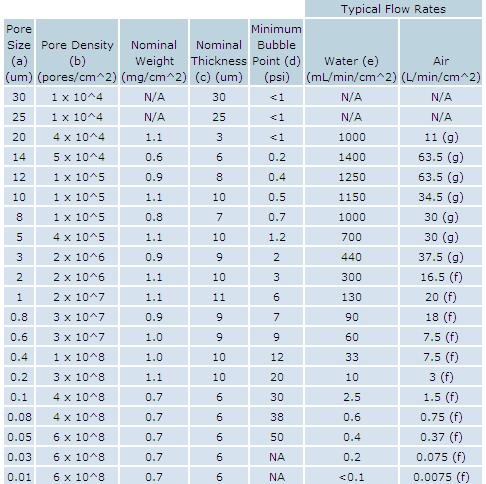
At what pressure was the data in the table acquired?