New sputtering system
The new sputtering system is scheduled for delivery at the end of June. It will bring several advantages over our current system; which translates (hopefully) into stronger and more consistent material. 75 days…
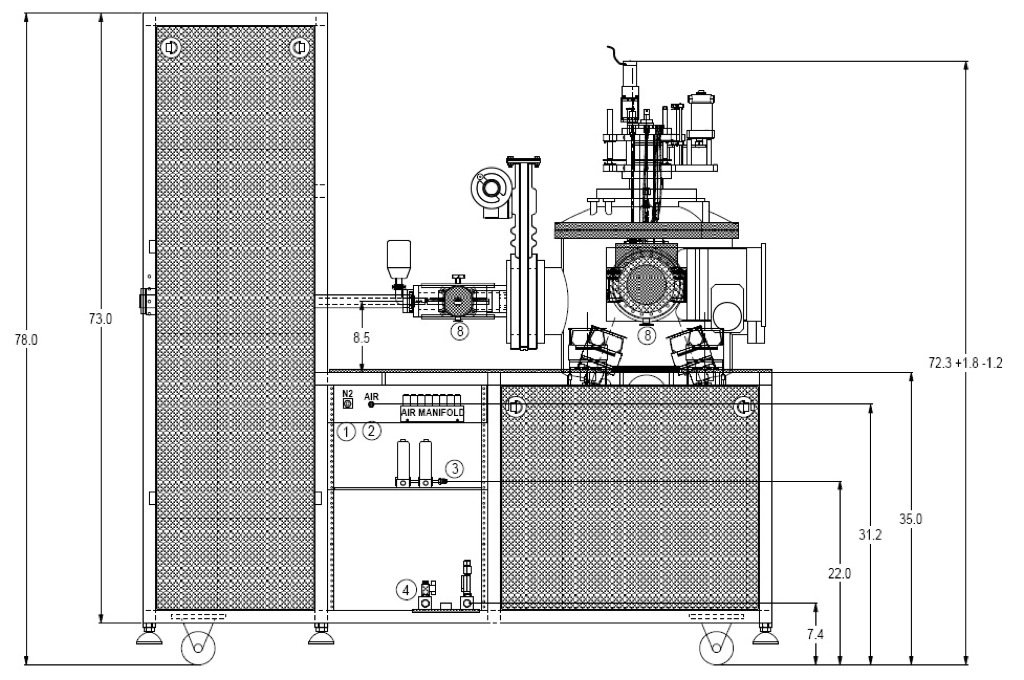

The new sputtering system is scheduled for delivery at the end of June. It will bring several advantages over our current system; which translates (hopefully) into stronger and more consistent material. 75 days…
Introduction In a previous post I introduced the concept of endothelium apicobasal polarity and the potential to utilize this concept for future sepsis drug development: Endothelium Apicobasal Polarity Regulates the Innate Immune Response In Vitro [In Progress] In this post, I will expand on the ‘mock’ TNF-α experiments with recombinant IL-8 as well as add…
Again a repeat of experiment and the observations. As seen above, the sample with both intact slits discolors the fastest (in Sepcon w/memb side down, DMEM w/o FBS, Oven @ 37C). Result is same as the previous two trials. One thing that I noticed is that the membrane in ‘one slit intact’ sample remains intact…
Earlier this year an MIT/Harvard group generated and transplanted a rat kidney and published in Nature Medicine Technical Report. “Regeneration and experimental orthotopic transplantation of a bioengineered kidney” Jeremy J Song, Jacques P Guyette, Sarah E Gilpin, Gabriel Gonzalez, Joseph P Vacanti, & Harald C Ott Center for Regenerative Medicine, Massachusetts General Hospital and Harvard…
In this post I show the sieving coefficients of simulations with a thin membrane, a thick membrane, or a no membrane case as they approach equilibrium. The simulations were carried out for 48 hours, and plotted for 1 hour time points. Both thin and thick membrane had the same pore distribution – monodisperse 10 nm…
This is a continuation of the initial experiments testing the possibility of creating porous Si membranes with thicknesses ranging from 50 to several hundred nm, and mean pore diameters from ~50-200 nm. As suggested, we’ve started using 200 µm thick wafers and we’ve patterned with the Cell Culture mask as well as the Deflection Mask….

Introduction As we’ve been trying for nanoparticle-based CAD-IA for multiple trials, we have tested various reaction routes, reaction conditions, and antibody pairs with 3 different nanoparticles. Here, I would like to take a step back to go through the CAD-IA stories based on different nanoparticles. CAD-IA based on different nanoparticles Fluorescent SA-modified magnetic particles Physical…