Adsorption to Extricated Membranes
In the previous adsorption trials I compared SepCons to MicroCons and NanoSeps. The SepCons appeared to have higher adsorption, which we thought may have been a result of the plastic used in the SepCon. I then removed membranes from MicroCons and NanoSeps and compared to pnc-Si membranes in the same manner as outlined in the previous posts.
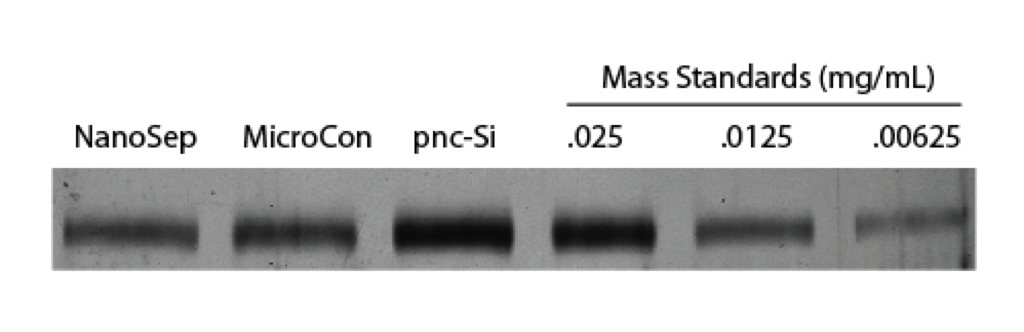
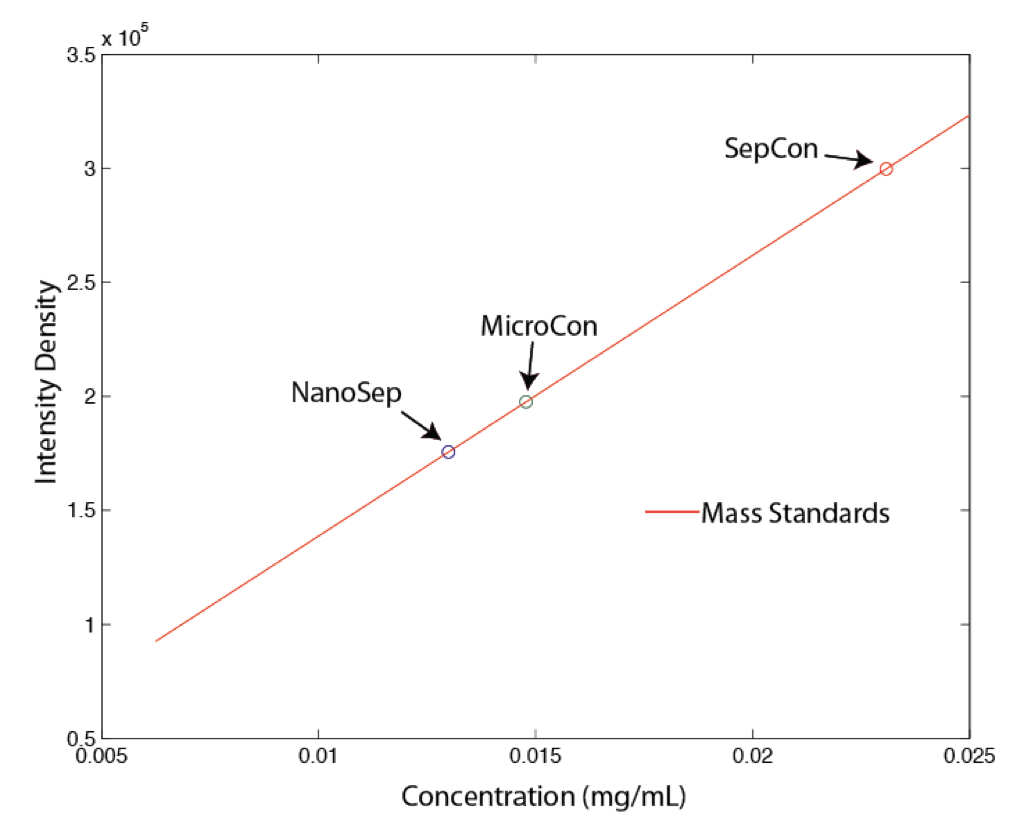
In this gel I have run the protein lifted off the three membranes along with three mass standards. It appears that the pnc-Si membranes still adsorb more protein. I then took the standards and fit a straight line to them in MatLab (these standards are all in the linear range of silver stain). I then found the intensities of the adsorption studies, multiplied by 3/4 to account for the dilution of the standards, and fit them to the line.
Well done. Can you compare to glass, silicon, and polystyrene? Perhaps all the membranes are “low binding” compared to these materials. If we can place ourselves in a low binding material class, that is something.
We should be able to put the binding on a mass per-unit-area of membrane basis – ug/cm2.
Were these samples ozone-treated or RTP treated? It may make a substantial difference. Also, were there intact membranes and if so, were you able to rinse them as effectively? These were likely also done on the backside, so it’s really testing the binding to silicon and oxide, as this is probably >95% of the area, right?
Jim,
This should work for glass, silicon, and polystyrene. I’m on it! Also you’re right, we haven’t normalized for active membrane yet in these studies.
Chris,
I didn’t do anything to these samples. They’re from w216, so they’re also a little old. The membranes are intact, but have a couple of pinholes, which really shouldn’t affect this study.
The same rinsing protocol was applied to all the membranes. The BSA was pipetted off and I pipetted 50uL dH2O on the membranes twice with agitation by pipetting up and down.
These experiments are done on the frontside, so it’s testing the pnc-Si material. I would expect the backside to be much stickier.