AFM Training
Yesterday, Chris, Dave, Graham and I were (exhaustively) trained on the Asylum AFM in Rick Waugh’s lab. We had an overview of the basic features of the AFM and got some real data, as well.
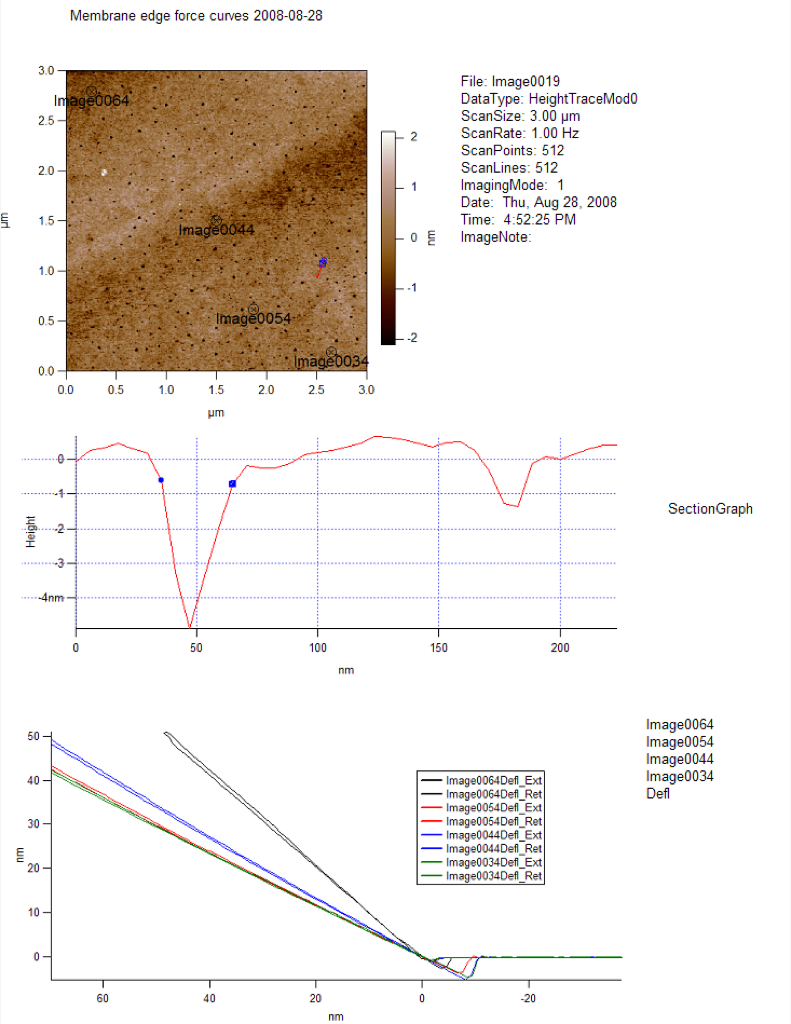
The top panel is a height image of the pnc-Si chip with the well side down. Notice the slight decrease in height tracking diagonally across the image. This is the interface between supported and floating membrane. The decrease in height from supported to floating membrane was about 300pm. Great news is that the force of the tapping tip in AFM did not break the free-standing membrane. We can image in air or liquid with this AFM.
There is TONS of image processing available with the control program (IGOR) for the AFM. We just selected a linear ROI on the height image and got a cross-sectional height scan (middle panel). From this scan, the pore diameter was estimated to be ~ 25nm. We should be able to process these AFM images with Mike’s pore image processor to validate TEM findings. Also, we should be able to image the membranes from both sides.
We also did some force curves (see panel 3). Here, the AFM tip probe is pushed into the surface and then retracted. Force curves are used to measure sample elasticity, adhesion forces and other material properties. We did force curves at 4 different points on the chip (0064-supported pncSi, 0044-free pncSi near bulk Si, 0054 and 0034-free pncSi far from bulk Si). At 0064, the supported pnc-Si had a force curve characteristic of an infinitely hard surface. As the distance from the bulk Si increased, we saw a decrease in the slope of the force curve, and thus an increase in elasticity/softness/compliance. This makes sense since the free pncSi is not supported by the rigid bulk Si.
There are many more advanced techniques available to us with this instrument. I think it’s going to be extremely useful for us.
How big is the tip you are using? I’m curious if you could pick up more of the background pores using this than the Krauss instrument could.
We were using a high aspect ratio tip from Olympus. I’m assuming you mean the tip radius? It’s <15nm according to the website. You’re able to image stuff that is smaller than the tip radius, though. Asylum sells all kinds of tips from different companies. If anyone is interested in checking them out: http://www.asylumresearch.com/Products/Levers/LeverGuide.shtml