Stirring and discoloration
Last week, we wondered whether the wells of pncSi chips created an unstirred volume in which an extreme environment could form (pH, byproducts), thus accelerating discoloration. To investigate this, I placed one chip flat on the bottom of a plate and another chip balanced upright on the sidewall of a well. I rotated the plate at 100rpm at room temperature and used DMEM/F12 + 10% FBS as the media.

I can’t find the day 1 or day 2 pictures, but there was no discoloration on these days. Even though the standing, upright chip should have had between volume exchange on both sides of the membranes, discoloration was not affected.
I also looked at discoloration in the SepCon format. The chips were placed into Sepcons and the SepCons were cut to fit into the top of commercial Transwell inserts. Therefore, the pncSi membranes are “floating” in wells, with media on both sides of the membranes. I used a chip on the bottom of a 24-well as a control and looked at both stirred (100 rpm) and unstirred SepCons at room temperature.
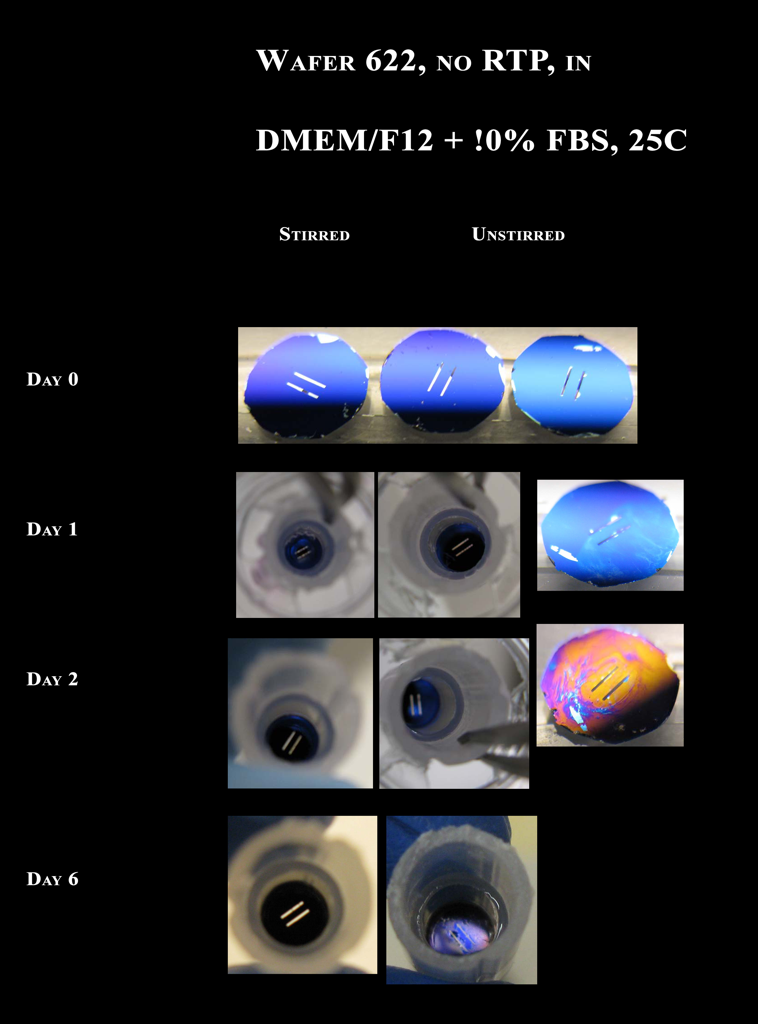
It is very difficult to get good discoloration images of the chips within the SepCons. However, the flat, unstirred chip discolored after 2 days but there appears to be very little discoloration in the SepCon pncSi samples, even after 6 days. There was no major difference between the unstirred and stirred SepCons. This suggests that the membranes may be more stable in SepCon format.