Discoloration – autoclave and Sepcon
I did an experiment earlier this week in the Sepcon and flat format. I intentionally broke membrane windows so that I could compare chips with no intact membranes vs. chips with 1 intact membrane (and also the effect of autoclaving). Unfortunately, all of the flat chips discolored overnight, so I couldn’t see any differences between 1 vs. 0 intact membranes. This picture is simply further evidence that the Sepcon format slows discoloration compared to the flat format. This is wafer 648, not RTP, done in the oven in DMEM/F12 + 10% FBS.
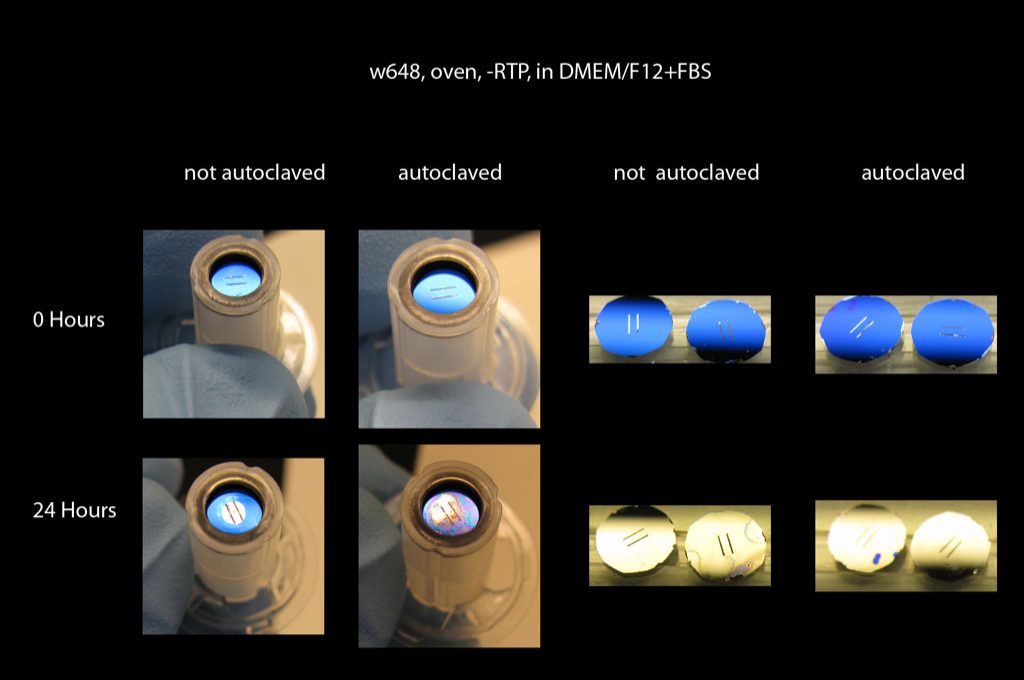
The not autoclaved Sepcon has an interesting discoloration pattern which clearly emanates from the membrane windows. The autoclaved Sepcon also has a radial pattern, although not as pronounced. It looks like the autoclave slightly slowed down discoloration.
In case of confusion – this is actually my post. I didn’t realize that anant was logged in.
I changed the post author by editing the page.
Can you be absolutely 100% positive that the entire membrane is wet by the solution and there are no large air bubbles? The sharpness in the “not autoclaved” sample looks like there was a definite interface…
I’m pretty careful about air bubbles. Anyway, the bubbles tend to stay around the edge of the chip, near the O-ring. I don’t think a bunch of air bubbles could have totally covered all but the center of the chip like the discoloration pattern indicates.
I agree. It could be the other way round, with a bubble covering center of the chip and preventing it from discoloration whereas the rest of the chip discolors.