AJA vs. CVC morphology
Last week we attempted to mimic our standard CVC recipe in the AJA system (15 nm Si, 450 C deposition temp, 1000 C RTP). I should note that the protective oxide thickness in the AJA membrane was 20 nm (not 40 nm as it was in the CVC). Below are two images comparing the AJA (tem003) and CVC (w705) morphologies along with histograms.
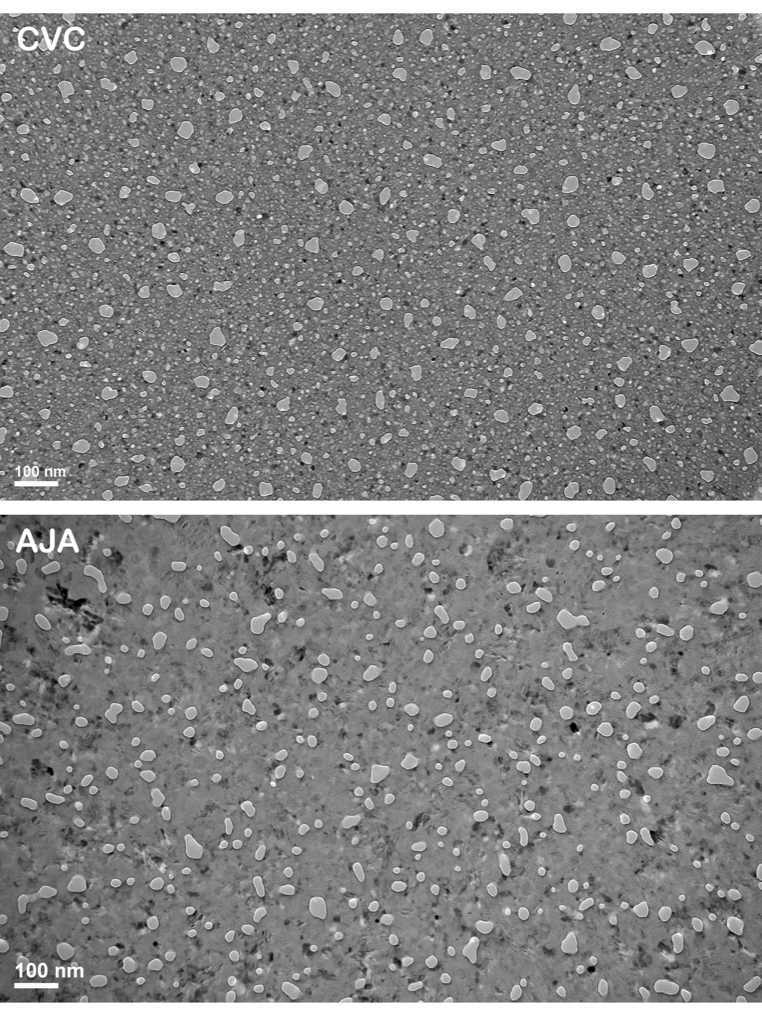

Overall, the morphology looks much cleaner in the AJA film. It’s interesting that the AJA histogram looks more symmetrical. I wonder if it’s because we get a more accurate pore count with the AJA film since there’s no background texture (less likely to count non-pores). I did not see a high concentration of pinholes in this sample, but Nakul should confirm. This week’s production will focus in part on varying RTP temperature to control pore size.
This looks great. I see the difference in histograms, but I’m impressed that the cut-offs are so similar. This suggests that we might have a genuine recipe for making ~40 nm cut-off material ‘on-demand.’
I agree with Jim- this is very good. Something jumped to my eyes though and that it the pearl neckless arrangement of the pores in the AJA membrane. Have you seen this on other AJA membranes?
I can almost see a grid pattern in the pores. I went back and looked at the previous AJA pictures, the ones with the clumps of pores, but there doesn’t really seem to be trails of pores like in this one.
All the AJA material shows a “pearl necklace” arrangement (though incomplete), and this is what Dave has referred to as “clustering”. However, if you remove all the distracting background shallow pores, and focus on the larger through pores, I don’t think the difference is that great. There are still fairly large regions that appear to be circled by large pores, and the large pores could be argued to show some linear arrangements. I’d agree that the AJA samples is more striking, but it also has far more “real” pores.