Does pnc-Si follow EO theory?
Back a year or more ago, we had analyzed the EO flow rates from pnc-Si and determined that the flow was much higher than any other material. We then went on to try to calculate the zeta potential using the Helmholtz-Smoluchowski equation:

We figured out the velocity of the fluid, v, from our flow rate measurements and assumed that the electric field, E, would be in the range that Probstein considers a “normal” field in a membrane. This gave us an extremely high zeta potential in the range of volts, not millivolts. So did we get the field wrong? Does our material have an insane zeta potential? Or does the theory not apply to thin membranes?
Now, with a little more knowledge on the subject, I will try to redo this analysis. First I ran an EO experiment with pnc-Si in 100 mM KCl with Pt electrodes:
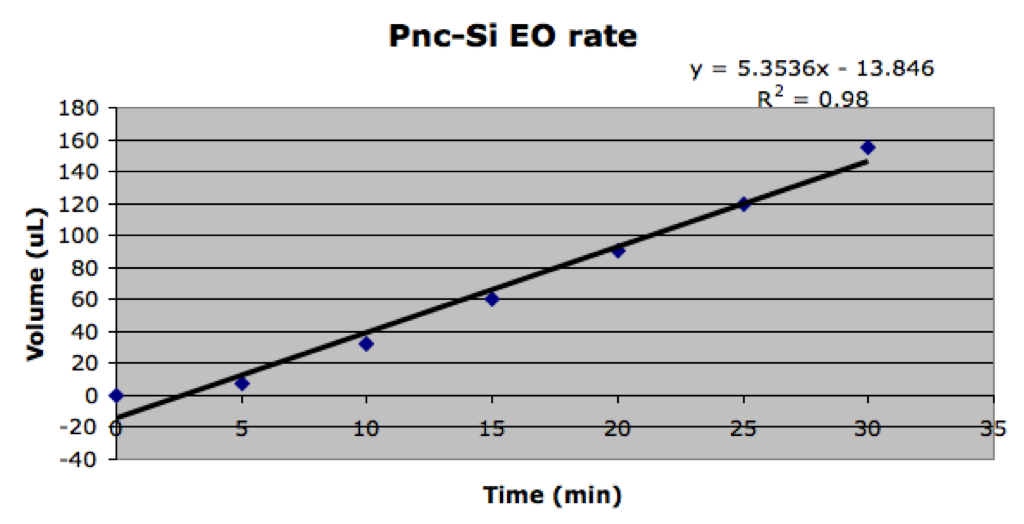
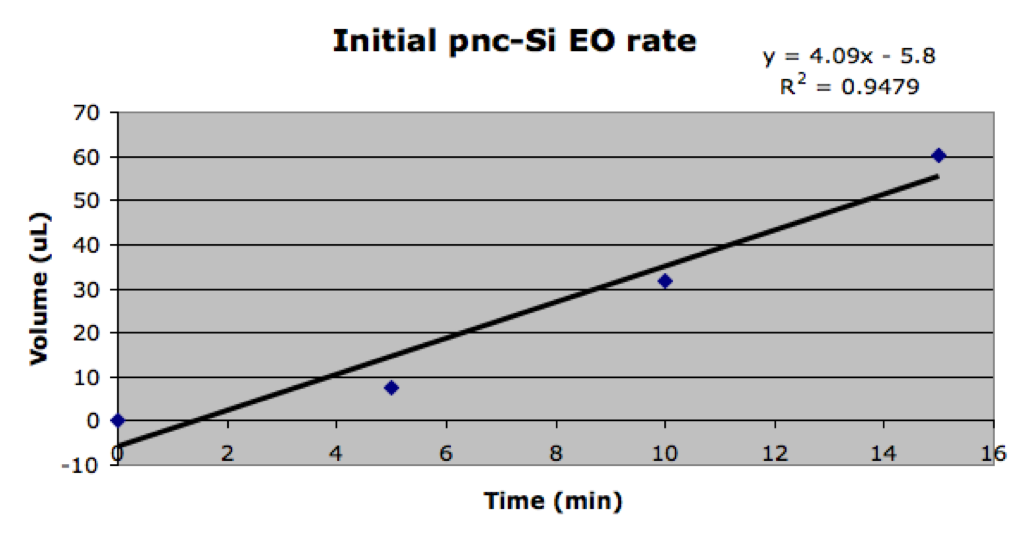
From this flow rate and the following equation (from this post):
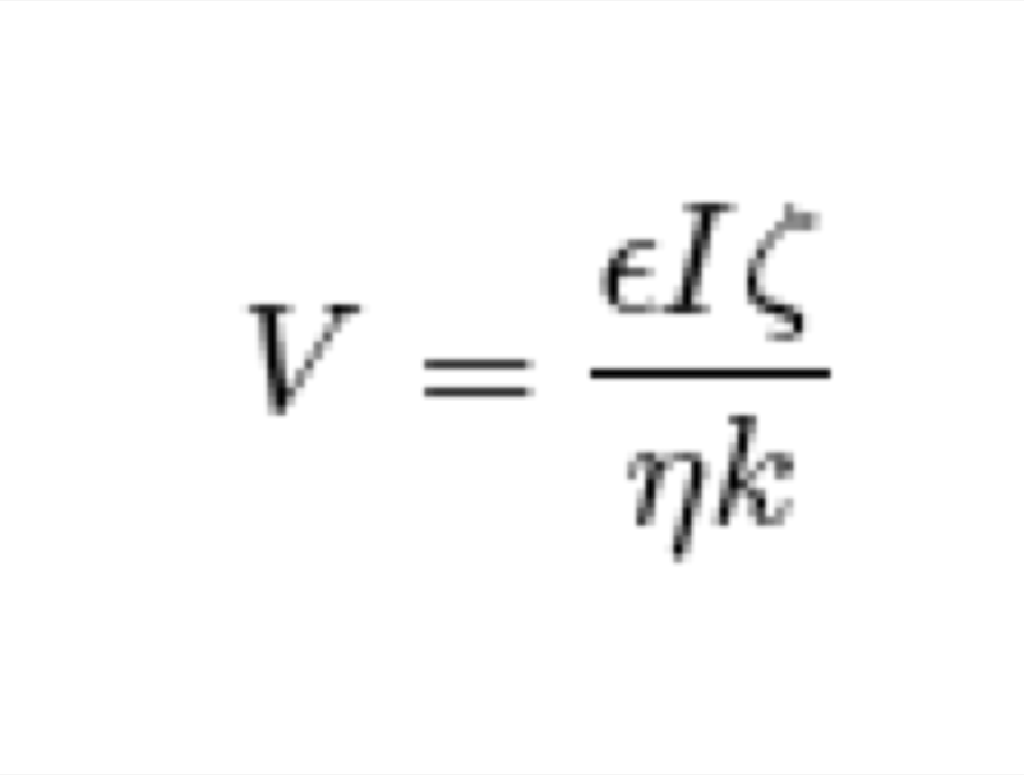
the zeta potential is calculated to be between -11.7 and -15.3 mV. This value is reasonable, and the neat thing about this equation is that it bypasses the field. This means that something was wrong with our field assumption.
Before we get into the field, I should mention that zeta potential calculated from streaming potential in 100 mM KCl was between -10.7 and -12.2 mV. So it seems that our methods are pretty close.
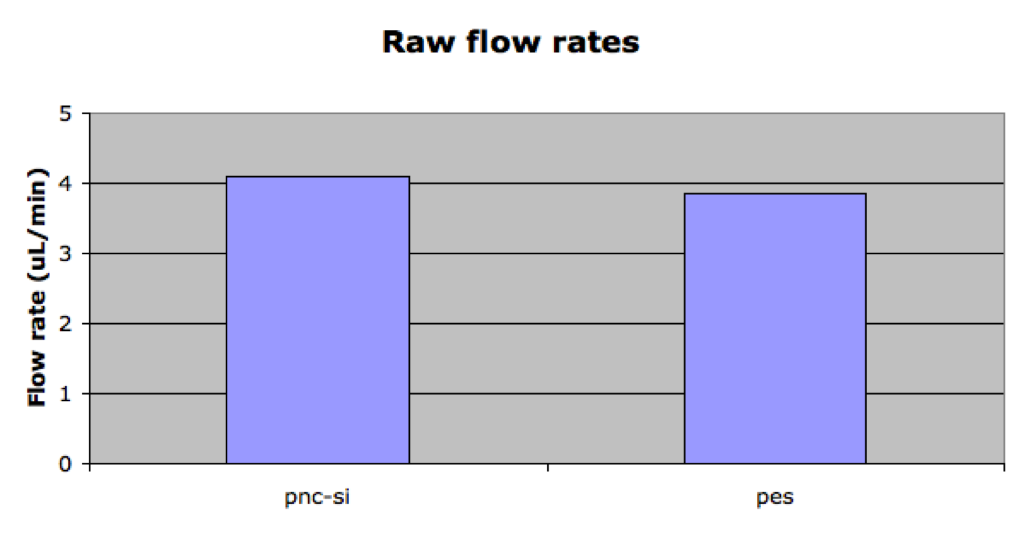
Now that it seems that reasonable zeta potentials can be calculated using theory (although I won’t say yet that we fit theory as variations may be beyond my measurement ability), what happens to our statement that pnc-Si EO is greater than other materials? The raw flow rate shows that pnc-Si has about the same or slightly more flow than PES:
However, if we normalize this flow rate to active area and voltage we see that pnc-Si has much more effective electroosmosis:
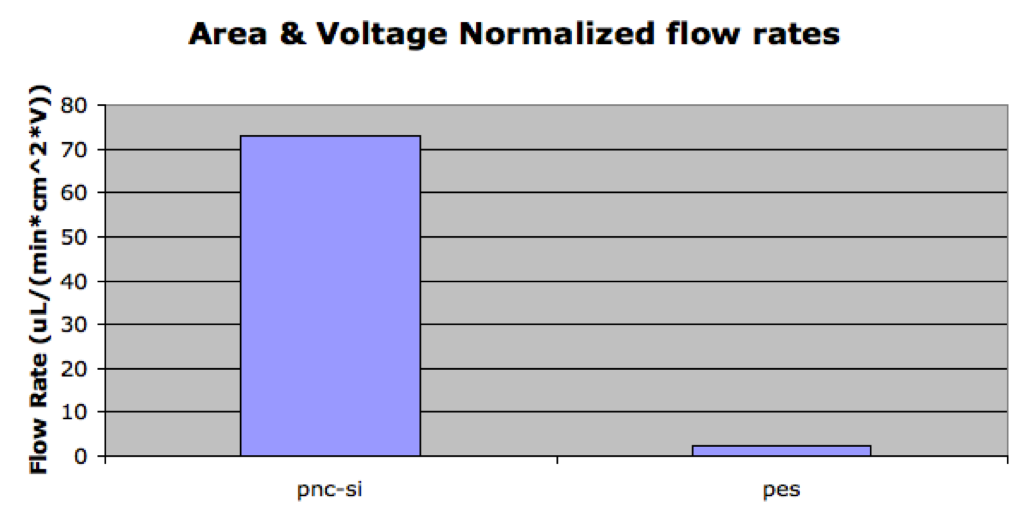
And even this is only normalized to active area – if I normalized to the pore area pnc-Si would jump up another order of magnitude.
This means that our flow rate for a given current is higher than that of regular membranes. Water is flowing faster through our pores than materials with longer pores, but our material still seems to be consistent with theory. For any given current, the field across out membrane must be much higher than thicker materials. We can use the following rearrangement of Ohm’s law to calculate the field:
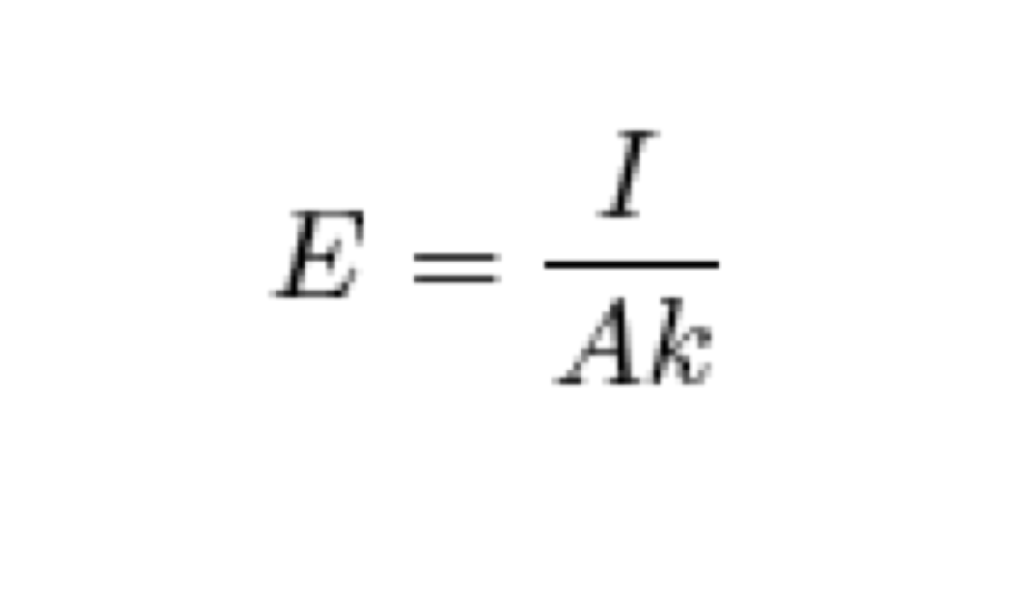
where I is current, A is pore area, and k is the conductivity. The only difference between the PES and pnc-Si experiments is the total amount of pore area. In the case of PES this is about .082 cm^2 (assumed 40% porosity for a .51 cm diameter filter), and for pnc-Si the area is .000072 cm^2 (9x 200 um squares at 2% porosity). The resulting fields are thus 89.3 V/m for PES and 101,750 for pnc-Si.
So pnc-Si has an extremely high field across the material, and is able to generate high electroosmotic flows with small active areas. The actual voltage drop across the material is only ~1.5 mV (given the field above for a 15nm length), so if electrodes are close, it won’t take much to run a lot of fluid through this material.