Sepcon vs Cloning ring II
Repeated the previous experiment with W683 and following images were captured after 5 hours of incubation in DMEM(-FBS), Oven @ 37C.
I took Sepcon samples with regular thin o-rings, fat o-ring, without o-ring and w/grease in place of o-rings. Also for comparison, used cloning rings and the 2D flat format (left=w/o grease, right=w/grease) samples. All Sepcon and cloning ring samples have their membrane side down whereas the 2D format samples have membrane side up.
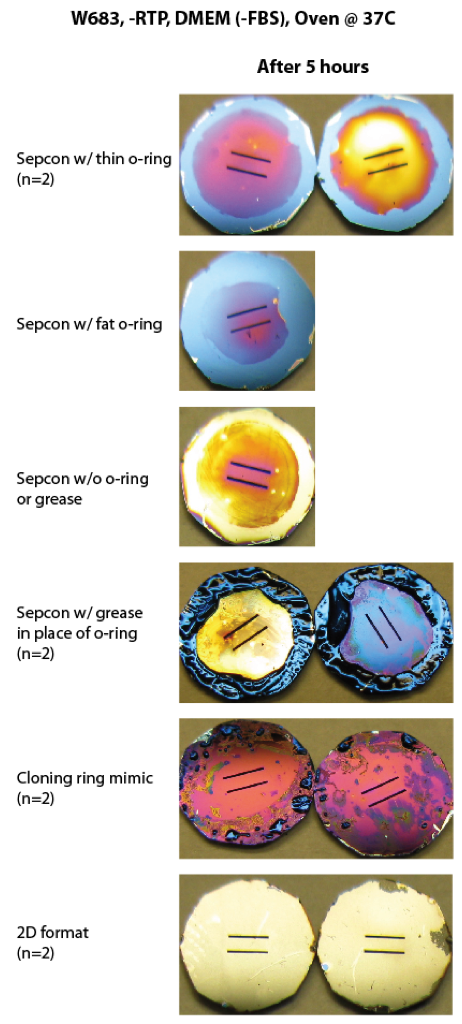
As seen above, there is sample to sample variability (check the thin o-ring and grease samples; unless there is some bubble formation in one of the samples which altered the chemical attack)!
Also in case of fat o-ring, there is very little surface exposed to the media hence its difficult to tell about its relative discoloration rate. (It was observed to be faster than the thin o-ring sample in Barrett’s experiment)
Infact, the samples in the cloning ring format discolors slower as compared to the flat 2D format and is roughly close to the Sepcon discoloration rate. This could explain the role of geometry which is similar in Sepcon and cloning ring formats.
Note: In the Sepcon sample w/o o-ring/grease, the regular blue boundary ring (seen in w/o-ring samples) is absent.
Finally, if I have to conclude an order, it would be:
2D format > Cloning ring mimic ~ Sepcon: {w/o o-ring/grease ~ w/grease > w/thin o-ring ~ w/ fat o-ring}
Sample-to-sample variation is really hurting us. All the recent activity has only convinced me of two things: 1) the SepCon format promotes stability over the ‘2D’ configuration, and 2) that back/side surfaces are not catalyzing the membrane decay. I doubt more experiments to sort out geometry vs. stress will yield any new insights, so lets stop.
Please focus on surface modifications and testing the new materials that might have better adhesion between layers. Jess has been working on silanization. Please coordinate with her. Also try coating with BSA in TE buffer and then checking for slowing of discoloration in DMEM.
Carbonization will also be coming online once we receive the gas fittings for the Acetylene…