Sepcon vs Cloning ring
I carried out this experiment in order to rule out any effect due to geometry of the setup in our discoloration experiments in Sepcon.
I used a cloning ring and mimicked the Sepcon as shown in the figure below. The only difference is the o-ring which is absent in the cloning ring setup. To cover this, I used Sepcon w/o o-ring and instead used vacuum grease (like in cloning ring) in one of the samples.
Samples were from W702 (discolors quicker as compared to others) with membrane side down, in DMEM-FBS, Oven @ 37C (no RTP).
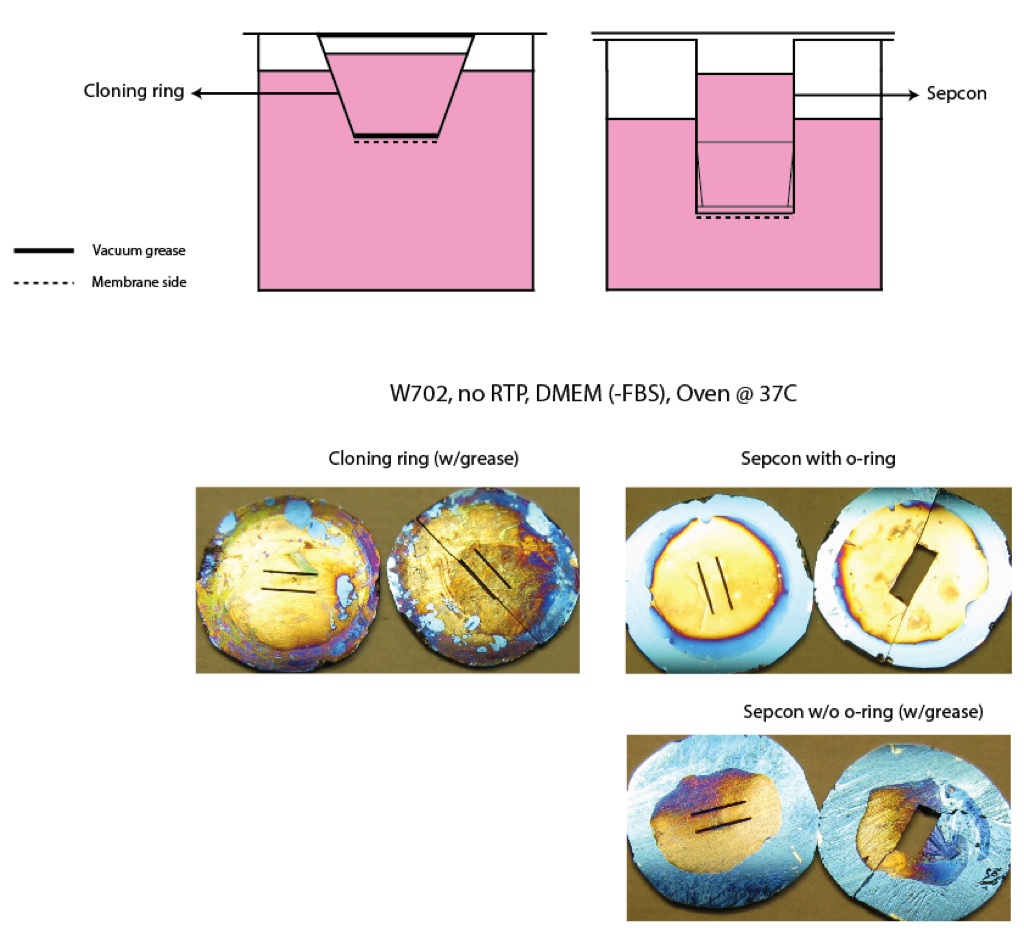
After 2 hours, above images were captured for all the samples alongwith duplicates. There is no significant difference in discoloration amongst the samples. This seemingly proves that the geometry may play a role in preventing discoloration in Sepcon (i.e. captured dead volumes, diffusion). BUT, the Sepcon samples contradict Barrett’s experiment (stress hypothesis), as here, the Sepcon w/o o-ring (w/grease) sample discolors as quick (or slow) as the Sepcon with o-ring sample. I think I need to repeat using a different wafer and see if this changes.
Everything is discoloring at roughly the same rate here. w702 might be a bad choice for capturing differences. I don’t think we can draw conclusions from this study about geometrical effects.