High Speed Photography of Composite Nanomembrane Structures
Background:
At the end of August, Greg Schmidt and I were investigating the feasibility of a project that builds off of my PhD research: templating and patterning new materials on top of NPN/microporous nitride. We hope to make composite nanomembranes with various ratios of NPN to sputtered thin films. In addition to my normal TEM, EDX, XPS and burst pressure characterizations, we want to be able to capture the fracture mechanics of these very thin composite materials. It’s a challenging process; the membranes aren’t particularly reflective, and the distances aren’t particularly far. Considering the speed of propagation (speed of sound in material), there is precious little time to watch a crack form and move though a window, hence the need for high speed photography.
Setup:
Greg arranged for a demo day from Photron, a company that sells high speed photographic services. We saw a Fastcam SAZ-2100k, which is capable of many different frame rates and resolutions. As a rule, the resolution of the image decreases as the frame rate increases; at 200k FPS, we can get ~300×200 resoluton, but at 700k FPS, it’s only 128×24 pixels.
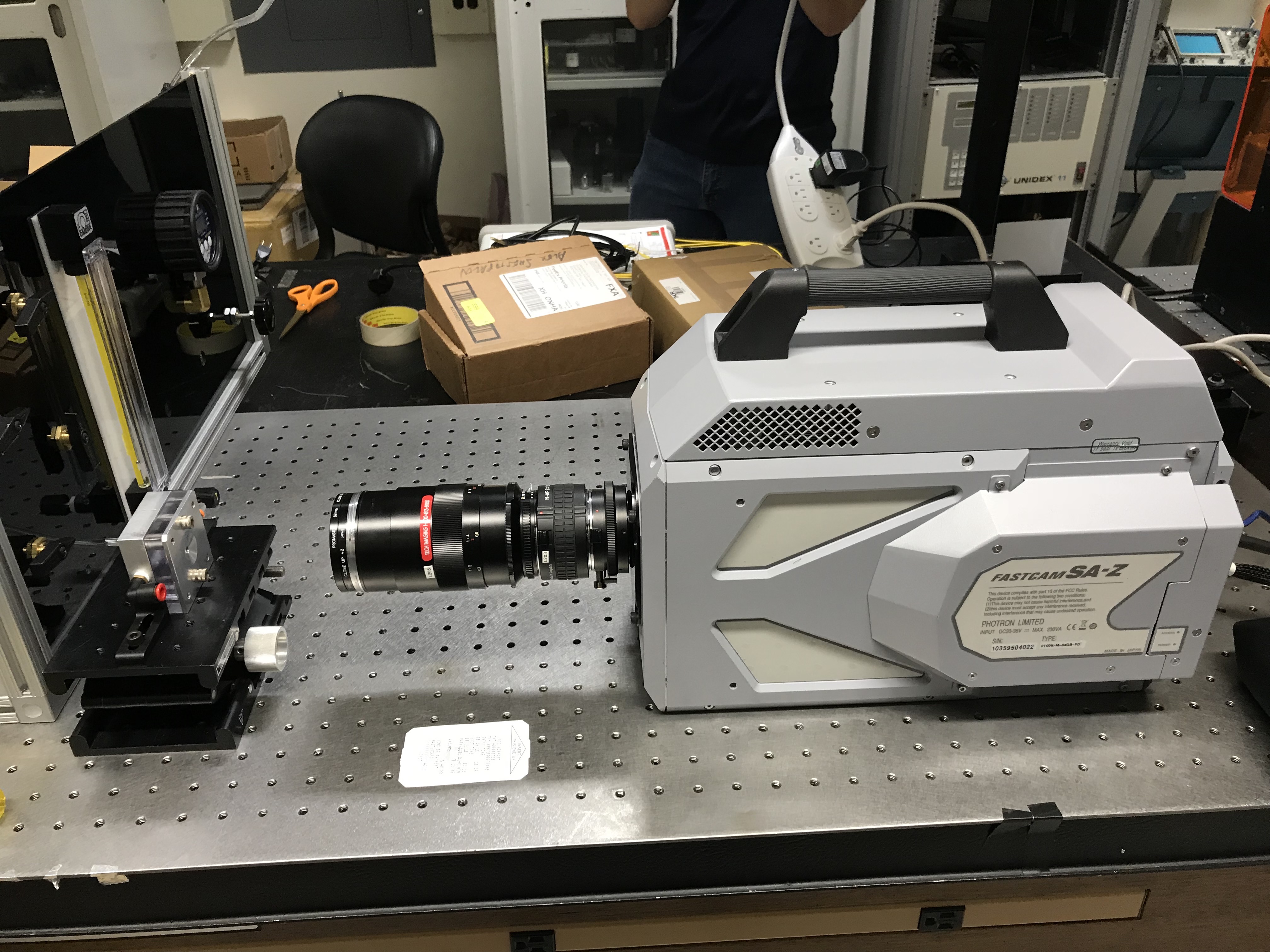
The camera is very heavy (over 30 lbs), so we positioned the camera, and then adapted a stage to the burst pressure setup that Joe built (gives us XYZ positioning). Here, we will flow in nitrogen gas to distend and eventually burst the membrane.

There are a number of different lenses available to this camera, in addition to a microscopic lens, which we used to image the active area of our chips. 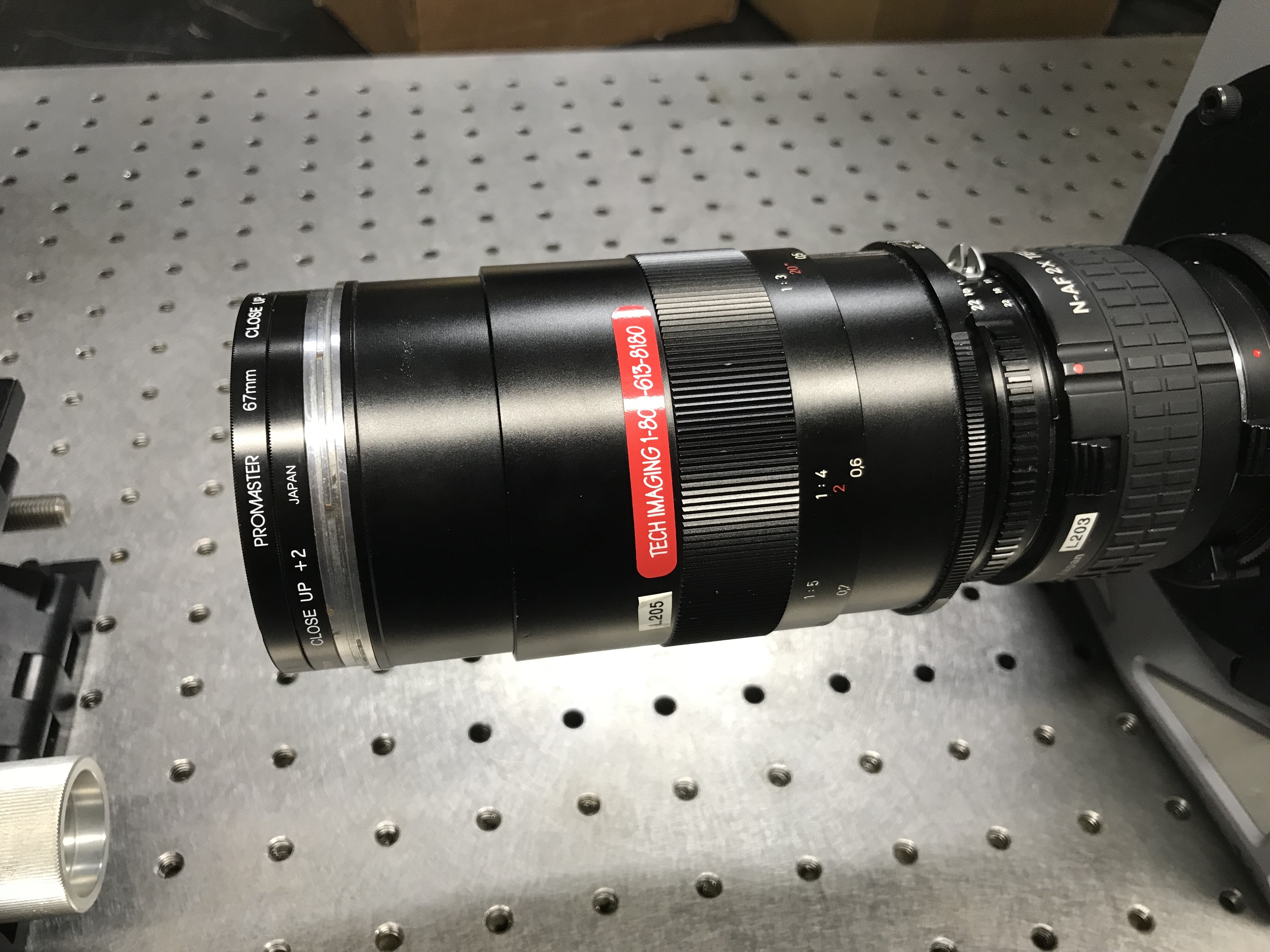
Lighting is particularly important to getting useable information. The sales rep brought in a SugarCube that we used to illuminate the cavity of the burst pressure clamp. We had a lot of difficulty bouncing light off of the deflecting nanomembrane into the lens of the camera. In the future, we’ll need to design a better illumination setup, with a trigger and flash lamps, or LEDs that are focused on the cavity itself. The transparency of the nanomembranes also seemed to be an issue. As we go faster (200-700k FPS) even more photons are necessary.
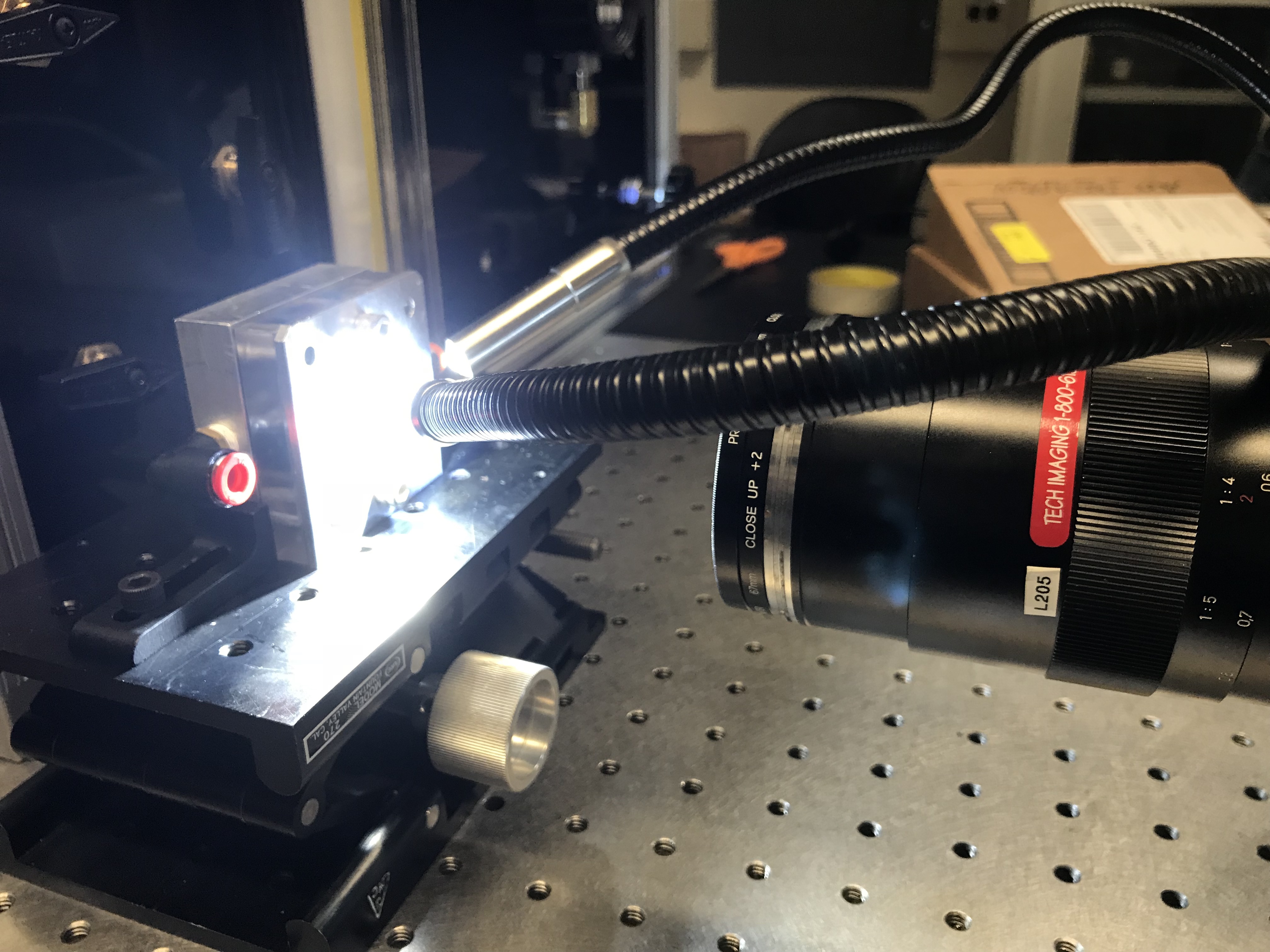

After recording the frames, I exported them into raw AVIs, and did some noise reduction using Fiji (denoise filter, theta = 25). These files were then saved as gifs and mp4s (encoded with handbrake).
Raw file (50 nm MgF2 on 50 nm NPN, 2000 x 700 um single window):
Denoised file:
Materials:
NPN (2229 NPN, single 200 x 200 um window, 7.6 PSI burst pressure)
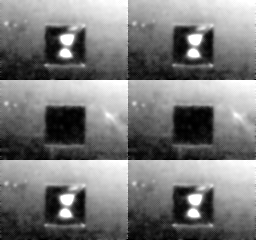
Only a few frames are visible, even at the fastest recording (700k FPS). Difficult to see the membrane as it is very thin and transparent; we had the most success illuminating the fold as the membrane is pressurized with nitrogen. Shards of membrane still persist.
1255 NPN, 2000 x 700 nm single slot, 100 nm thick
The larger single slot NPN material shows more shattered domains than the smaller 200 micron square window. Some domains appear to be larger than others. Impossible to say where the cracks nucleate from, but the shattered component stays in focus for a frame within the field of view, suggesting that it happens much faster than the displacement from the gas flow pushing the fragments out.
NPN+Au (3-slot, microslits, 50 nm Au on 400 nm nitride)
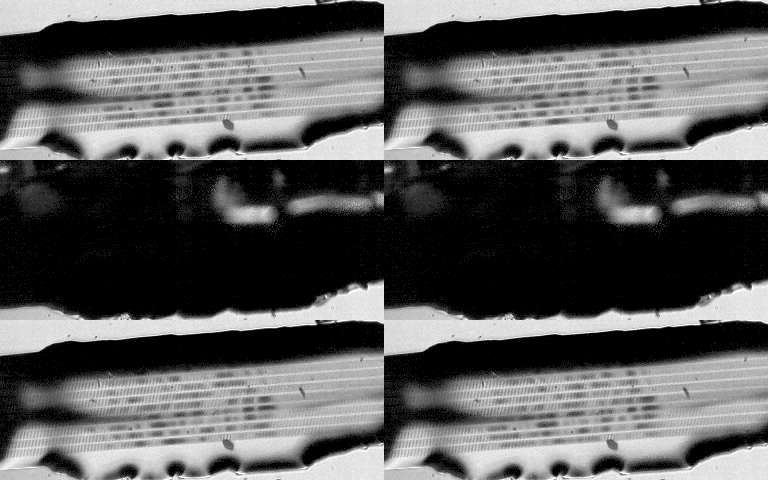
This material was very interesting. We could see the undulating bubbles for half a second before the membrane burst (a very long time in the high speed photography world). Greg hypothesized that the shadows are the result from the material turning and twisting in the breeze under gas pressure (like a standing wave). The gold is much easier to see and photograph; if we can improve the shininess of our nanomembranes without adding to the mechanical structure, it will facilitate easier imaging.
NPN+MgF2 (50 nm MgF2 on 100 nm NPN (1255), 2000 x 700 um single window)
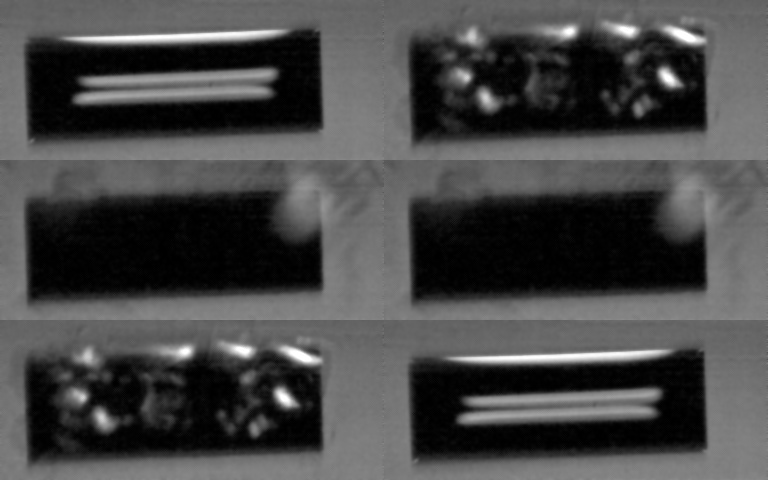


The MgF2 seems to shatter and be ejected at the same rate as the NPN. however, the fragments appear to be smaller. Maybe the compressive MgF2 film caused a different mode of fracture? Or are the fragments immediately curling up due to the strain of the MgF2? Again, having another reflective surface made this membrane much easier to image.
Conclusions:
We need to go faster. We only have 1-3 frames where the fractures are forming. Going faster necessitates more light. We are looking into finding a good trigger with a flashlamp, or design a burst pressure setup to accommodate strong LEDs.
More fun with high speed photography: https://photron.com/gallery/
epic!! 😀