pnc-Si degrades into silicic acid
Over the past month, I’ve posted some results of a colorimetric assay for silicic acid. Previous posts are here and here. These results showed that the assay detected silicic acid after pnc-Si and PSi degraded. However, bare silicon wafers also yielded silicic acid, according to this assay. Since pnc-Si samples have the Si well-side surface, it was uncertain from these experiments whether or not the silicic acid came from pnc-Si side or the Si well side.
In this experiment, I (tried to) blocked the Si well side of pnc-Si samples with 2 different methods. 1. I used nailpolish to coat the well side only and also both sides of pnc-Si chips. 2. I assembled a Sepcon transwell with the pnc-Si side down and suspended in buffer without wetting the well-side in the donor compartment (basically a wet-dry format). I used a harsh buffer (0.6mL 3.7mg/mL NaHCO3 + 0.1mL 1M NaOH). I took a baseline measurement at t=0 (blue columns below), right after I added buffer to the samples and then waited 3 days to take the second sample:
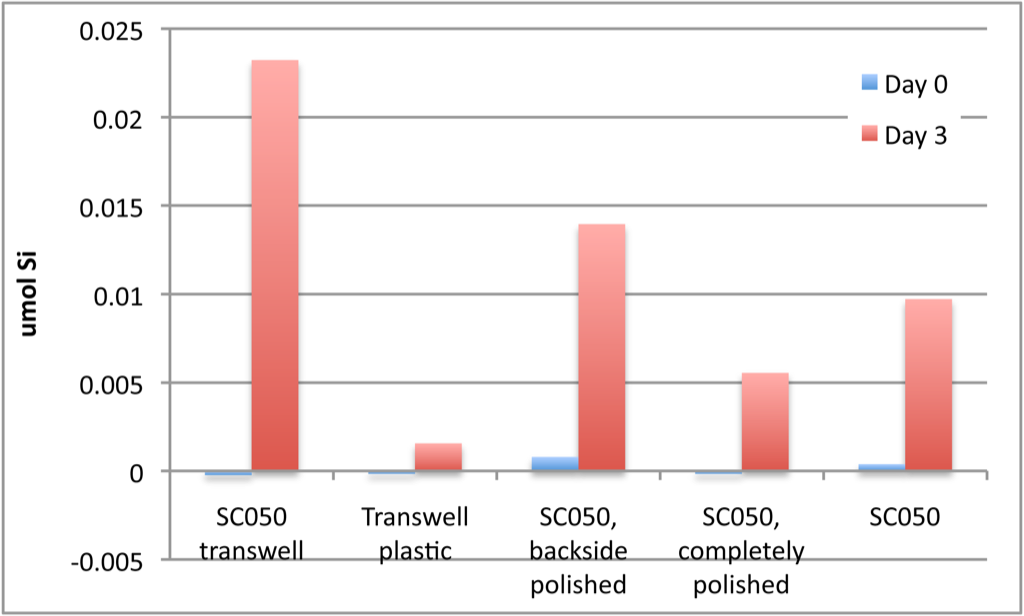
The first 2 sets of columns show the transwell format results. As a control, I assembled a Sepcon transwell without a pnc-Si chip, which accounted for any silicon signal that may have come from the plastics of the Sepcon housing. This control showed a small but probably insignificant increase in silicic acid. However, there was a huge increase in silicic acid for the Sepcon transwell with the pnc-Si chip. The next 3 columns show the 2D format results. From day 0 to day 3, there was an increase in Si for all 3 samples. I expected little, if any, increase in Si for the pnc-Si sampel with both sides polished (the 4th data set) and the manimum increase for the unmodified SC050 sample (the last data set). I expected the well-side only polished sample to fall somewhere in between. Here’s why I think this didn’t happen: All 3 samples were completely discolored, which indicates that the buffer leaked through the nailpolish coating on the completely blocked sample (or I did a bad job coating this sample with nail polish). This leaky coating allowed pnc-Si to disoclor and release silicic acid. Also, I didn’t test the nailpolish alone – if that reacts with the assay it could be increasing the background absorbance slightly.
I think the 3D transwell format is pretty convinving – pnc-Si degrades into silicic acid.
So pnc-Si in transwell releases more silicic acid than free pnc-Si chip? Maybe I’ve got it mixed up, but didn’t Anant find that pnc-Si discolored more slowly in the SepCon?
Did the pnc-Si chip in transwell discolor completely, like the samples in 2D format?
I didn’t track discoloration, so I’m not sure if this particular wafer discolors slower in the transwell. After the 3rd day, all of these chips were completely discolored – and that’s when I took the samples to assay.
Is NaOH commonly used in your buffer experiments? I suspect that this would accelerate the degradation by quite a bit, since it is a Si etchant.
I’m not sure why the signal was largest in the transwell format, but the data seems convincing that pnc-Si degrades to silicic acid.
I don’t normally use NaOH – I just wanted to speed things up here.
I’m not sure how to definitively show that the pnc-Si film degrades to silicic acid. It’s hard to separate pnc-Si from the underlying silicon dioxide degradation. Do we have any Sepcon wafers that contain just the silicon dioxide layer?