DDM diffusion through SC267
In a previous post I showed that a colorimetric assay using sulfuric acid and phenol can be used to establish a linear relationship between known detergent concentrations and absorbance values. This assay proves helpful in the project related to Mark Dumont’s work in that it will allow detection of small quantities of detergents that pass through a pnc-Si membrane.
On Friday I set up a diffusion experiment using Jess’ diffusion cell and two samples from SC267. On the topside of the membranes I placed 6uL of a 50/50 volume ratio solution of 1.0% DDM and 1mg/mL BSA. On the backside of the membranes was 60uL of DI-water. This setup was placed in a humidity chamber and allowed to sit over the weekend. This morning I collected the 60uL of solution from the membranes backside (the top 6uL had evaporated) and ran the colorimetric assay along with a series of DDM, BSA, and DDM/BSA dilutions.

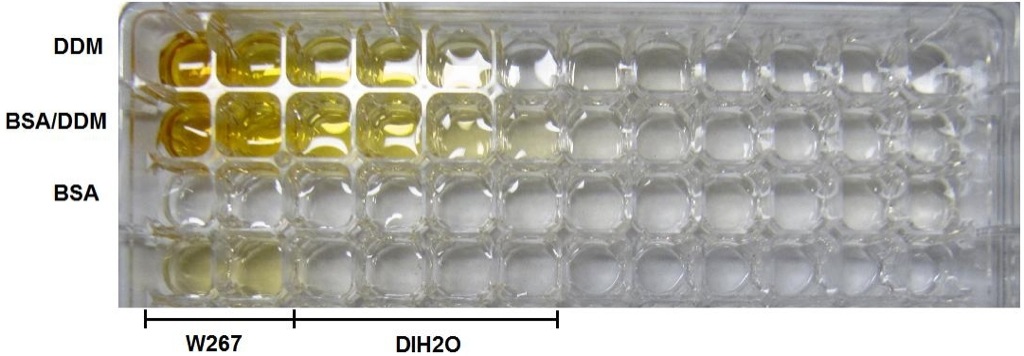
The above image illustrates the colorimetric assay results for the DDM, BSA, and DDM-BSA dilutions. As expected the assay detects the presence of detergents in the DDM-BSA solution, and as previously shown is not triggered by the presence of BSA protein. The bottom-left shows a color change associated with the SC267 separation, and the DI-water control shows no color change. Note: The average absorbance values associated with the DI-water controls and the BSA dilutions are approximately the same, about 0.07.
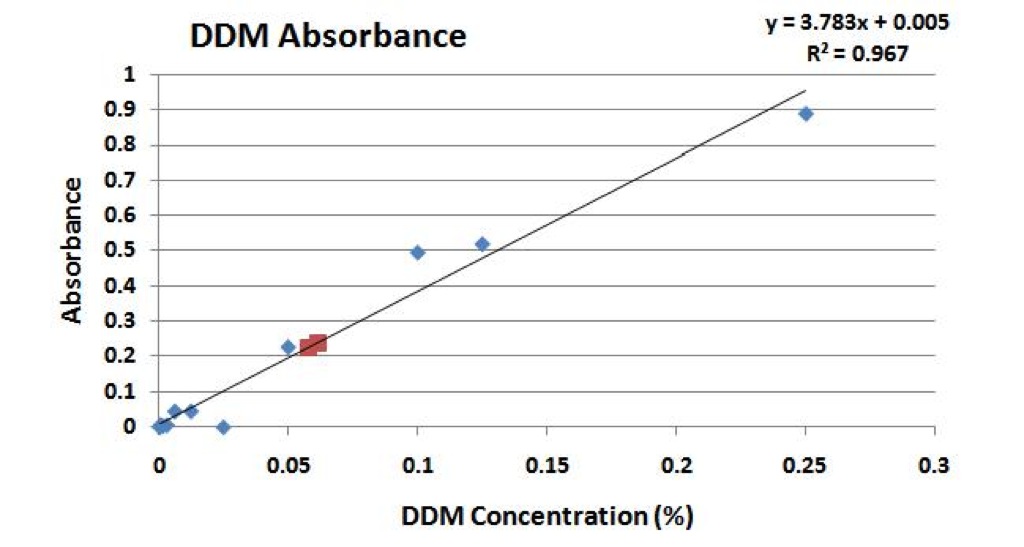
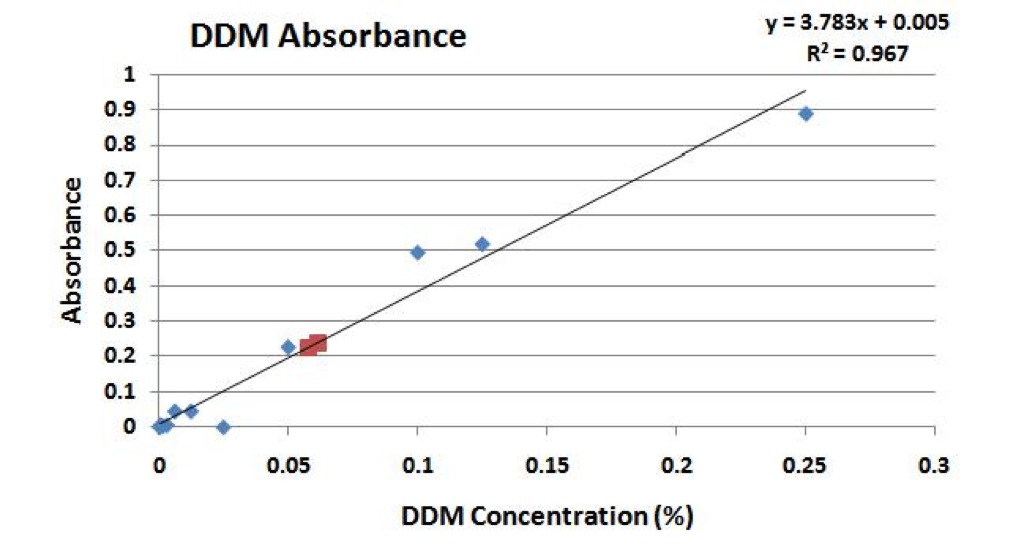
The blue data points in the image above show the linear concentration vs. absorbance curve established for the known DDM concentrations after having been normalized to absorbance values for DI-water controls. The red data points represent the DDM concentrations calculated using the linear regression of the known concentration points. The initial DDM concentration of the diffusion sample was 0.5% (after 50/50 mixture with BSA). The concentration of DDM in the 60uL filtrates was calculated to be 0.061% and 0.058%.
This experiment shows that DDM is able to diffuse through the pnc-Si membrane, however it does not show whether BSA was also able to diffuse across. Unfortunately I cannot run a Bradford assay on the filtrate because the presence of detergents in solution also triggers the assay. The next step is to run samples from the same wafer side-by-side, some with only BSA and some with BSA and DDM. This way the presence of BSA in the filtrate could be tested directly.