Crystallization of free-standing amorphous membranes
Last week, I annealed a few amorphous 15 nm TEM grids in the RTP. We have always speculated that the stress from the bulk silicon was a necessary condition to induce pore formation and I wanted to confirm this. I picked six different temperatures: 600, 700, 750, 800, 900, and 1000 C. They were annealed for 1 min.
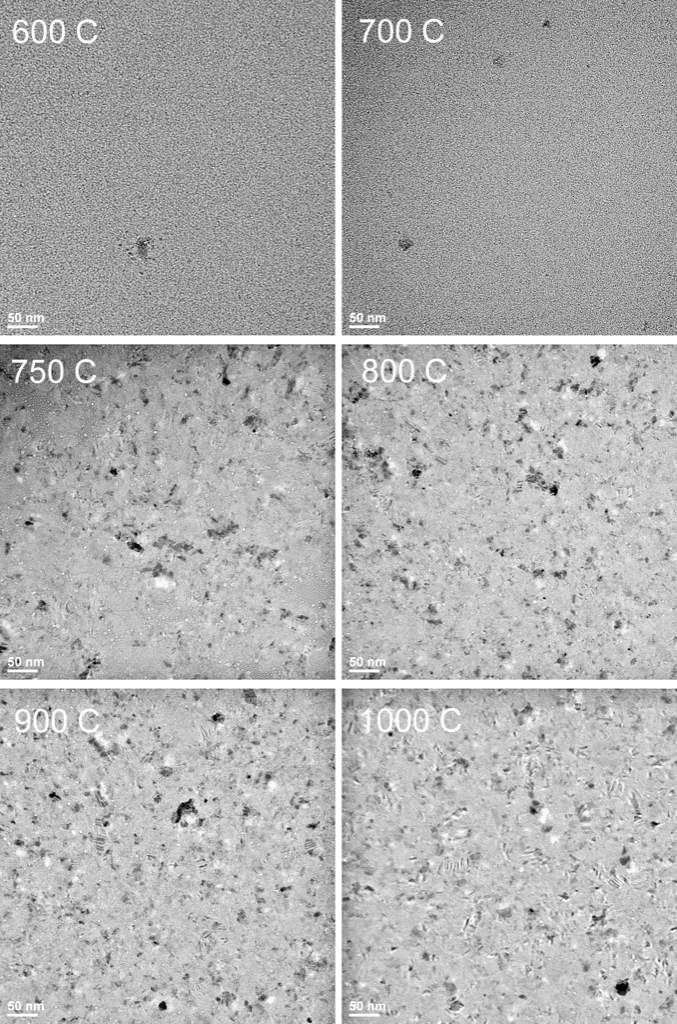
There is a transition between 700 C and 750 C from mostly amorphous to mostly nanocrystalline material. It is unclear what the exact temperature at the membrane is, but these were annealed inside the susceptor so my guess is that we are pretty close to the TC reading. As expected, with increasing temperature the crystals increase in size.
From these images, there does not seem to be any through-pores. But as we have learned in the past, just because we can’t see them does not mean there are no paths for small molecules to pass.
Lastly, the 800 – 1000 C annealing condition yielded flat membranes. These would be good candidates for Barrett’s experiment with vacuole growth on a “non-porous” membrane.
Might be good for H2O2 permeability too. Doing both would be interesting. Is it possible that cells are exquisitely sensitive to permeability so that they form vacuoles on membranes that only pass H2O2?
I forgot to comment on this earlier – my post here was supposed to investigate porosity vs. vacuoles. My 0% porosity sample was SC348, which (based on this post) is porous enough to pass H2O2. So maybe cells are sensitive enough to this minute porosity?
Let me make sure I understand the results. First, are you saying there are no visible pores even for the samples annealed at the highest temps? It seems to me I can see a few pores… Second, if you annealed at the same nominal temp the usual samples (i.e., sandwiched between SiO2), are you saying these usual samples are porous at all or some of the temps? Finally, these films were bare Si films, stripped from the oxide and substrate-free, correct?
Philippe
Philippe –
1. I agree that there are features that look like pores, but from my experience these are just areas of thinner material. As Jim suggested, it would be a good idea to run H2O2 and Rhodamine permeability experiments.
2. I have never tried annealing a membrane with the protective oxide still present (on the list of things to do). I did run an experiment a while back where I took a partially crystallized membrane and annealed it again.
3. Yes, the membranes were annealed after the bulk Si etch without protective oxide.
In the past, when the RTP was new, we did a series of experiments where we etched to form membranes and then did the anneal. The reason for this experiment was that we noticed that we could easily make pinhole-free a-Si membranes, but not pnc-Si. We found that if we kept the protective oxide on the membranes prior to the anneal, we could still form pores. However, this process would often damage the edge of the membrane where it anchors to the support. At that time, we had no luck annealing a-Si membranes without the protective oxide – they would break during the anneal. Our material must be a little different now.