Status the 'Harold Smith' Project
This is my attempt to summarize where we are with our investigation into the use of membrane arrays in high throughput screening. The effort is known colloquially as the ‘Harold Smith Project’ because the model protein system comes from Harold and is inspired by work in his laboratory on HIV.
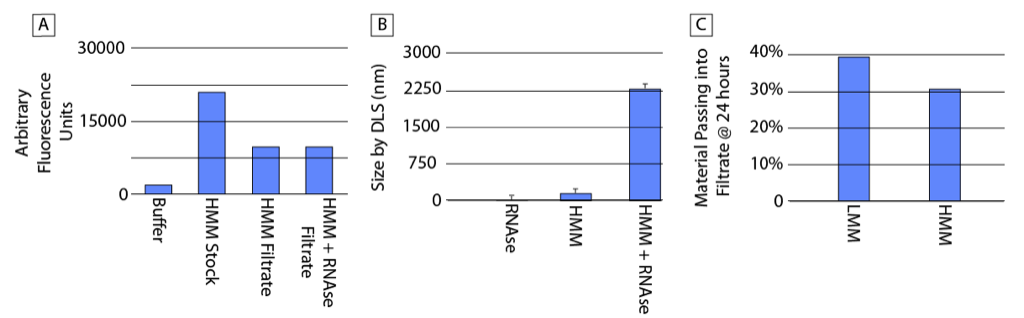
The principle being tested is that in a high throughput screen format, arrayed membranes that retain pathological complexes away from arrayed detectors, will allow investigators to identify compounds from a library that disrupt the complexes, because small pieces will be liberated and pass through the membrane to detectors. In Harold’s case, the pathological complex is an assembly of a protein known as A3G and RNA. The minimal form of A3G is a dimer. Harold originally told us that he thought the dimer was the active (desirable form) while the RNA complex was tetrameric or larger and inactive. Recent work in his laboratory suggests that DNA is necessary for A3G activity. So the best current picture is that RNA sequesters A3G dimers from DNA and disruption of RNA/A3G binding is necessary for the anti-HIV activity of A3G. Thus far, we have investigated three aspects of this project:
- Identified pnc-Si membranes that pass LMM A3G but retain HMM A3G.
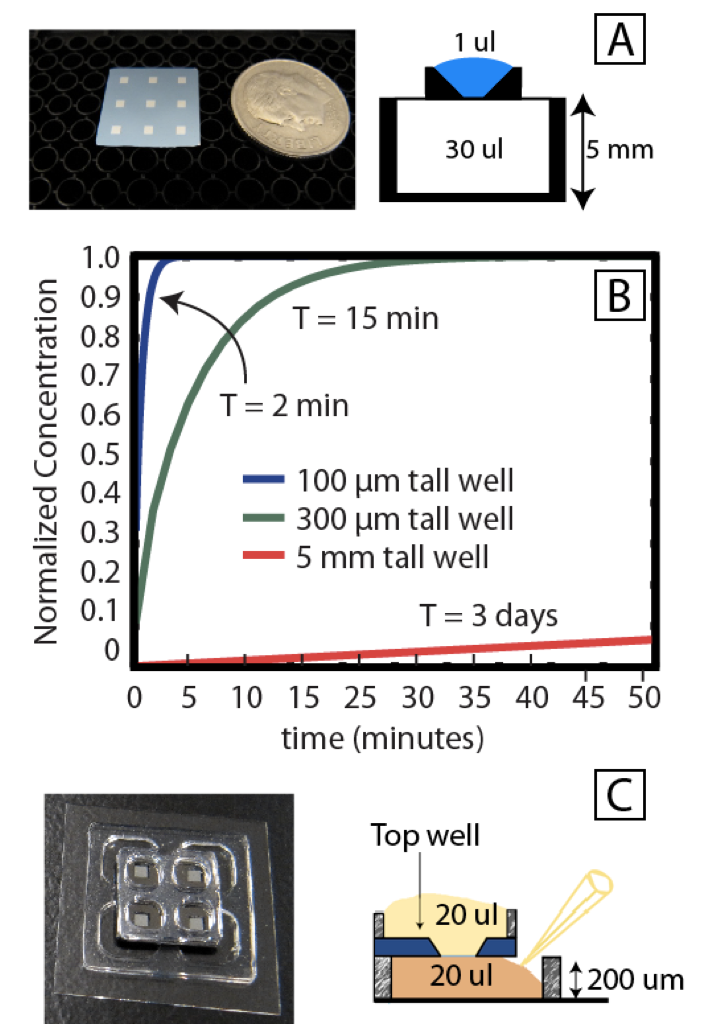
- Addressed the proper design of arrayed formats
- Investigated the use of general fluorescence assays for detection of protein in arrayed assays