Shadow Mask ITO Deposition Characterization
Josh has been kind enough to fabricate a shadow mask for me to create interdigitated electrodes without the hassle of photolithography and etching. In order to be able to use this method, I want to make sure the produced electrodes are the same or better than the old method. I worry about shadowing effects due to improper seating of the slides/coverglass (space between the glass and the shadow pattern) or the height of the pattern itself (~1mm). In order to quantify the degree of irregularity, I can take profilometer readings to assess the gradient, electrical resistance measurements and optically compare the processes using DIC.
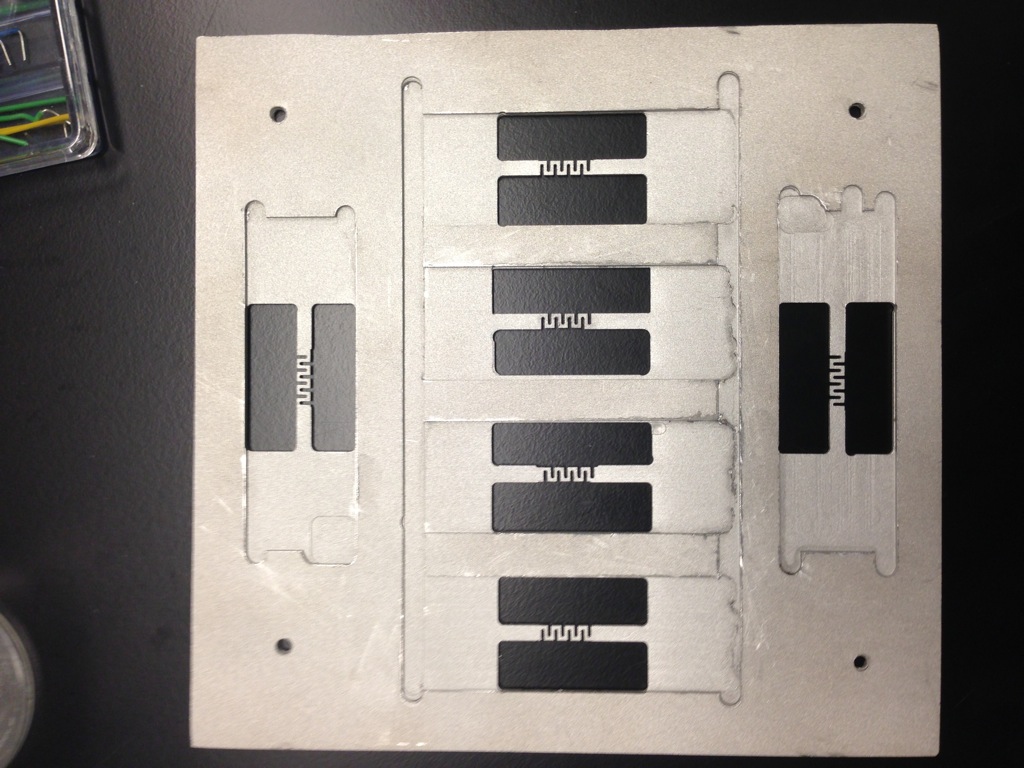

Using a basic, unheated recipe did not produce a conductive film, nor the means to characterize any shadowing effects, as the contrast was low and the profilometer didn’t register a step height . Rerunning the film with the 1500A recipe produced a conductive film, but with significant variation between the pad area and the fingers, as well as resistances cross the mask. Different film colors corresponding to variations in thickness were observed.
Shadow Mask ITO Deposition Resistance Statistics
Line Scan across ITO Shadow Mask sputtered finger

Seeing the large disparity in resistances between coverglass and the slides, I’m assuming that the heating of each substrate may play a role in this variation.
Some drawbacks are the aformentioned shadowing effect; nonlinear electrodes will not serve us well, as the thickness and thus resistance of the film is not constant. The density of the electrodes is also not great, I had to reduce the number of fingers in the channel to 5, down from 10 with the photolithography. A new mask would have to be milled using another process than the one Josh used in order to regain that finger density. I have to tape in the coverslip electrodes because they are smaller than the microscope slides, and could easily slide around, producing alignment problems.
Based on these results, I cannot use the shadow mask in its current state. If we can reduce the thickness of the mask, we can reduce the shadowing effect and get more consistent films.