3-mer PEG vapor deposition on pncSi: time stability studies
This is my first attempt of depositing PEG using vapor deposition methods, in a controlled fashion. The stepwise procedure:
- Josh was extremely kind by providing me with a diced pncSi wafer [windowless]. He taught me how to do the buffered oxide etching to remove the native oxide from the surface. This step is just to ensure that I have a consistent surface everytime I proceed with my experiment. The BOE process includes dipping the membrane in 15:1 HF solution for 60 mins [time needs to be optimized!] and drying it in IPA.
- After BOE, I immediately treated the membranes in UV-OZONE chamber for 15 mins to oxidize and charge the surface. This is for cleaning and for exposing the -OH groups on the surface.
- I used the smallest PEG with 3 units in the physical vapor deposition device [LADD system, SEM prep room]. I vaporized about 60 ul of silane for one cycle, which took approximately a bit more than a hour.
- Immediately after the PVD, I washed the membranes in IPA and dried using nitrogen. Acetone based sonication could be done to remove physically adsorbed silane, but I did not do this. Contact angles were measured for untreated sample [n=1] and treated samples [n=3] on Day 1, 2 and 4.
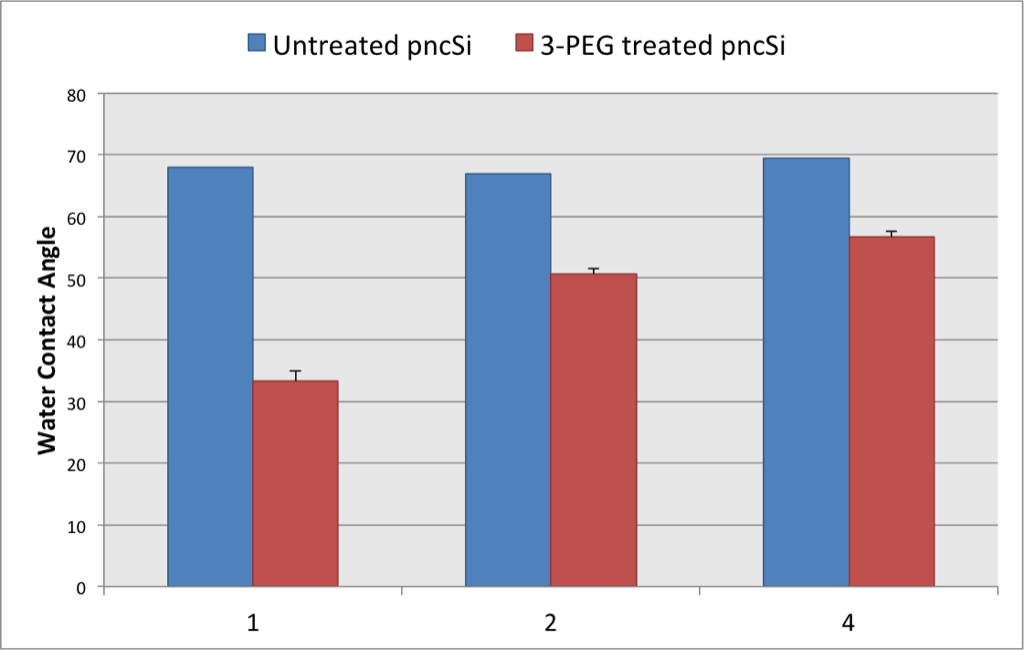
The hydrophilicity falls down for the treated samples, showing the instability of the deposition. All samples were stored in dry conditions [gel pack] and reused. More details about this experiment in next post ……