Clogging as a function of Active Area and Concentration
In this post we look at the effect of altering the area available for filtration on a standard 5 slot SepCon. Karl and I did this by simply cutting gaskets such that they covered different regions of the surface of a chip. We have three configurations, 1, 3 and 5 slots. Here’s a picture of a 3 slot:
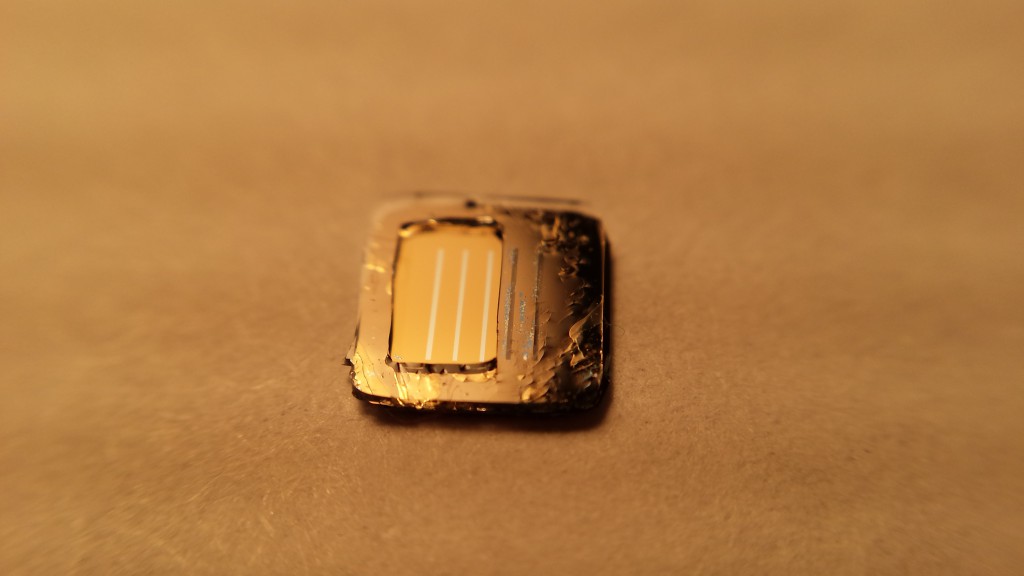
Karl and I measured the permeance of all of the chips in this experiment to verify that we were getting good seals with the gaskets and consistent slot coverage.
We used 100 nm polystyrene beads in 1xPBS and 0.1% Tween 20. 10 uL of buffer was added to the top and bottom of the chip to induce wetting. 300 uL volumes of NPs were put in the SepCons. We used the angled rotor centrifuge at 3k rpm. The chips were taken from the center of wafer 1142. (~14%, 36nm)
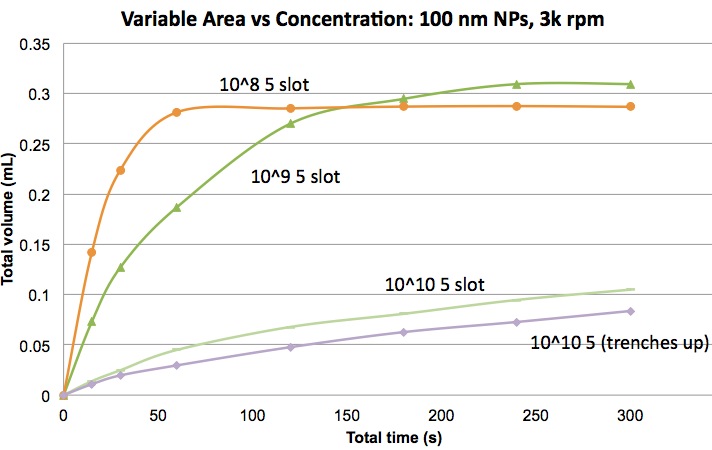
The first plot is of the samples using 10^10 particles/mL. We measured the mass of the filtrate at different intervals up to 5 minutes. I decided that the best was to orient the chip for a good gasket seal was with the membrane side up. Typically however, SepCons are assembled with the membrane down (trenches up). So to make sure the orientation wasn’t significant, I did a side by side comparison of 5 slots with 10^10 assembled in both ways. We do see a difference and it may be enough to warrant further investigation, but I don’t think it will have a significant impact on the findings of this study.
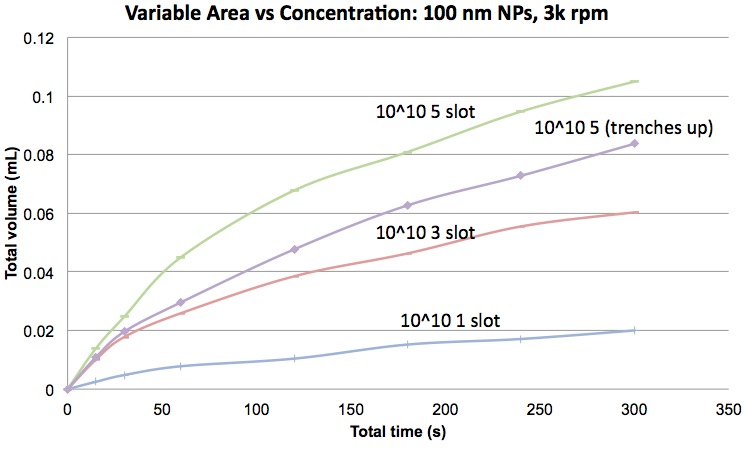
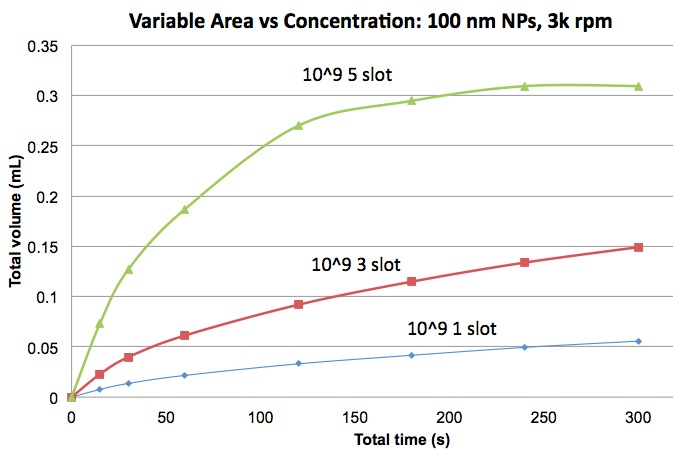
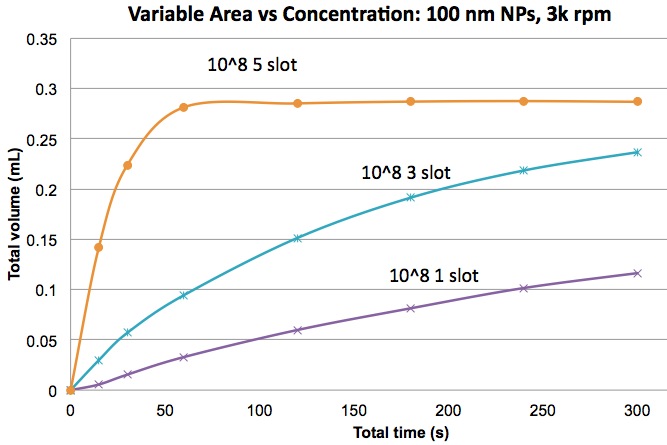
So we see that more slots pass greater volumes of filtrate. That trend continues with 10^9 and 10^8 as seen below. (Keep in mind that once the filtrate volume gets to ~0.250 mL, there is limited material left in the reservoir and the results tend to be less consistent.)
Next I’m plotting the different slot numbers for all three concentrations.
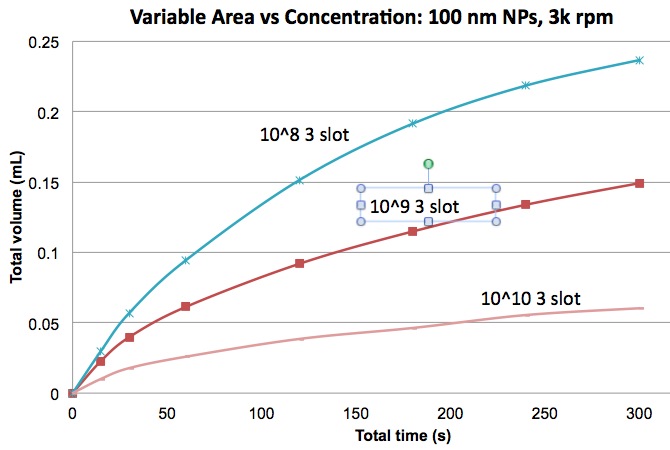
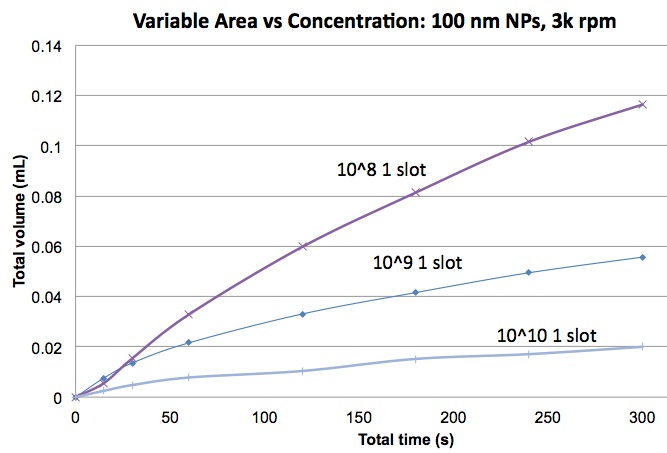
Finally, I’m plotting a comparison of the different slots and concentrations at a fixed time, namely 1 min and 5 minutes. Interestingly, the 10^10 filtrate volumes are fairly linear with active area, while the lower concentrations show a greater increase in filtrate volume with active area than I would have expected. It may be that these differences could be explained away by really digging into details of the forces in the angled rotor and the difference in pressure on the reservoir when full vs nearly empty, but I have not done even preliminary calculations to investigate.
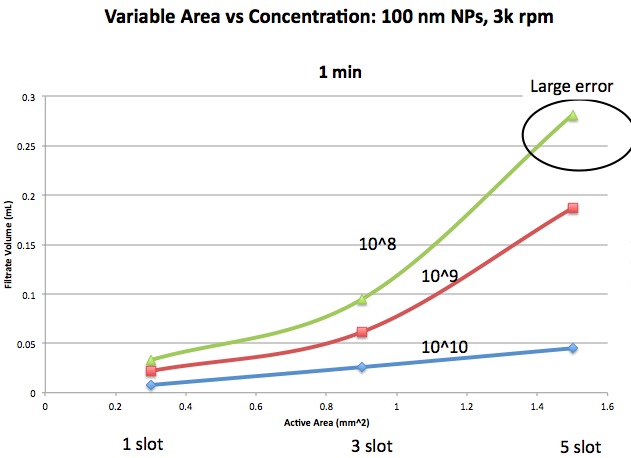

In summary, we have proven that more area is better! But we also now have a better idea of the minimum area necessary to do a separation using “lower” concentrations of particles. For example, if we are dealing with 10^9 particles/mL, using only 3 slots of our standard SepCon should be sufficient to concentrate the retentate in ~10 minutes.