Using Resistance Measurements to Ensure Al2O3 Film Integrity
Sarah recently attempted to build a prototype voltage-gated drug release mechanism using one of my standard nanofluidic transistors. When she turned on her circuit (pictured below),
instead of getting voltage-dependent diffusion behavior, she instead saw electro-osmosis.
We’ve been debating what this means, but I contend that this means the insulating alumina film coating the silver is either incomplete or fractured, and as a result current is free to flow out from the silver into the bulk fluid using the commonly exploited Ag/AgCl redox reaction. I made some new bare silver chips (12 nm Ag on 3.5 nm Ti) in the PVD and compared them to an older batch of NFT’s (that I made before my vacation) and got quite similar resistance values (pictured below):

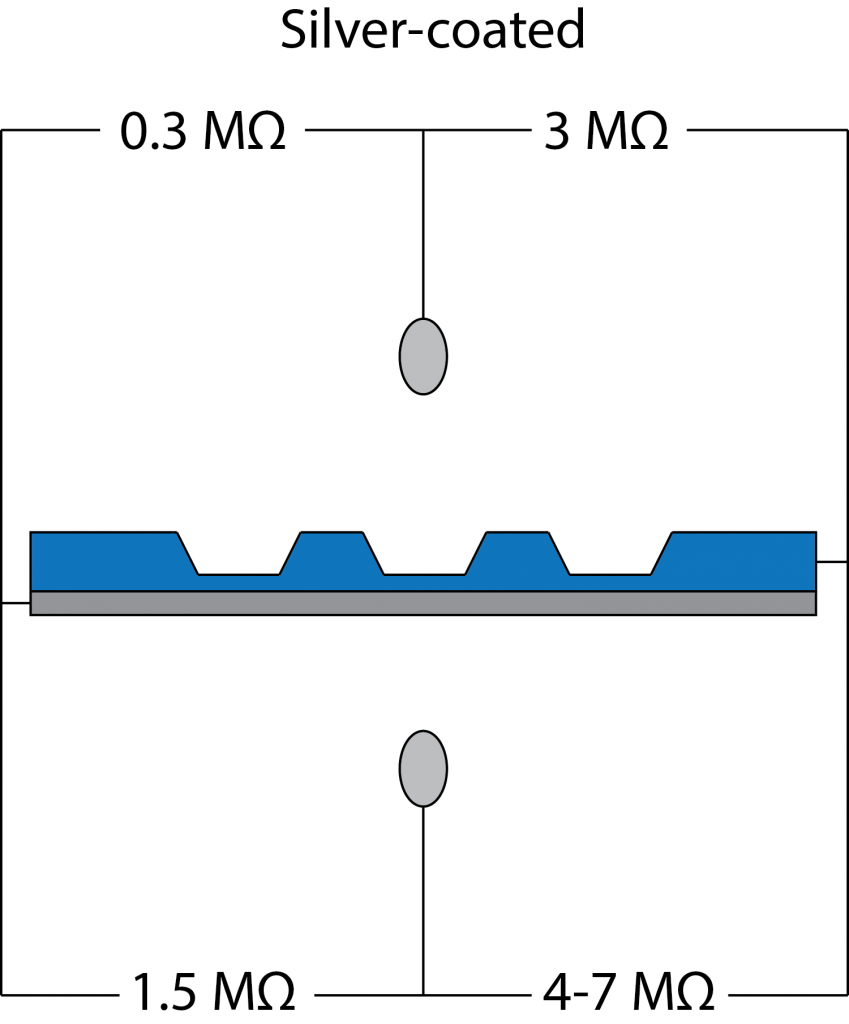
It could be that the Alumina coatings degrade over time (and indeed most of the old NFT’s have obviously degraded), but perhaps that’s not the lesson to take from this. I’ve been using silver coatings because they’re relatively easy and because Josh knows everything there is to know about thin silver films, but silver is almost the only metal (iron can redox a little it looks like) capable of failing in this particular way. It seems to be an obvious and easy fix to switch over to platinum or gold coatings, with platinum being particularly attractive because we can use the ALD for them. I made some platinum chips earlier, and the resistance measurements are below:

First, note that the coating isn’t purely on one side (it should be on both top and bottom because I used ALD to deposit the Pt). What is weird is that the resistances are so low, when Pt should be behaving like a perfectly non-polarizable electrode. I tested the voltage that the ohmmeter uses to measure resistance, and it can be as high as 5 volts, meaning electrolysis of water is likely happening, allowing current to flow. In fact, I found that making resistance measurements damaged my electrodes (presumably because the voltage was so high) and I am in the process of replacing them. Measuring resistance to determine film quality doesn’t work as well as I’d hoped, and in the future I’ll either need another technique for interrogation or I’ll just switch over to platinum where I won’t have to worry about alumina coatings.
If you are using a multimeter to measure the resistance and it is set to autorange, it will adjust the voltage to what it thinks is best. I think if you pick a specific range on the lower end of resistances it will fix the voltage to a lower value.
I think you also might be best running a voltage sweep and measuring current to see if the response is linear. I would guess it is not given the complex nature of your system.