Zeta Potential measurements with MgF2 nanomembranes
I believe that we can use MgF2 nanomembranes as electroosmotic pumps, along the same lines as pnc-Si and NPN materials. To first get a sense of how much pumping I would expect, I wanted to know what the zeta potential of these membranes would be, as the potential is directly proportional to the amount of pumping. I found a paper (Waltz2011) suggesting that MgF2 nanoparticles have a zeta potential curve that would be very useful in an acidic setting.
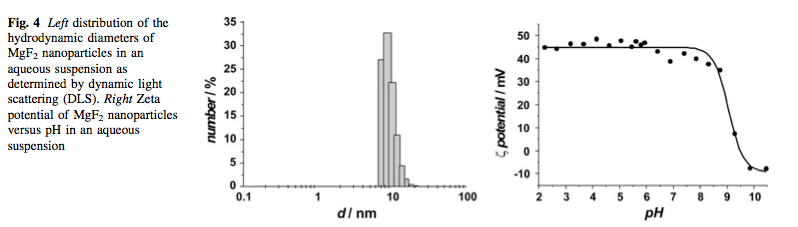
For comparison, Karl has shown zeta potentials around 20-30 mV for nanoporous nitride in the pH 6-8 range. If there were the same pore sizes/distribution and thickness for my fabricated MgF2 membrane as in the membranes he tested, I would expect there to be a 1.5-2x increase in pumping volume for the same active area.
To attempt to get a few measurements of the zeta potential, Karl and I used the streaming potential measurement setup in the basement. After wetting and inserting the chips into the o-ring holder (10 M KCl, pH 7.2, conductivity 1543e-6 S/cm, ), we equilibrated the chips and Ag/AgCl electrodes in the system for 5 minutes. We proceeded to record a pressure and measure the resultant voltage shift across the membrane, incrementing the pressure and letting the system equilibrate over 15 seconds.
The membranes used here were fabricated from NPN wafer 1127 initially, with an average pore size of 40 nm and 18% porosity. I ran my MgF2 process, depositing 50 nm of MgF2 at room Temperature, annealing at 700 C, and then etching the NPN away with RIE (CHF3 + Ar + O2 for 120 s, then a 30 s O2 plasma clean). I ran this process a few times, creating different lots.
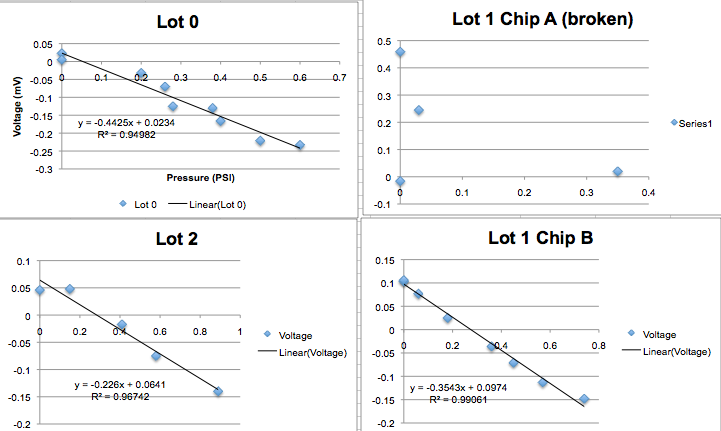
Zeta potentials:
Lot 0 = -13.96 mV
Lot 1 = -11.18 mV
Lot 2 = – 7.13 mV
I had given most of the unbroken materials to Kevin when he came over this August, so we were unable to get replicates for each of the lots, where we did not break the chip upon insertion. The lots were run in chronological order (Lot 0 -> Lot 2). These numbers are very low compared to the published data. It will be interesting to see if these low values hold up under further zeta measurement and back calculations from EO flow rates.