Sneak Peak of a Simple “All Purpose” SiN System
Hi all,
Presented here is a prototype of an “all purpose” SiN chip system for use in cell studies. The reason it was called “all purpose” because it is intended for simple cell culture and migration/chemotaxis studies.
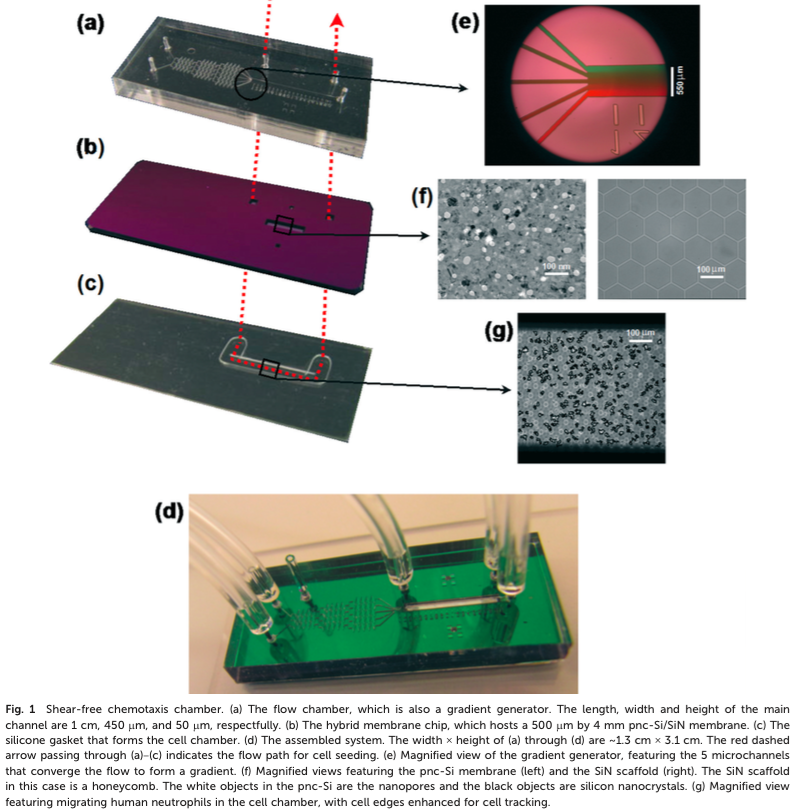
This prototype is essentially a less complicated and cheaper version of the device that was showcased in our Lab on Chip paper, which has the following system schematics:
The prototype looks like this:
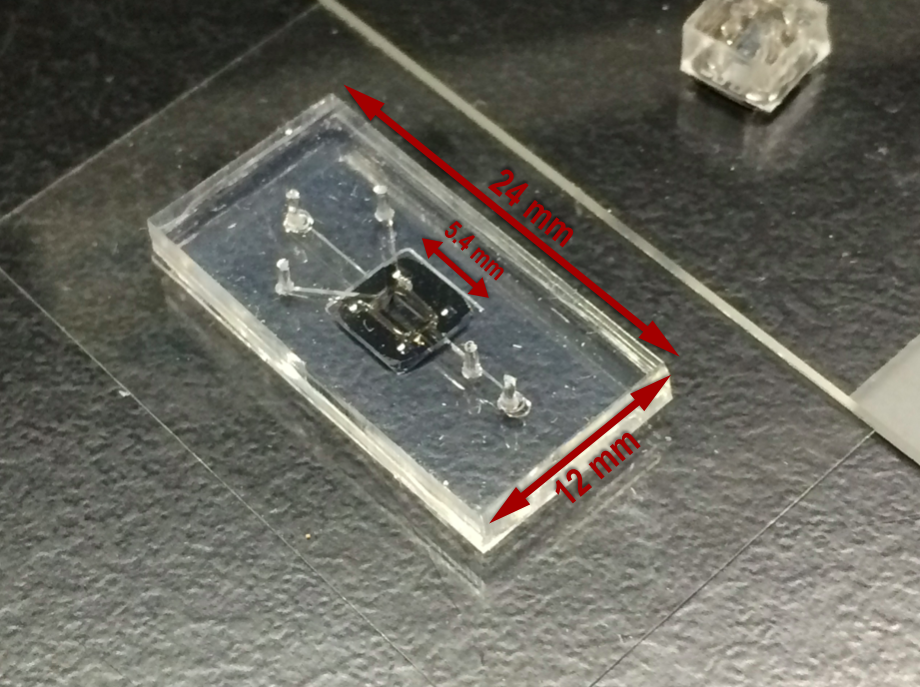
The main difference between this prototype and the older design is the use of a smaller membrane chip and the elimination of the premixer gradient generator (that was pioneered by the Whitesides group back in around 2000), which looks like this: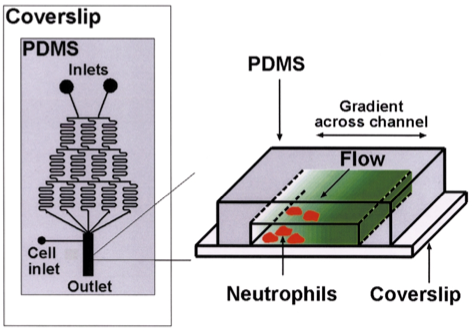
Before, I used a bigger membrane chip so I have more “real estate” to bond the premixer gradient generator. From my past experience, the bonding of PDMS to silicon (or glass) is easier than the bonding to PDMS to PDMS, possibly because the PDMS “conforms” to the stiffer silicon substrate better. Since I do not want to have seepage between the neighboring serpentine channels, I chose bigger chip in favor of the use of PDMS to create the real estate.
Subsequent examination our lab on chip chemotaxis device showed that its OK to have a steep gradient, because after the gradient diffuses through the membrane there will be decrease of gradient steepness due to diffusion. So instead of using the premixer gradient generator as the mean for forming the gradient, we can use a T-sensor instead, which looks like this:
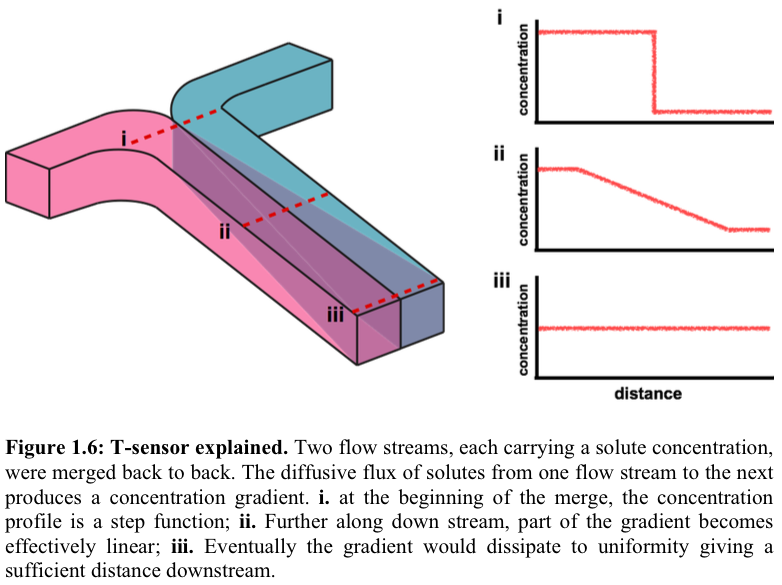
While the T-sensor produces a much steeper initial gradient, it actually can help us address the decrease in gradient steepness as the gradient pass vertically through the system. The T-sensor is also much simpler in design.
Recently, Tejas has demonstrated a good use of silicone gasket to create the real estate for his microfluidic device for TEER study. The key strategy Tejas utilizes is to UV-ozone-bond the gasket to the chip first to compartmentalize the system, then “fill up” the rest of the system with more gaskets or PDMS. I have adopted this approach and used T-sensor for gradient generator, yielding the presented prototype.
The inlet- and outlet- inserted device looked like:
![[UniT] full_device_view_labeled](https://trace-bmps.org/wp-content/uploads/2014/11/UniT-full_device_view_labeled.png)
Below is a movie of the shear-free chemotaxis conducted using the above device:
shear_free_chemotaxis_300um_height
For ease of fabrication, I have used the 300 μm gasket to form the cell compartment. 100 μm gasket (which was used for our published manuscript) may be better and I will use that for my next iteration of the device.
After the chemotaxis experiment (at 37C), we observed bubbles in the flow compartment (the T-sensor that generates the gradient). Consistent with previous observations, the bubbles are always formed on the top compartment (where there are flow). We speculate the bubble formation to be related to pressure differential (whenever there is a decrease in pressure, bubbles form at the region of lower pressure). However, this is purely speculative and requires and further investigations.
![[UniT] bubble_formation](https://trace-bmps.org/wp-content/uploads/2014/11/UniT-bubble_formation1.jpg)