Error made when assuming identitcal pore size during simple flow modeling
Hi all,
Sometimes for flow modeling I assume all pores to be identical in size. However, since larger pores allow much higher passage of flow, the above assumption will generally underestimate the prediction of flow.
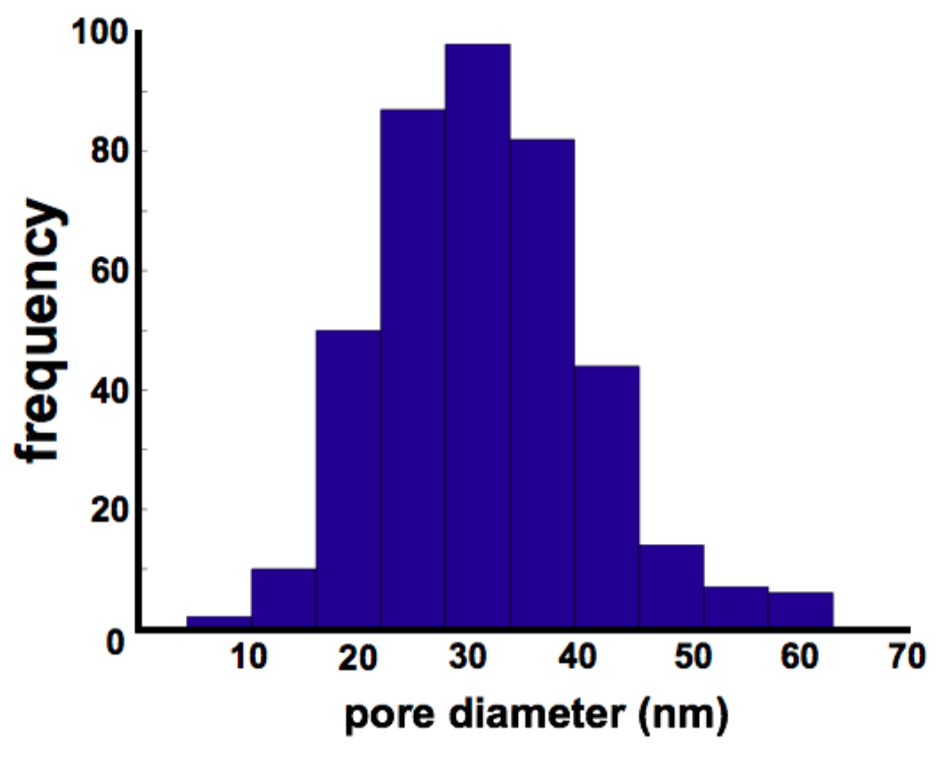
Presented here is a simple example, base on the following pore distribution (obtained from a SEM image):
Assuming all the pores in the membrane are resistors connected in parallel, the permeability of the membrane can be calculated as:
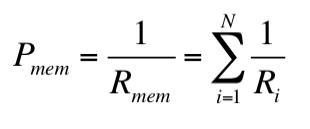
where Pmem is the membrane permeability, R is the pore resistance determined using the Dagan’s equation, and i indexes each individual pore.
Evaluating the membrane permeability base on the given distribution of pore size, we obtained a permeability value of 5.30 × 10⁻¹⁸ m5/ N×sec (assuming the membrane thickness/pore length of 15 nm and the viscosity of 1.0 × 10⁻³ Pa×sec).
In our idealized framework of analytical model, however, we assumed all the pore diameters to be identical to the mean. Under this premise, we have the membrane permeability as
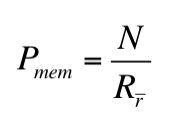
where N is the total number or pores (400 in the case), and each pore has the resistance of 1.36 × 10²⁰ N×sec/ m5 (obtained using the mean pore diameter of 31.44 nm).
The membrane permeability obtained from the above equation yielded a value of 2.95 × 10⁻¹⁸ m5/ N×sec, which underestimates the true membrane permeability (5.30 × 10⁻¹⁸ m5/ N×sec) by a factor of 1.80.
If all our membranes have a similar ‘tightness’ of pore distribution, we are looking at a correction factor of about 2.