Derivation of an Analytic Solution to the Problem of Flux Decline and Fouling in a Centrifuge Tube
In my previous post, I derived a formula for the time-dependent flux decline in a centrifuge-driven membrane separation, assuming that the resistance of the membrane was held constant. The problem with that approach is that, as Josh discusses in this post, the resistance of the membrane increases with time according to one of several standard formulas – and choosing which of the standard descriptions of fouling best described our data was the whole point of the derivation in the first place.
As a more general solution, Jim derived the following set of expressions:


 is flux, with units of m^3/s. rho is the density of water, g is the force due to gravity (690m/s^2 in our small centrifuge when set to 3000 rpm). h is the head height.



 , where N determines the mode of filtration, with N = 2 corresponding to pore constriction, and N = 1/2 corresponding to cake filtration. Note that
  for pore blockage.
  is a constant we’ll also need to fit that at this point we have no derivation for.



taking the derivative with respect to time of both sides yields:




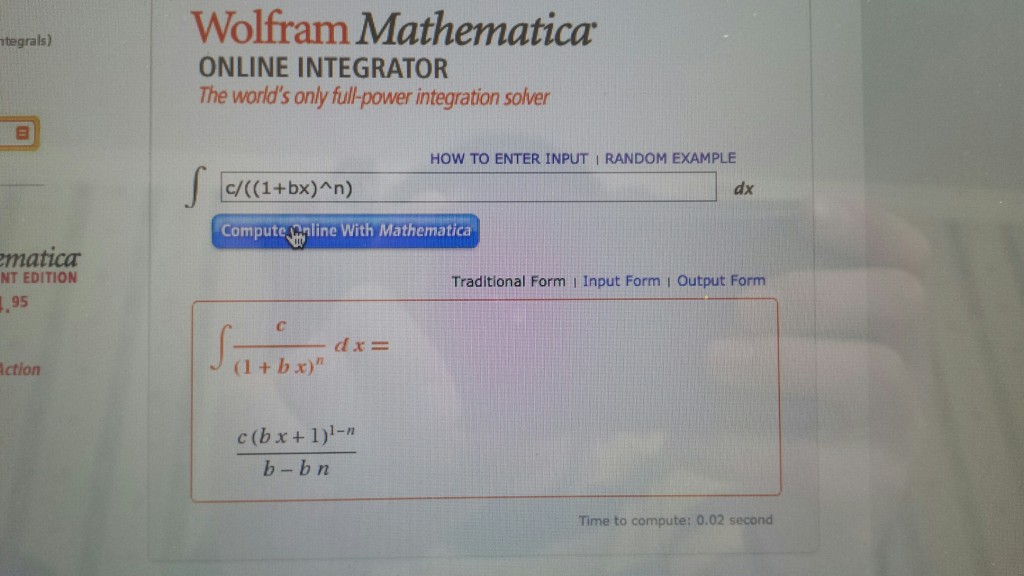



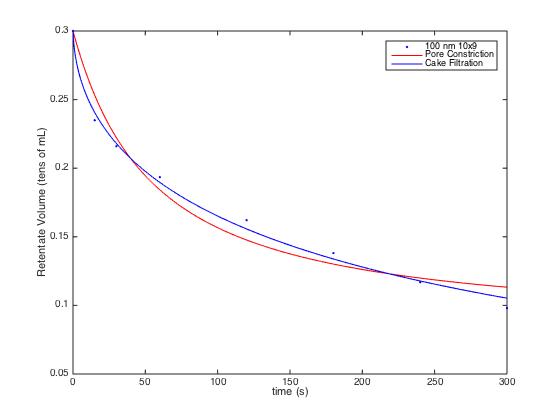
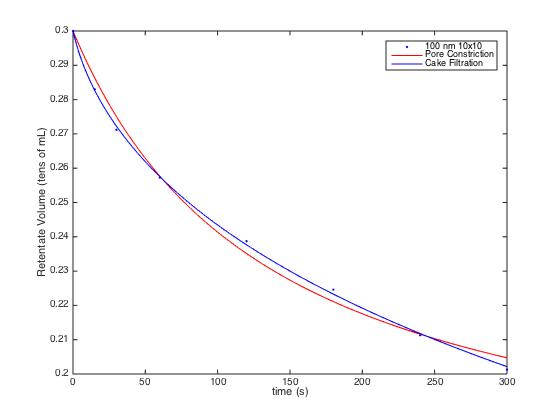
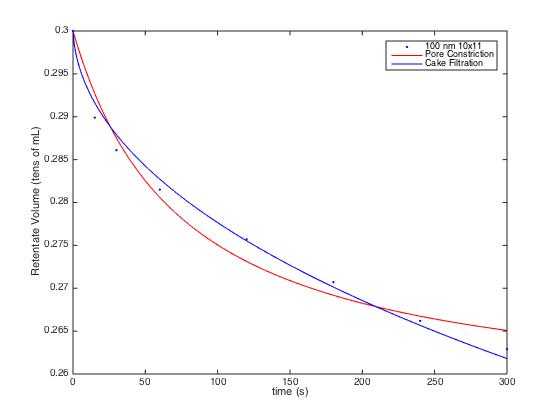
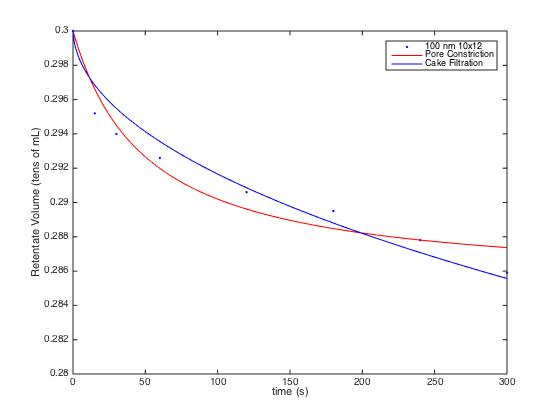
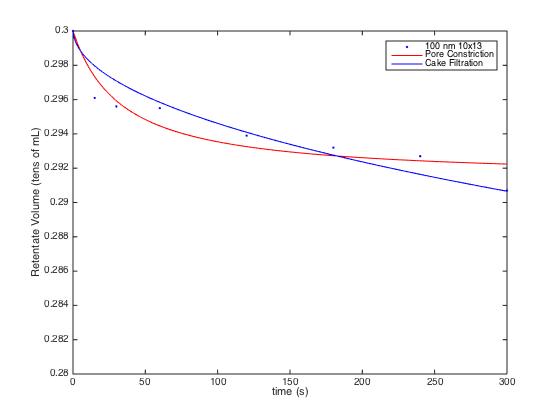
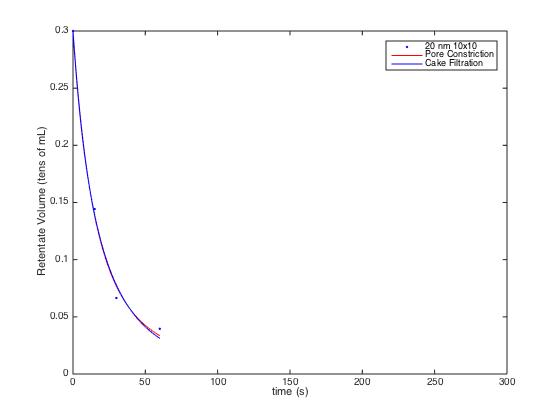
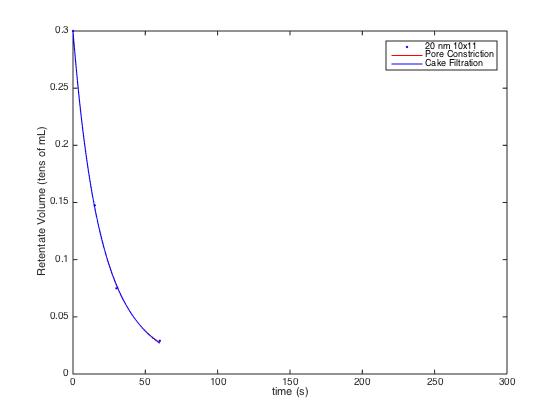
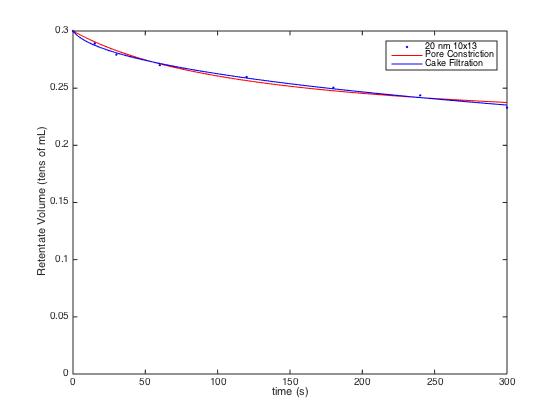
We can use this to fit our data:
What did you use for Beta for the fits?
Cake filtration looks great for 100 nm until 10^12.
Pore constriction looks good for all 20 nm fits.
Makes sense! Sadly Cake filtration also looks pretty good for most 20 nm.
Try …
Log V*/Vo = Constants + (1+n)*Stuff
And see if we can see the slope (1+n) more clearly.
I fit both beta and R_h. I want to repeat the fits with an empirically derived R_h, and I’m going to poke around to see if I can find a way to empirically derive beta. The fits will be far more compelling with that much less wiggle room.