Attempting to use Nafion-coated chips for salt water filtration
Jirachi has been working to make thin nafion films using our membranes as a support structure. Nafion is polymer that contains a sulfonate group, and as a result acts as a proton wire, allowing for cations (+) to be transported across a membrane, but not anions or electrons. Such a membrane can be used for filtering a salt solution, as the electroneutrality assumption (the voltage in an electrolyte everywhere is equal) means that if you can’t force anions through the membrane, no cations will go through either.
Normally nafion films are quite thick, but through a novel drying technique that takes advantage of the porosity of our membranes, Jirachi was convinced he had made a ~100 nm nafion film on a pnc-Si substrate, and gave me a few chips to test. Because efficient seawater filtration has such obvious immediate benefits for humanity, we were very excited at the prospect of using superthin nafion films to filter salt.
I measured the conductivity of a 15 mL sample of Barnstead water (I needed to wash the vial I was using ~ a dozen times before the conductivity stopped dropping with each successive wash, so be careful you’re using very clean glassware). I then measured the conductivity of 15mL barnstead water with 100 uL of 100 mM KCL added. I washed the beaker thoroughly and made sure I returned to baseline, and did this three times to get some statistical power. Next, I put two of the nafion chips (which appeared broken to visual inspection) into sepcon housings, added 10 uL barnstead water to the bottom, and 300 uL of 100 mM KCl to the top. As soon as the meniscus from the wetting slots on the bottom of the sepcon cup touched the sidewall of the outer sepcon cup, capillary action quickly drew ~100-200 uL of fluid into the filtrate. This is consistent with a broken chip, but I checked the conductivity measurements anyways, on the off chance that the membranes simply had amazingly high permeabilities. Alas, the measurements were consistent with the membranes being broken. Data is summarized below. Note that measurements of filtrate salt solution fall by ~10-20% because they are diluted by the 10 uL used for wetting.
Conductivity of 15 mL pure Barnstead water: 0.37 +/- 0.02 uS/cm (N = 3)
Conductivity of 15 mL Barnstead + 100 uL 100 mM KCl: 99.5 +/- 1.0 uS/cm (N = 3)
Conductivity of filtrate from chip 1: 76.0 uS/cm
Conductivity of filtrate from chip 2: 92.6 uS/cm
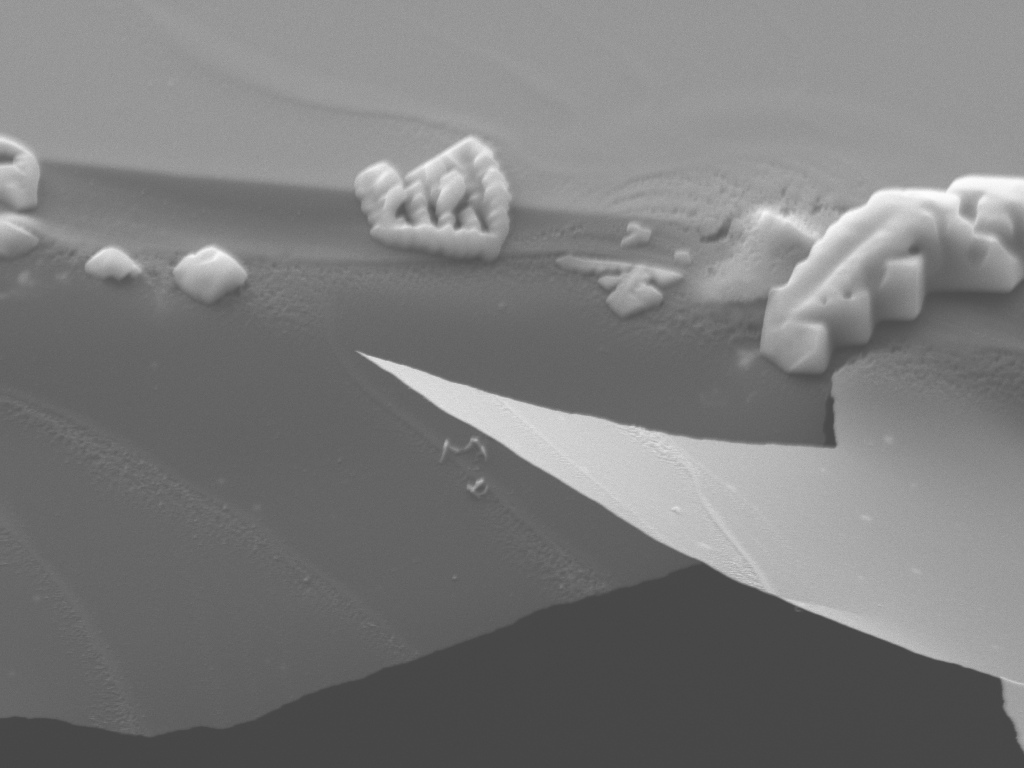
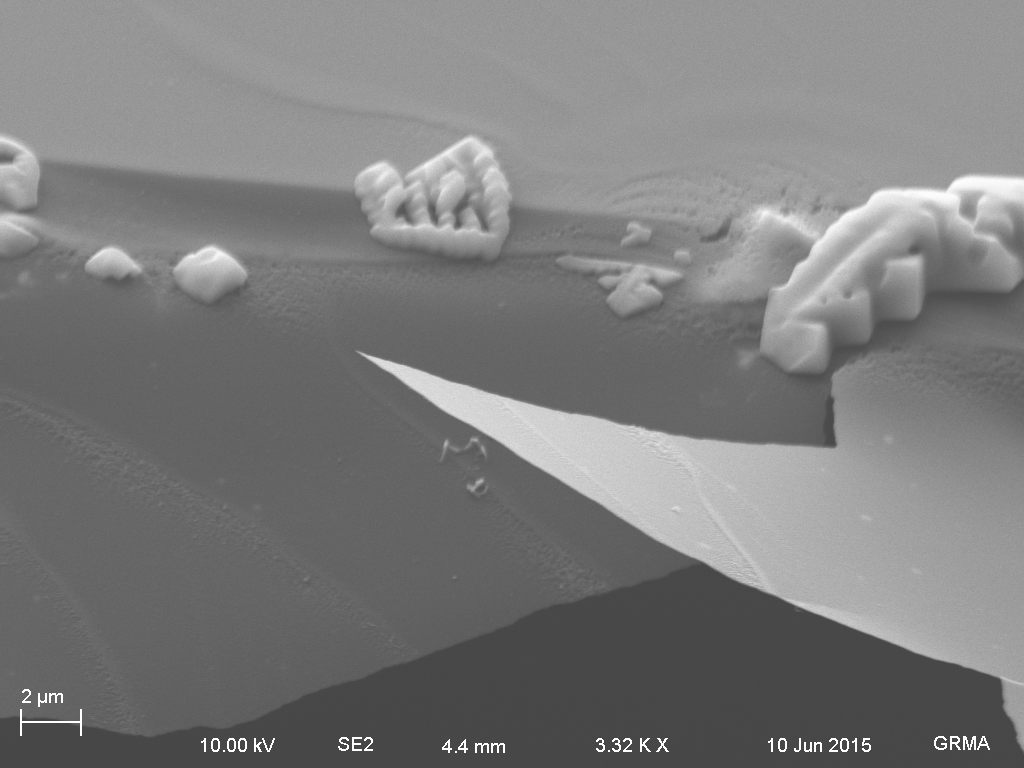
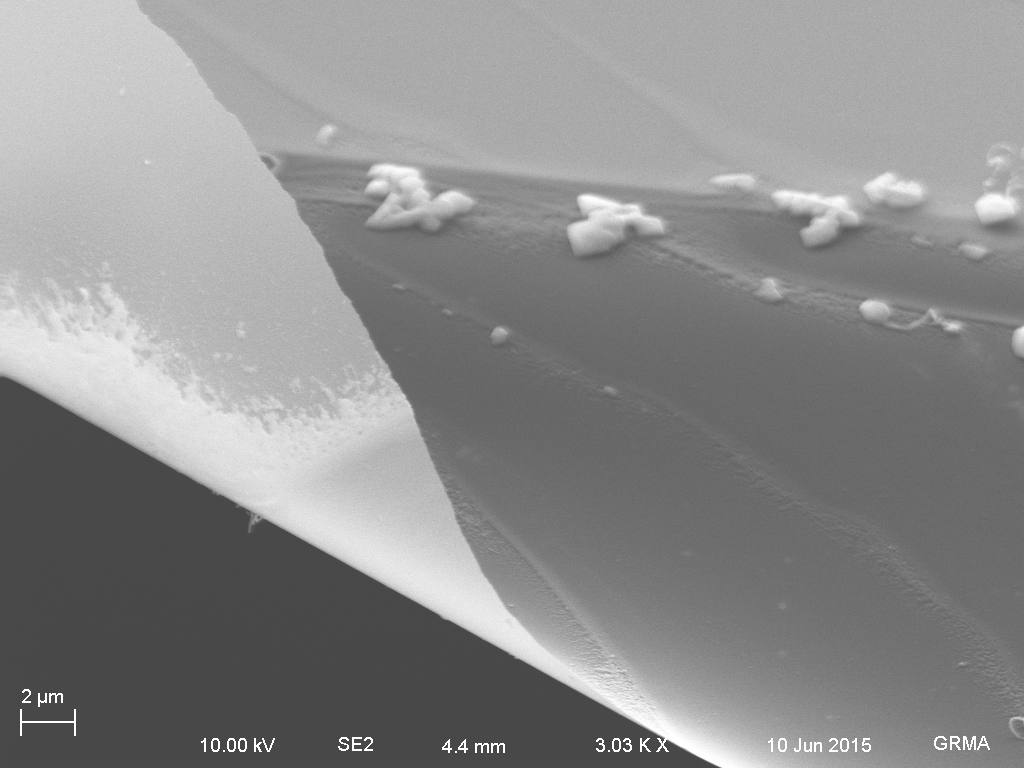
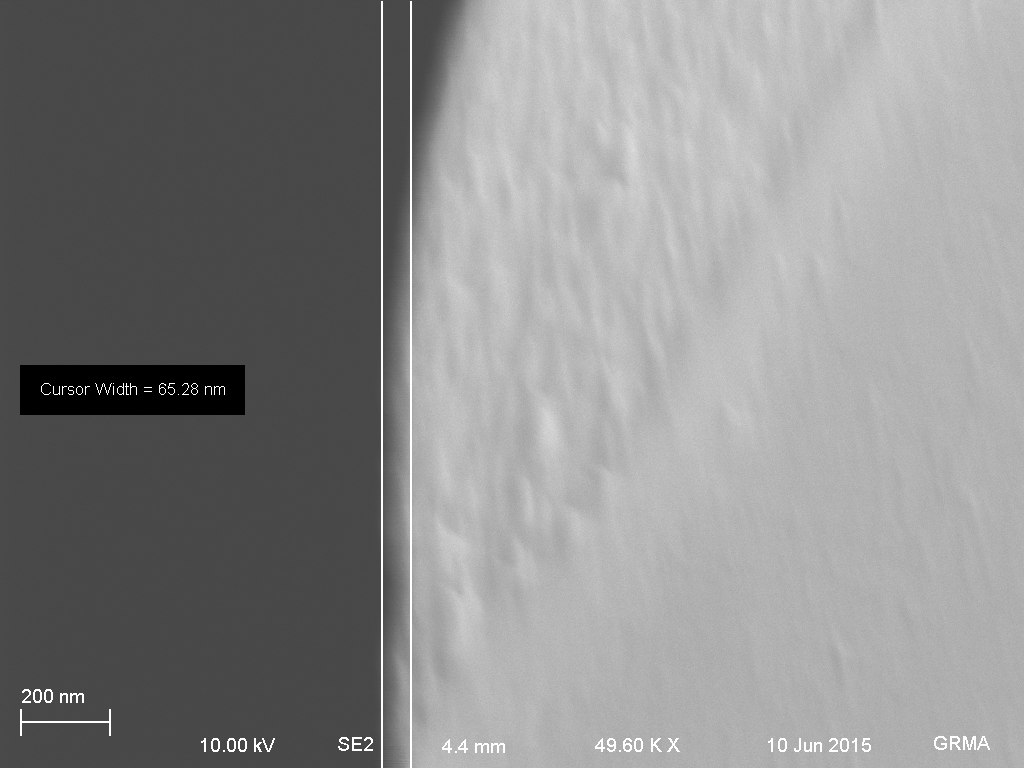
Greg helped me take some SEM images of the cross section of the chips. We were having some trouble focusing the beam, and Brian is out of town, so the images aren’t great, but it looks as though the total film thickness (pnc-Si + nafion) is ~65 nm. Maybe this means the nafion peeled away when I broke the chips, or during the filtration experiments (these images were taken on a chip that was used for the salt separations in the first half of the post). It’s not possible to distinguish the nafion layer from the underlying pnc-Si.


Are there any particular advantages for using pnc-Si for this work? Should the five slot SepCons with 50 nm NPN tried next?
Jamie – I don’t think there is an advantage to pnc-Si. But perhaps the nafion plays with it better. I do think we should try NPN next to find out.
Karl – Can you take a look at the chips in the SEM? Can we confirm Jiracahi’s 100 nm thick estimate?
Post updated with some SEM images of the membrane.