Chip Design for Hemodialysis and ECMO
Recently, SiMPore has been working on a new chip design which involves incomplete etches on both sides in order to create a fluidic system built directly into the silicon, consisting of many long, shallow trenches. These trench chips are designed to obviate the need for silicone gaskets on one side of the chip, reducing the thickness of the fluid exposed to that side of the membrane and thus improving the rate of diffusive transport of solutes out of that fluid. The most obvious application of this sort of design is to hemodialysis and/or ECMO, both of which rely on transporting large quantities of solutes out of or into a patient’s blood or plasma.
In order to assess the exact magnitude of the improvement this design represents for the transport characteristics of such a system over our traditional chip designs, I created COMSOL models of these chips exchanging solute with a dialysate and compared the results to those of a similar model incorporating the chip design Dean uses for his hemodialysis work.
| Trench Chip | Traditional Chip | |
| Simulation | 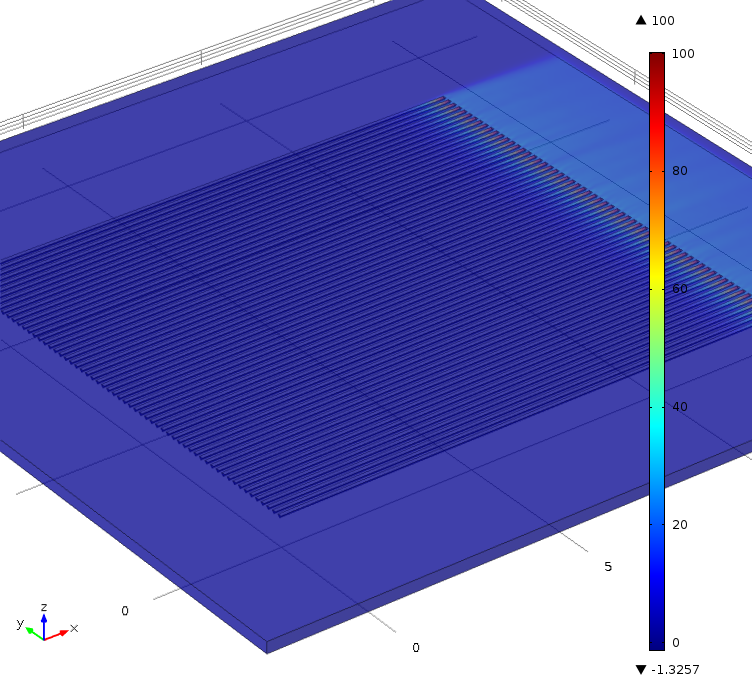 |
 |
| Well Geometry | 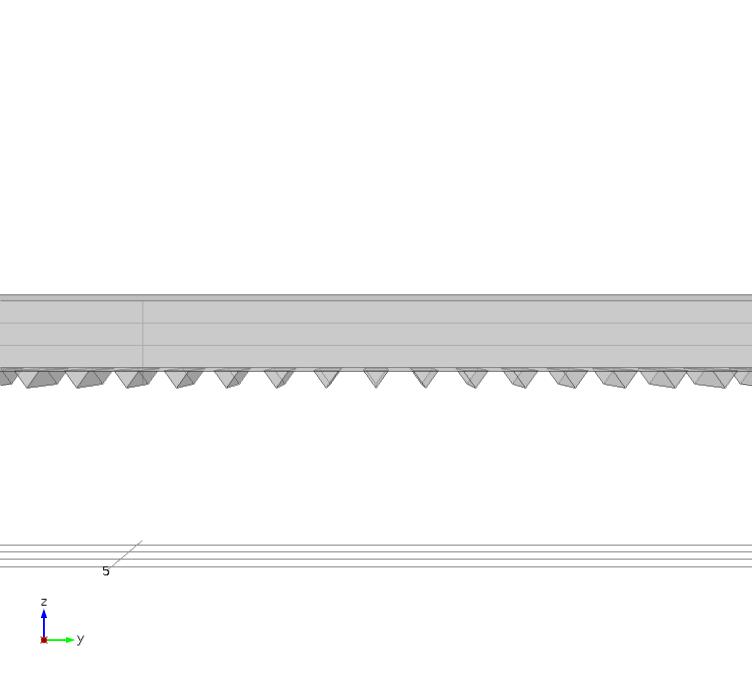 |
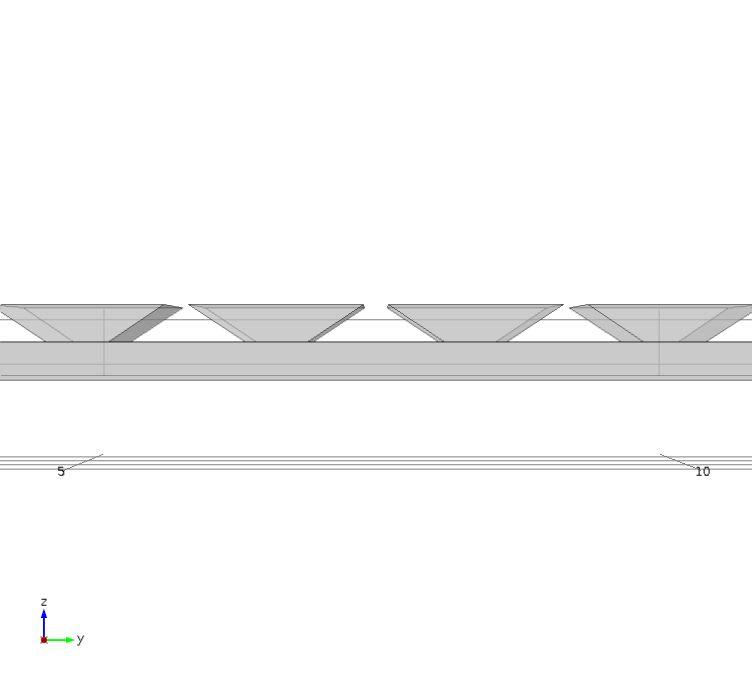 |
The trenches in the new chip design are triangles with a width of 0.1 mm and a height of 0.07 mm, compared to the 0.3 mm-tall trapezoidal wells of the traditional design. Based on my previous work, it’s unsurprising that the new design was much more effective in clearing the solute, which here had a diffusion coefficient equal to that of Cytochrome C: The old chip format cleared just 27.2% of the solute in the same time it took the trench chip design to clear 99.994%.
The V-shaped trenches are favorable even when compared, more fairly, to a near-identical design employing rectangular trenches of equal cross-sectional area (clears 98.4%). This difference is small, but would become more pronounced I suspect for solutes with smaller diffusion coefficients and/or at higher flowrates, owing to the non-linearity of the relationship between channel height and transport rate.
It actually is all good news. A major practical concern for a device consisting of narrow channels like this is the hydraulic resistance the channels present — the coefficient relating the pressure applied across the device to the volumetric flowrate achieved through it. Using an empirical relationship I found in literature [1], I calculated that the hydraulic resistance of the trench chip to blood is approximately 5E4 Pa*s/mL — which means that in order to achieve a flowrate of 5 L/day (which is roughly our goal for hemodialysis, and is probably very slow for ECMO,) a pressure of about 7.3 psi across the device would be required. For comparison, Dean’s chip requires between two and three orders of magnitude less pressure for the same flow. The adult human arteriovenous pressure difference is at most 2 psi.
Fortunately for the hemodialysis application, 99.994% clearance of cytochome-sized particles is overkill in the extreme. As a preliminary goal for my thesis work, I’ve identified that roughly 50% clearance of urea (a small molecule which diffuses much more readily than cytochrome C) per day is reasonable. This gives us some breathing room to toy with the tradeoff between channel thinness and hydraulic resistance in order to arrive at a middle ground which clears solutes well enough without requiring much pressure.
EDITED 7/8/15: I made a dramatic mistake in my calculations in that I was accidentally using a fluid three orders of magnitude more viscous than water. I’ve corrected the mistake and revised my opinions based on it.
[1]: Mortensen et al., “Reexamination of Hagen–Poiseuille flow: shape-dependence of the hydraulic resistance in microchannels.” 2005, Phys Rev E Stat Nonlin Soft Matter Phys 71(5 Pt. 2): 057301.
This is interesting. I would suggest also looking at channel length as a key variable. It is obviously a waste of real estate on a chip to have a fine channel that is so long that it actually clears >99.99% of the solute. Instead, try looking at setting a threshold of say 80% clearence or whatever is a good number, and see how short you can make these channels to reach this level. If you only need 1/10th the length, then you can put down 10 additional channels and increase flow rate by 10X. I don’t think the fluidic manifold is that much more complex, but you pickup an extra dimension – a 2D array of channels. I suspect that you could start to get close to something practical by making far more efficient use of the membrane area….
There are numerous advantages to having shorter channels as well – membrane strength, yield, simpler defect correction, more robust support scaffold, etc…
I’ve made an edit today after I realized that I had made a big mistake in the math which affects the resistance calculations by three orders of magnitude. It turns out that the pressure-flowrate relationship is actually very favorable for hemodialysis using these new trench chips.
Sorry for the mistake.