Game plan for NPN-Nanopore integration
The new oxide chips arrived this week, so I have materials for lots of experiments going forward. The current inventory stands as follows:
~100x NPN chips (mostly still in wafer form)
81x 20nm SiN + 200nm + 10nm SiN cap
93x 20nm SiN + 200nm oxide
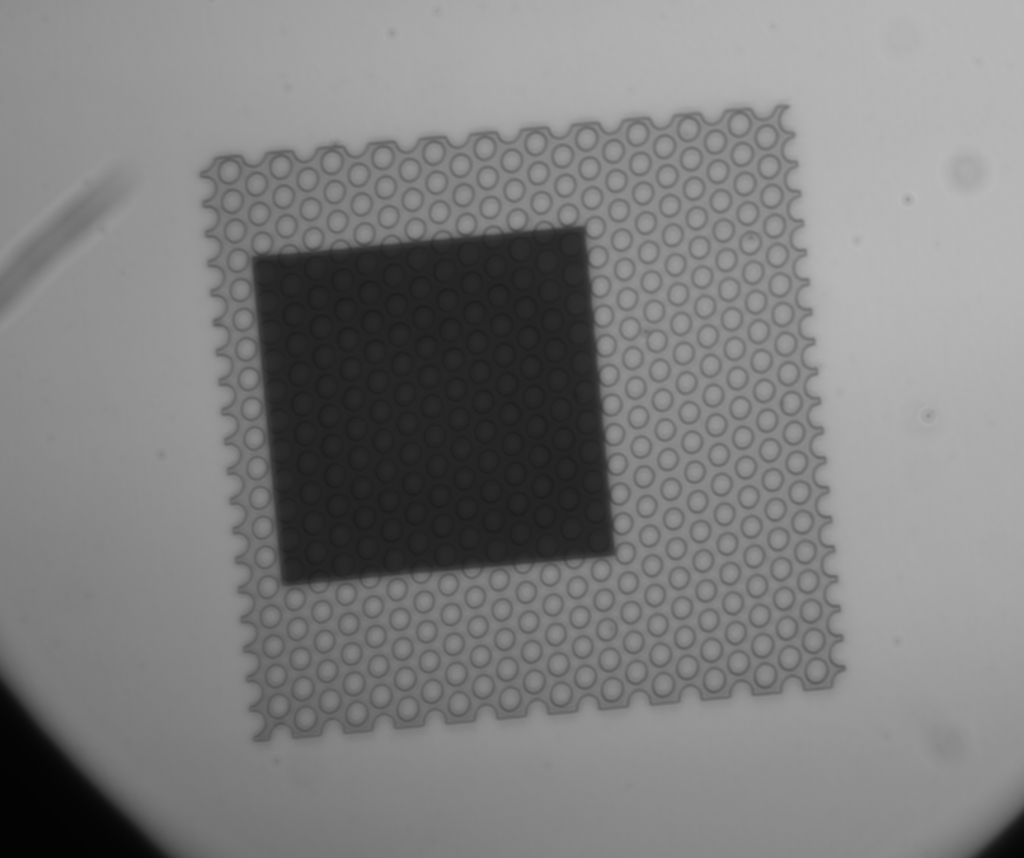
Imaging of the membranes shows the expected images for the ones with the nitride cap. I believe that we went with 50 micron windows, so the dimensions of the holes are right on, at least to visual inspection.
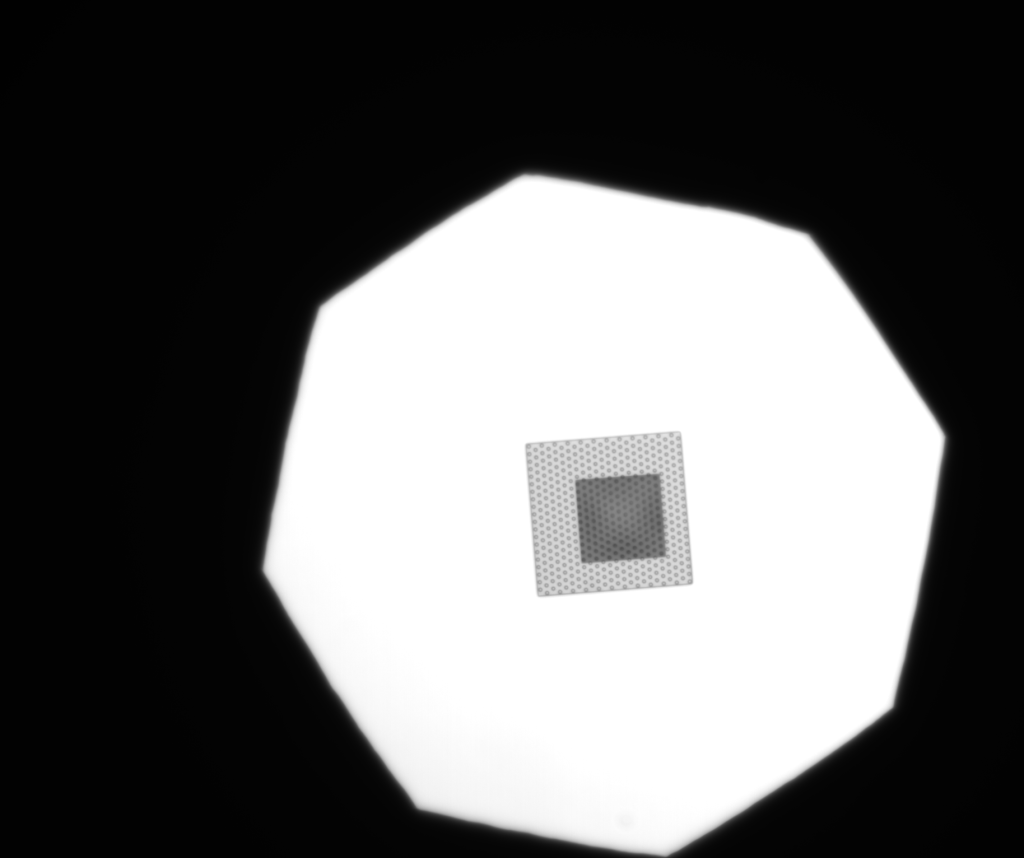
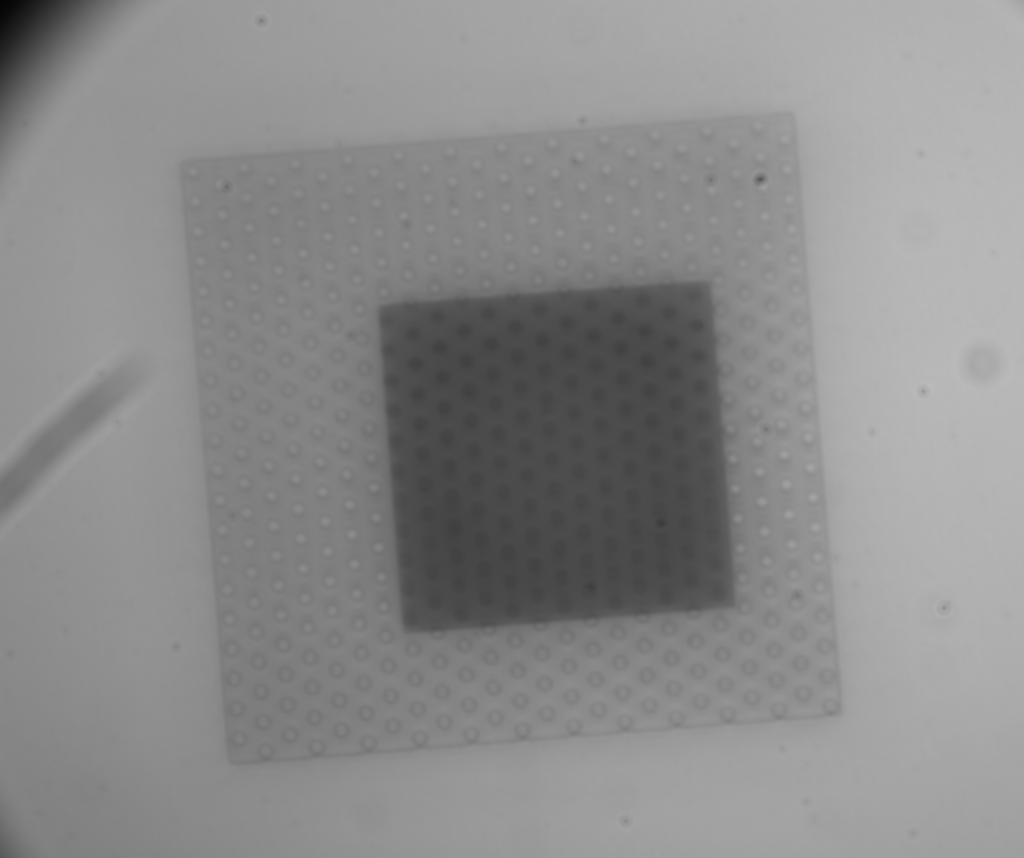
The chips without the SiN cap seem to have much larger oxide holes, appearing to be somewhere around 3-4 microns instead of the 1 micron for the SiN cap version. I am guessing without the cap there was some extra etching taking place. The inter-pore spacing is the same, however. I recall you guys did some calculations for how large the hole could be before the membrane would buckle down by more than the 200nm spacer, so let me know if these will have that issue. For the first set of experiments while I will stick to the capped chips anyway.

During the hiatus from the filter project I picked up another one that needs to be wrapped up in January because of time-sensitive samples that will be unusable by the end of January. So, the plan going forward looks like this, at the moment:
Right now: preliminary test are underway with gold nanoparticles to try to conjugate DNA and show that we clog regular pores with the AuNPs, but that the filter blocks them. Currently we are optimizing buffer conditions to do these tests, since our usual high-salt go-to buffers cause nanoparticle aggregation. Today the plan is to identify a suitable buffer for the particles. Over the break, one of my colleagues will be refining and testing the conjugation process.
Dec 16-Jan 6: back to New Brunswick. I will be in e-mail contact and I am happy to skype from home if anyone wants to discuss the project.
January 6-8: I set up new hardware (Chimera Instruments, high-bandwidth current amplifier that should allow us to reliably detect much smaller targets)
2nd week January: rewrite our software to be compatible with new hardware
3rd week January: Experiments related to perishable samples
4th week January: Finish perishable sample experiments, and start filter project again
So, as of late January/early February I will be full-time working on filter projects again, with significantly upgraded hardware. The initial hardware setup will benefit the filter project as well, since it might enable us to detect nanoparticle translocation whereas before it was far too quick to be detected by our 100kHz bandwidth.
If this timeline is too long for you, let me know. I might be able to pass some of the experiments on perishable samples off to a colleague who is doing related work.
Filter experiments planned:
- Show that regular pores without the filter layer are clogged by DNA-conjugated AuNPs, but that the filter-interfaced pores are not
- Show that filters provide a size exclusion mechanism by passing increasing strand lengths of DNA (50-2000 bp?) and comparing concentration-normalized capture rates with and without the filter layer. This will probably require a few repeats, since multiple samples in the same pore can get tricky.
- Additional experiments for first paper?
- Write paper
- Explore entropic trapping
Kyle and I discussed the plan. We will be testing the integrity of the new batch of membranes before Dec 23, and their performance for making CBD pores. Kyle is also going to prepare a couple of devices earlier in January to make sure all the components received are functional. He will be back full time on this project early February.
Your plan should include an assessment of the effects of the SiN cap to getting a good seal. You had some electrical evidence of the membrane fluctuating and this should be good enough if the cap makes it goes away.
We’ll use the coming weeks to create a couple of figures for the paper. And I’ll get you an answer to your mechanics question for membrane drop over the larger uncapped pores.
What size gold NP are you using?
Also, it seems there is an imperfect alignment between the oxide pattern and the SiN windows so the windows are not centered. Are there any unusable windows that are only partially covered with oxide?
All the chips I looked at had good oxide coverage, but in any case I will be individually inspecting them all before use so misaligned oxide won’t be a problem.
Good point about stability. I will also try a capped device without pdms and see if the nitride stabilizes the npn by itself.
Jim,
we are using 50-nm gold nanoparticles functionalized with 50-nt ssDNA (+ hybridized with complementary strand).
http://www.cytodiagnostics.com/store/pc/Gold-Conjugation-Kits-for-Thiolated-Oligonucleotides-c310.htm
Although we will start collaborating with a colleague from Chemistry (Tito Scaiano), with expertise in NP, for other projects, so if we need more advanced NP or functionalization it will be more easily accessible.