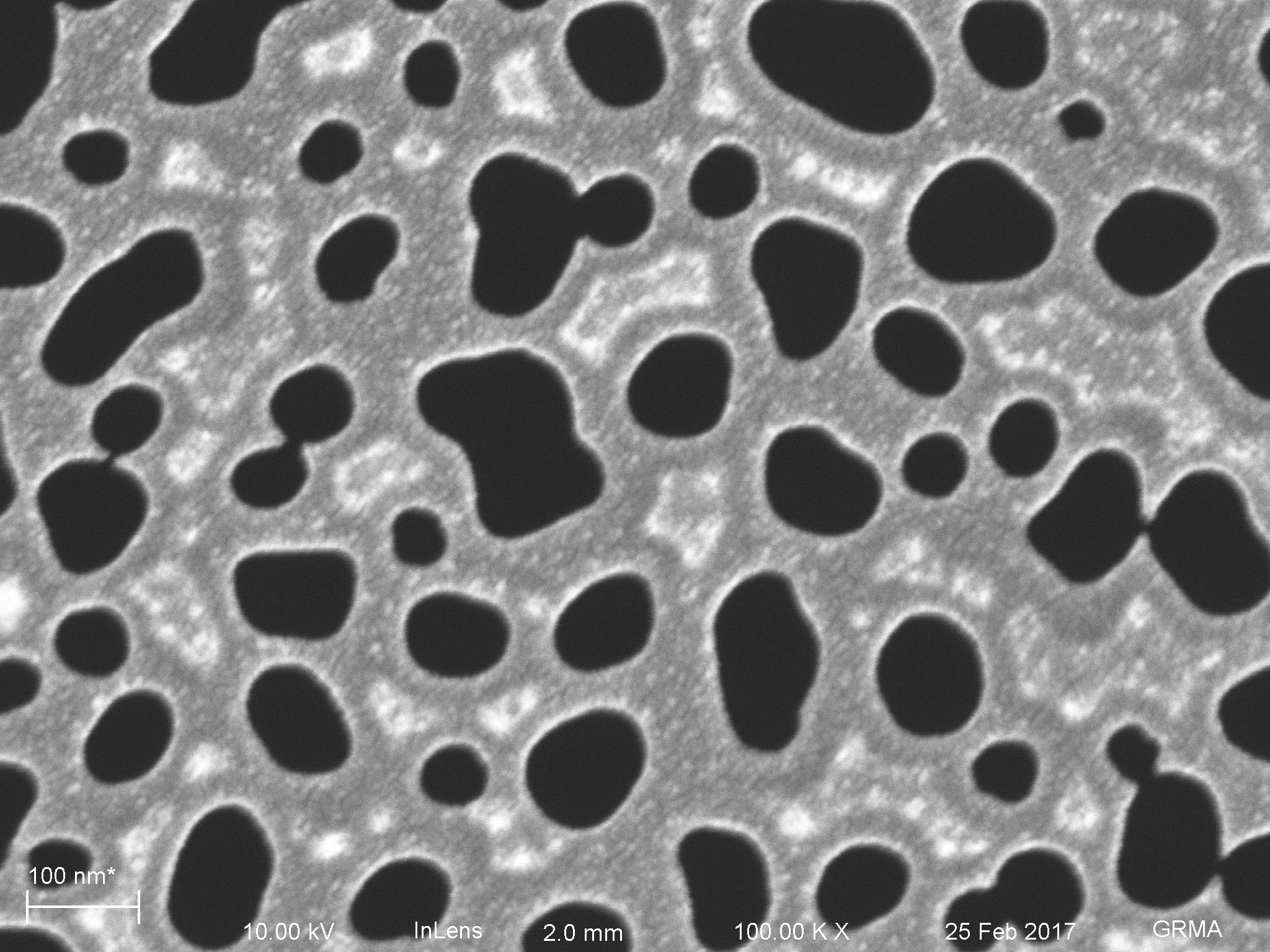
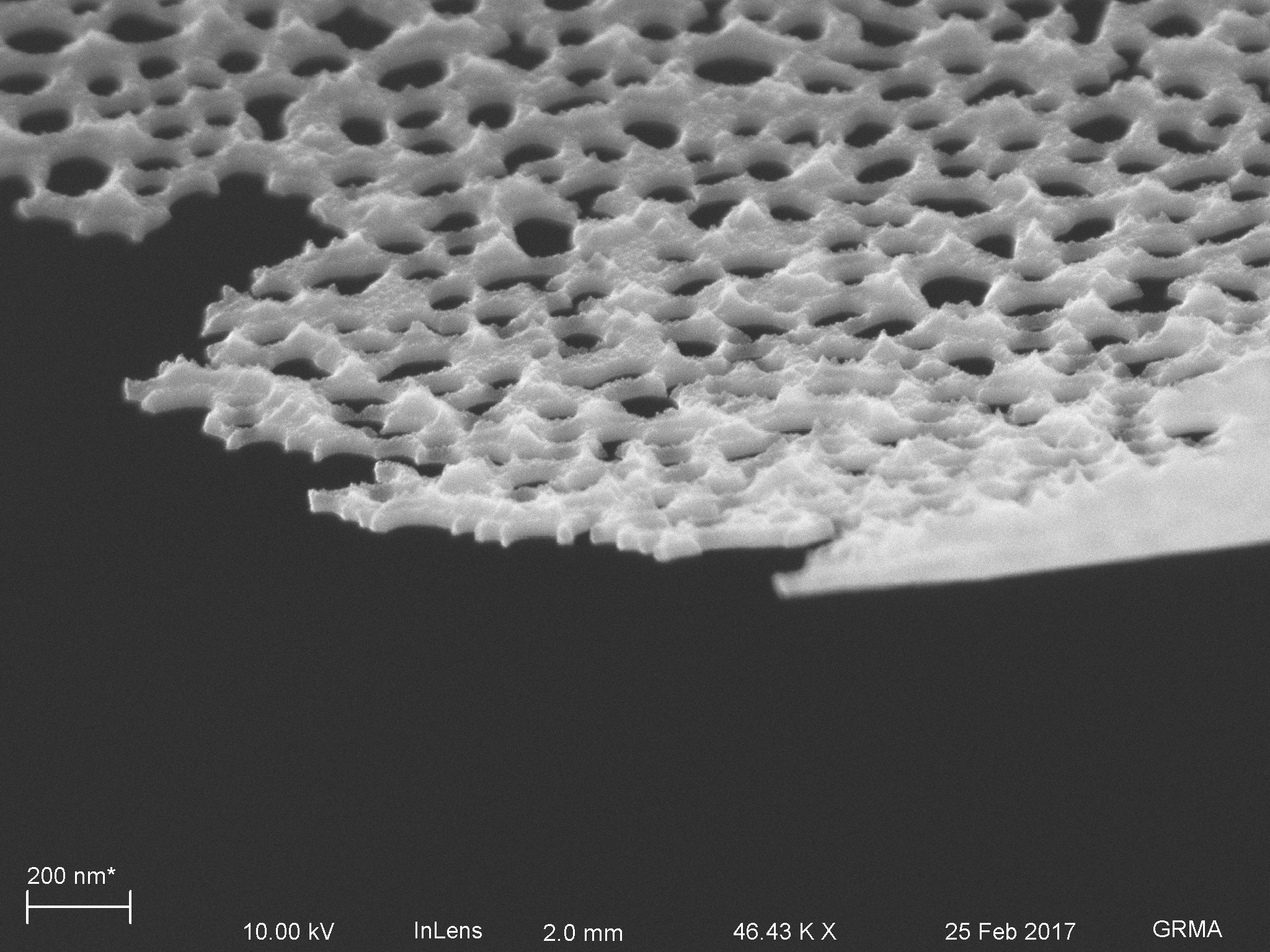
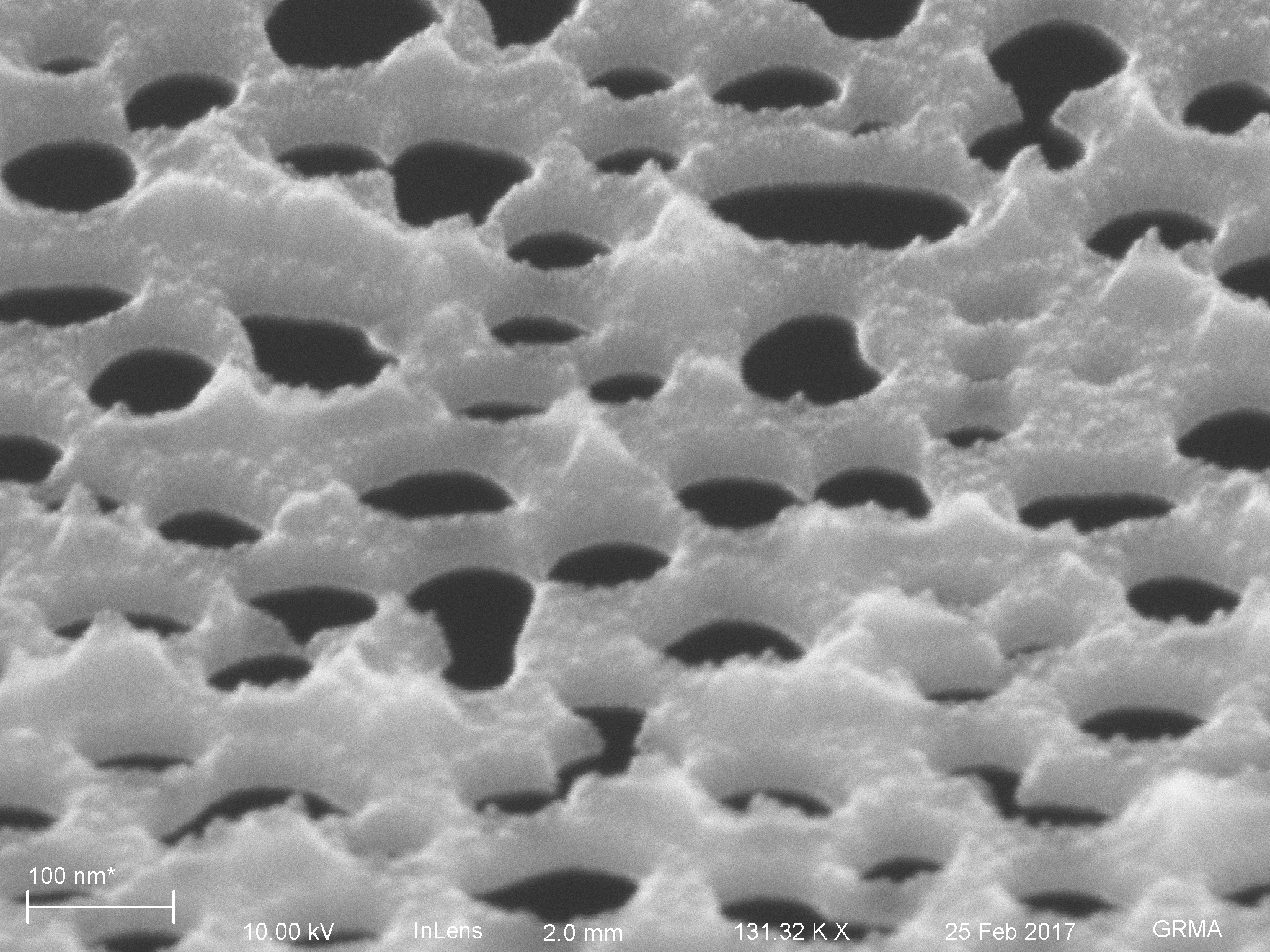
As the title states, I partially etched some different material (Wafer 2238, 100 nm NPN) to create nanofeatures with blown out holes. With a thicker membrane, we can blow out the pores more (etch longer) without compromising the strength of the material (with regard to templating purposes). These membranes were fractured and coated with 6 nm of platinum. These images are only the NPN; not coated with gold or templated with MgF2.
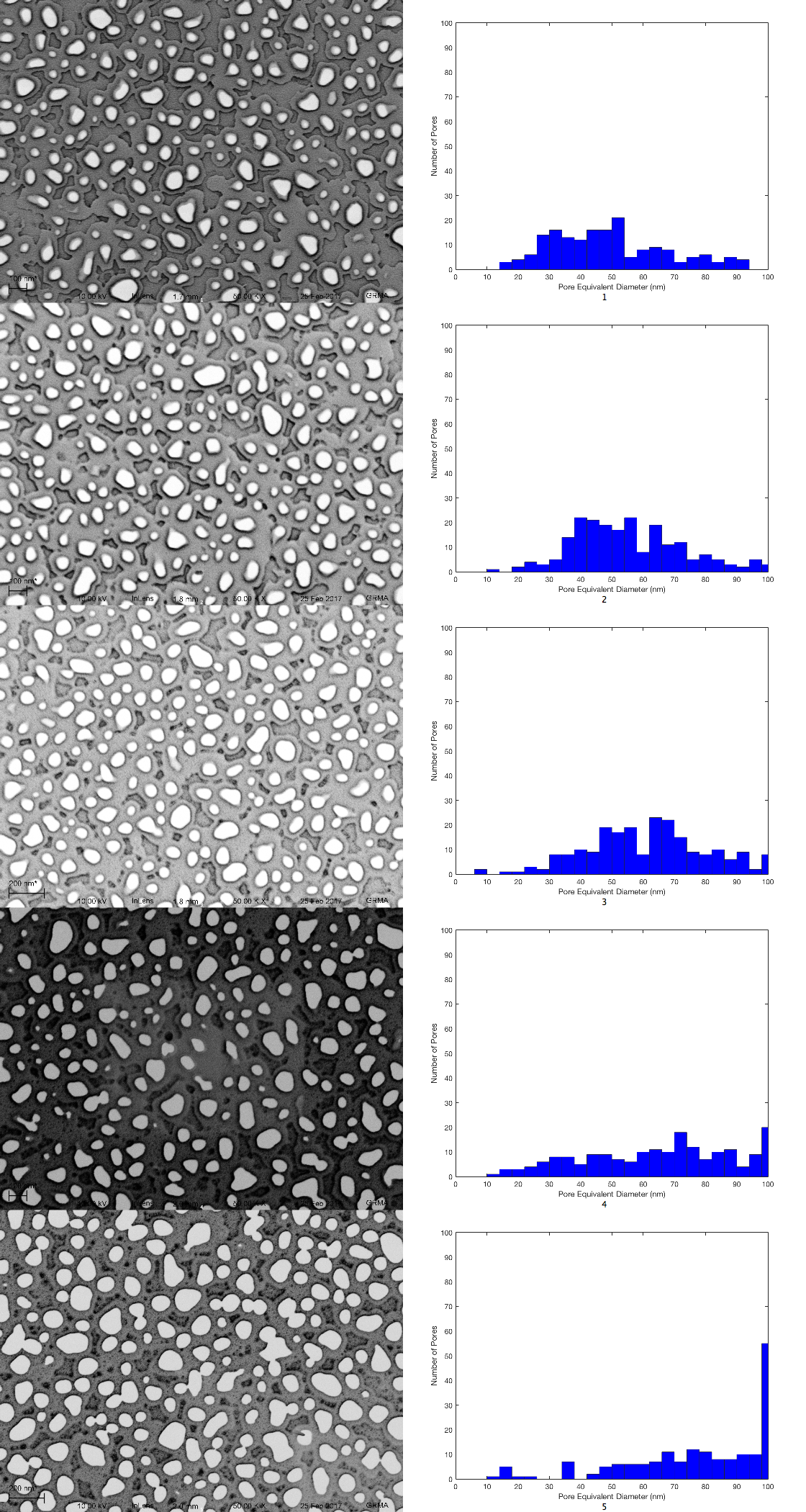
Equivalent pore diameter histograms for partially etched substrates.
Minor Axis histograms of partial etch (0, 20, 40, 60, 80s) of Wafer 2238 (from top to bottom). Average length: 42, 48, 53, 56, 72 nm. Based on estimates of etch rate, the thicknesses of these membranes are (100, 80, 60 40, 20 nm, from top to bottom). Pores merge considerably below 40nm.
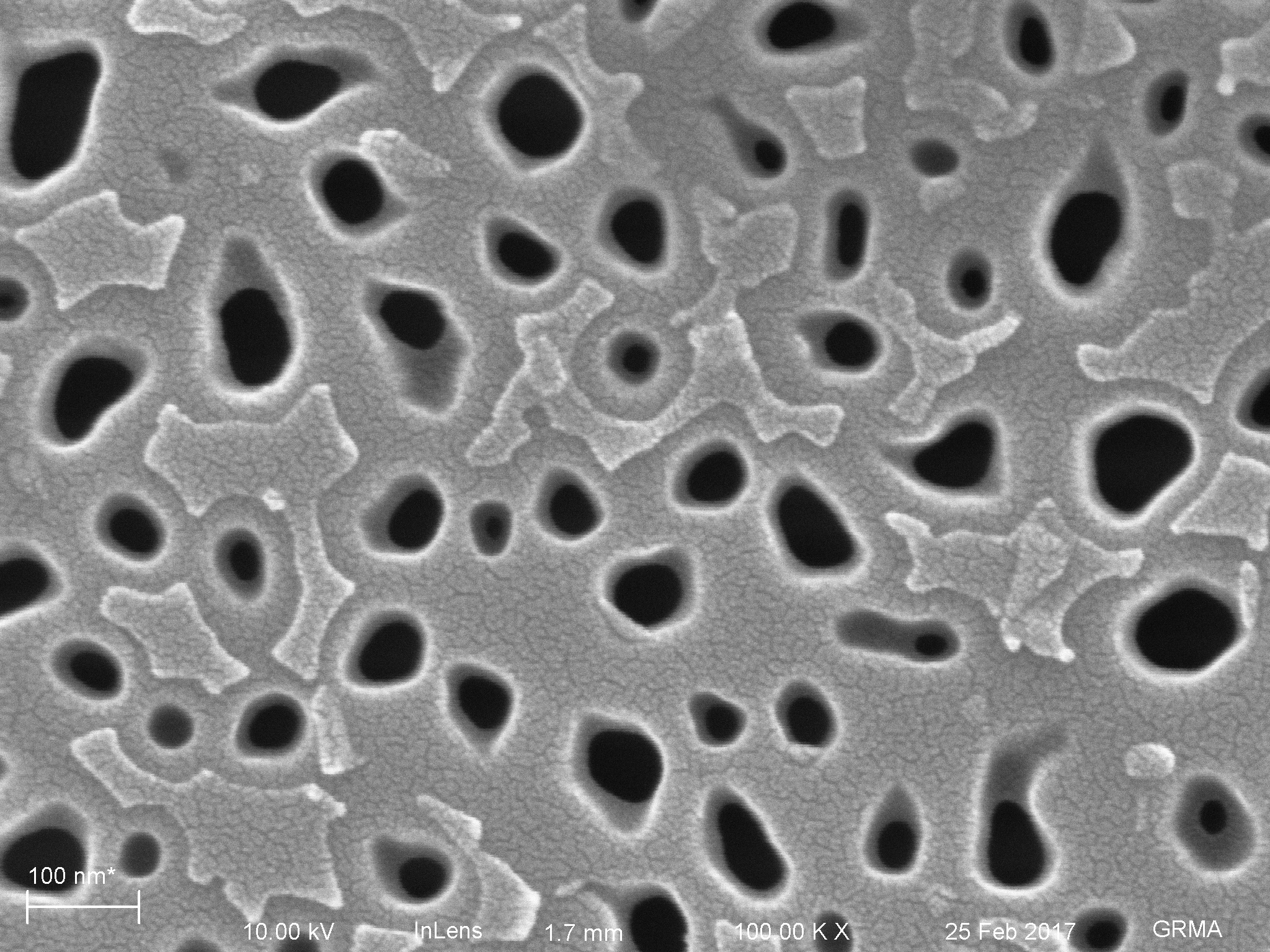
Zoom-in of wafer 2238. The scaly structures are residual pieces (siloxynitride?) used as a mask to create the thicker NPN materials. there also appears to be some conical shape to the pores, instead of anisotropic sidewalls.
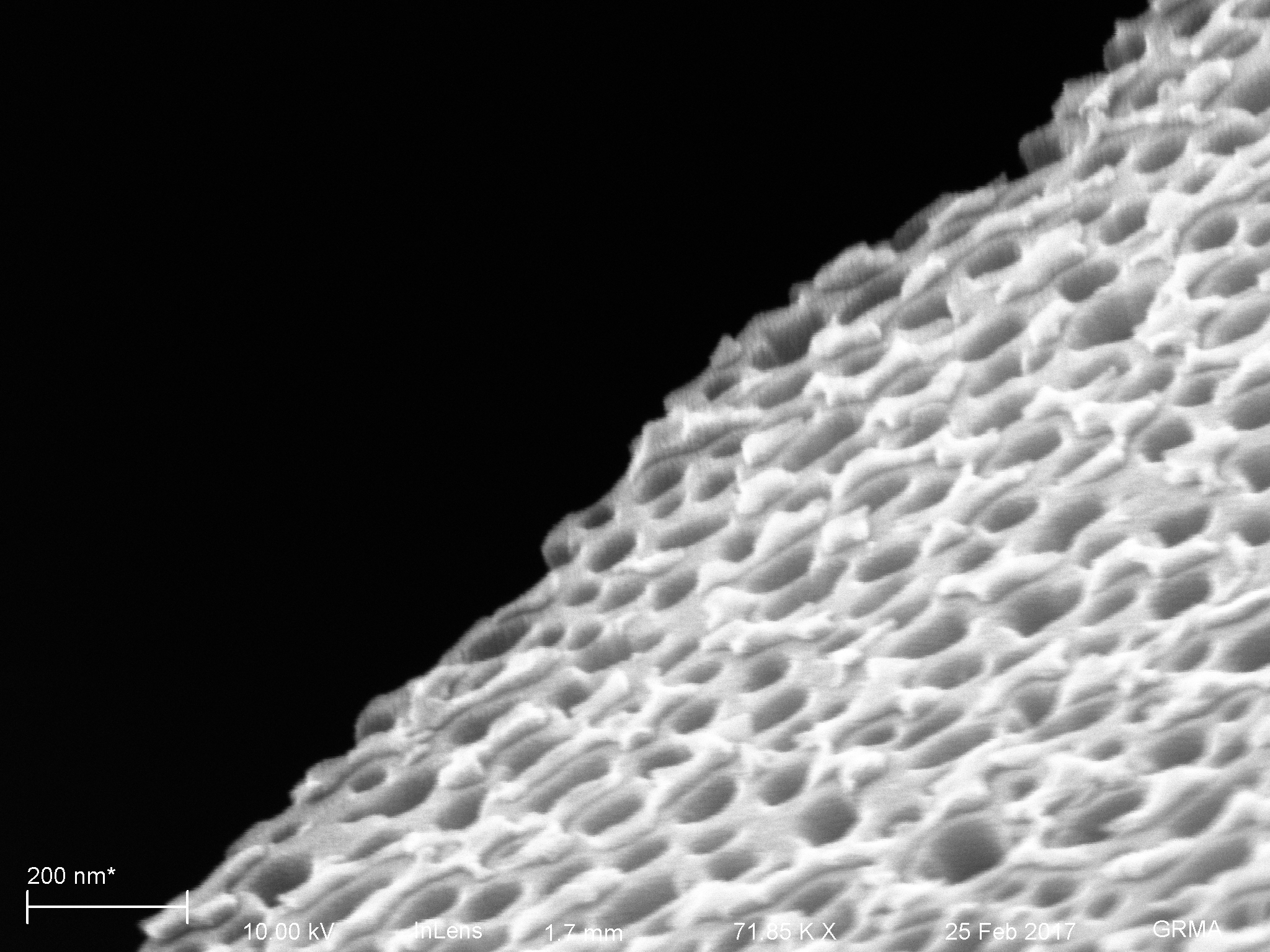
Viewed off-normal, the thickness of the siloxynitride is appreciable.
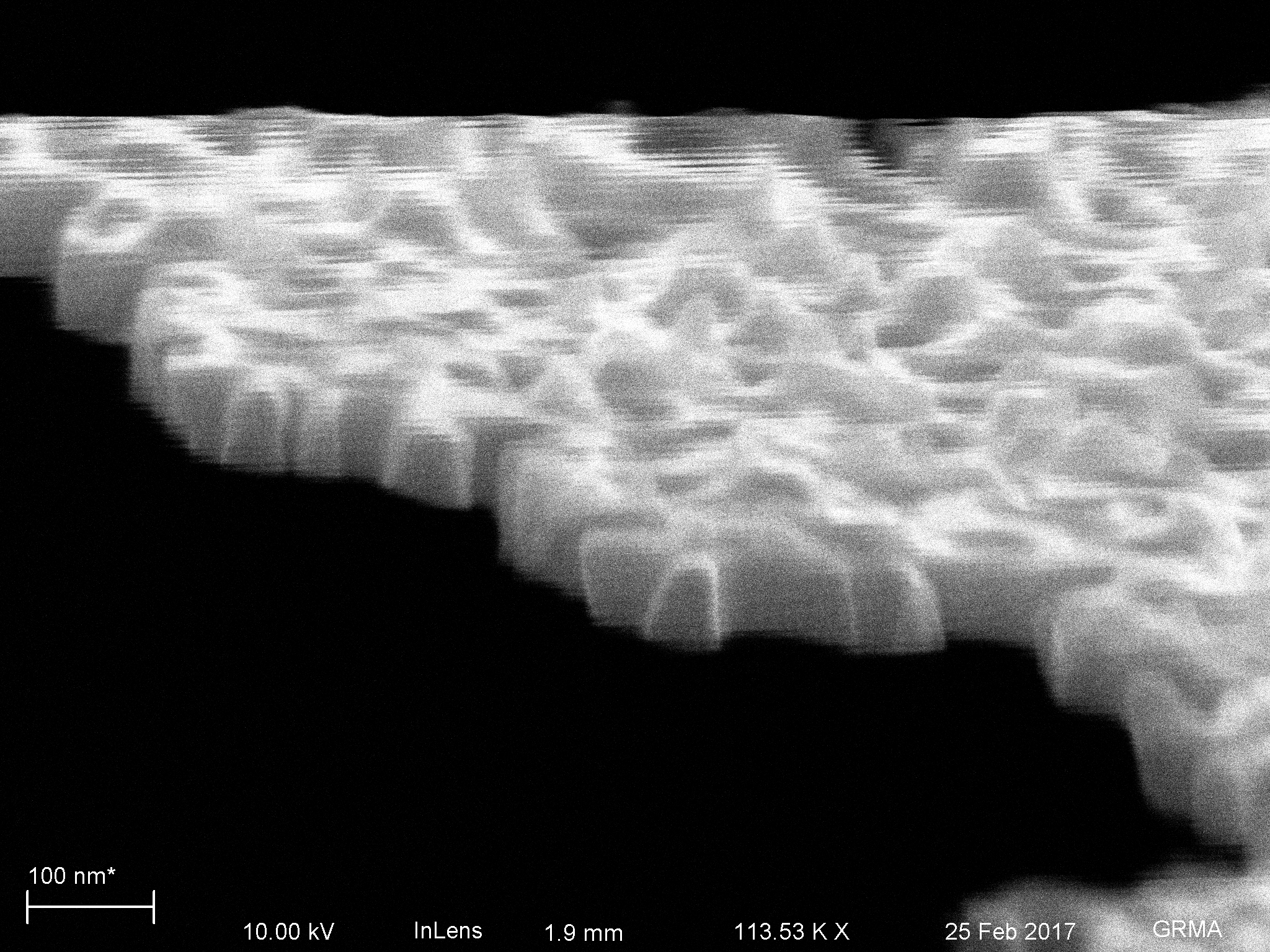
40s etch crossection, 64 nm thick. (vibration hinders some resolution). The pores have a conical crossection.
80s etch aerial image. Residue pattern from the silicoxynitride is transferred through the nanomembrane’s volume.80s etch crossection. 23nm thick. The silicoxynitride acts as an etch mask (with poor selectivity) and is causing the texture at the surface.80s crossection. Shows the scalloped merged pores with sharp peaks.
I think the 2238-80s material is too weak to hold up to MgF2 processing, but there is hope for the 60s material.
Key Ideas I took a wafer with ~400 chips of varying square window sizes, ran my MgF2 process, and recorded the pressures it took to burst them. Overall yield was about 20%, most of them smaller windows. I was expecting ~50% based on my previous work. Variation in the etch step destroyed the yield. MgF2 nanomembranes…
Art is going to make a second stir cell this week. I asked him to replicate it as closely as possible, however I’m not sure how well that’s going to work. The one we currently have is made out of Ertalyt, a material similar to teflon. Paul gave us polyethylene which is much softer than…
In the field of gas permeance there is a plot called the “Robeson Plot” (the paper that debuted it) that is used to compare the separation behavior of various membranes made of different materials and measured in different systems. An example is pictured: Various literature data for the log permeability of H2 gas versus the…
In our prior work we showed that endothelial cells form far fewer focal adhesions on microporous SiO2 membranes compared to non-porous SiO2 and tissue culture plastic (see prior post by Ana). We performed this analysis at 24 hours, which seems to be the standard in the literature. Interestingly, we found that the number of FAs…
Charles designed a macro for excel to represent the data gathered from wafer characterization, in a visual format. It is built on VB platform and runs off Microsoft excel. The data is input in a simple fashion by selecting the relevant field from a drop down box for columns representing different positions (see fig. 1)….
Introduction Motivation: We want to assess if the bladder cancer cell line T24 would influence the baseline characteristics of bladder epithelial cells (BdEC, a.k.a. ATCC® PCS-420-010™) when the two cell types are cultured together. Ultimately, we are interested if the T24 induces BdEC malignancy (turning the normal epithelial cells cancerous). The ultimately test of malignancy would…